Rajnath Singh attends Delhi Rath Yatra, hails Jagannath's grace
Synopsis
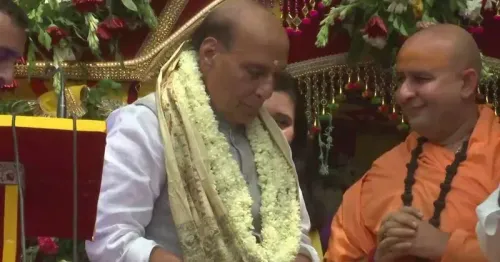
Union Defence Minister Rajnath Singh attended the Jagannath Rath Yatra in Delhi on 16 July 2026, calling it a uniquely wondrous festival where the deity steps out to walk among devotees — an act of divine love he said has no parallel in any other culture.
Key Takeaways
Rajnath Singh attended the Jagannath Rath Yatra procession in Delhi on 16 July 2026 .
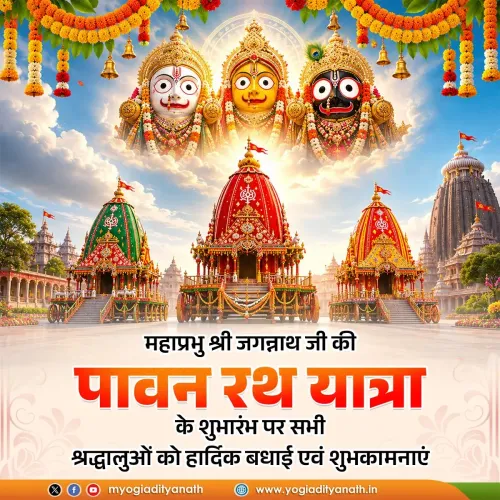
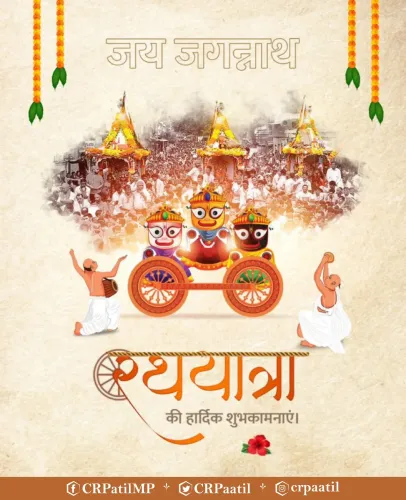
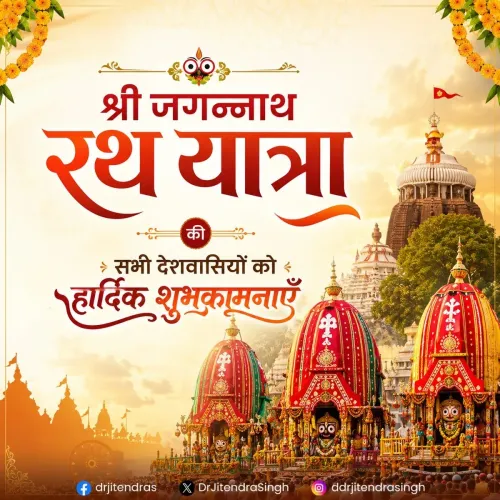
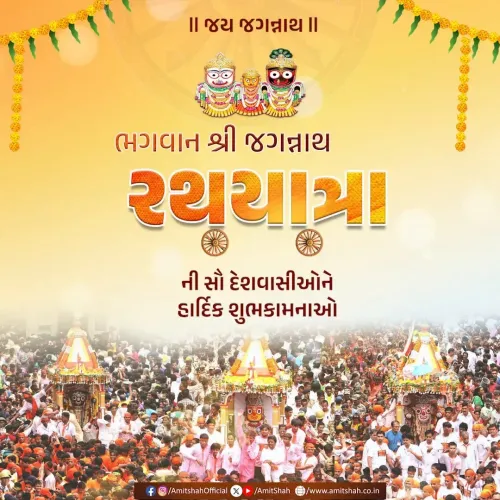
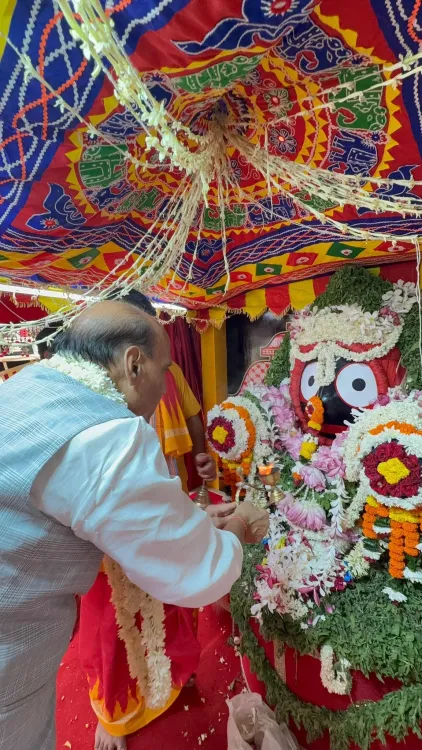
He described the festival as 'unique, wondrous, and extraordinary' ( anokha, adbhut, vilakshan ) in a post on X accompanied by four images .
Singh highlighted the theological core of Rath Yatra: Mahaprabhu Shri Jagannath leaving his temple to move among ordinary devotees.
He called this expression of divine love unmatched by any example in any other culture in the world.
The Delhi Rath Yatra is an urban parallel of the centuries-old procession originating in Puri, Odisha .
Senior BJP leaders regularly attend major Hindu festivals as part of a broader pattern of cultural engagement.
Union Defence Minister Rajnath Singh attended the Jagannath Rath Yatra procession held in Delhi on Thursday, 16 July 2026, calling it a singular festival unlike any other in world culture and invoking the blessings of Mahaprabhu Shri Jagannath for all devotees.
Sharing his experience on X, Singh wrote: 'महाप्रभु श्री जगन्नाथ जी की रथयात्रा के अवसर पर दिल्ली में आयोजित रथयात्रा का दर्शन करने का आज मुझे सौभाग्य प्राप्त हुआ' — 'Today I had the good fortune of witnessing the Rath Yatra organised in Delhi on the occasion of Mahaprabhu Shri Jagannath's Rath Yatra.' He concluded with the invocation 'Jai Jagannath!'
Context
The Rath Yatra is one of Hinduism's most ancient chariot festivals, rooted in the tradition of Puri, Odisha, where the presiding deity Shri Jagannath — a form of Vishnu — is taken in a grand procession through the streets. The festival's defining theological idea is that the deity steps out of the sanctum and moves among ordinary devotees, dissolving the boundary between the divine and the common people.
Urban centres across India, including Delhi, hold parallel Rath Yatra processions that mirror the Puri tradition, drawing large gatherings of devotees and public figures. Singh described the occasion as 'ek anokha, ek adbhut, ek vilakshan parv' — 'a unique, a wondrous, an extraordinary festival' — precisely because of this direct communion between god and devotee.
Policy Backdrop
Senior leaders of the Bharatiya Janata Party (BJP) have consistently engaged with major Hindu festivals as a visible expression of cultural participation. Rajnath Singh, one of the party's most senior figures, has served as Union Home Minister and Chief Minister of Uttar Pradesh before assuming his current portfolio as Union Defence Minister.
His attendance at the Delhi Rath Yatra fits a broader pattern in which cabinet ministers participate in religious and cultural events, reinforcing the ruling coalition's emphasis on Hindu cultural identity in public life.
Stakeholders and Impact
For Hindu devotees and Delhi residents, the Rath Yatra is a deeply personal occasion of faith. The presence of a senior Union minister lends the event additional public visibility and signals institutional regard for the tradition.
Singh's post, accompanied by four images from the procession, reached a wide audience on X, amplifying the festival's cultural resonance beyond those physically present. His reflection — that no other culture offers a parallel example of a deity leaving the temple to walk among common people — underscores the theological distinctiveness he attributes to the tradition.
What's Next
Attention will now turn to the main Puri Rath Yatra in Odisha and whether other Union ministers attend parallel city events in subsequent years, a pattern that has become a recurring feature of the political calendar. The Delhi procession's growing profile as a site of ministerial participation may see further institutional engagement in coming editions.
Point of View
Which serves both devotional and political signalling functions. His articulation of the festival's theological uniqueness — the deity descending to the people — also carries a subtle populist resonance that aligns with the party's broader messaging around faith and governance. As one of the BJP's most senior and broadly respected figures, Singh's participation lends institutional weight to what is increasingly a visible fixture on Delhi's cultural calendar. The post's wide reach on social media suggests the party views such cultural engagements as effective tools of public communication beyond formal policy announcements.
NationPress
15 Oct 2026
Frequently Asked Questions
What is the Jagannath Rath Yatra and why is it significant?
The Jagannath Rath Yatra is a major Hindu chariot festival in which the deity Shri Jagannath — a form of Vishnu — is taken in a grand procession among devotees. Its central significance is that the deity leaves the temple sanctum and moves among ordinary people, an act of divine accessibility unique to this tradition. The festival originates in Puri, Odisha, and is replicated in cities across India including Delhi.
Did Rajnath Singh attend the Rath Yatra in Delhi or Puri?
Rajnath Singh attended the Rath Yatra procession held in Delhi on 16 July 2026, not the main Puri procession in Odisha. Delhi hosts its own annual Rath Yatra that mirrors the Puri tradition and draws large crowds of devotees.
What did Rajnath Singh say about the Rath Yatra?
Singh called it 'a unique, wondrous, and extraordinary festival' and said that the idea of a deity stepping out of the temple to walk among common devotees is an expression of divine love that has no parallel in any other culture in the world. He ended his post with the invocation 'Jai Jagannath!'
Why do BJP leaders attend Hindu festivals like Rath Yatra?
Senior BJP leaders regularly participate in major Hindu cultural and religious events as part of a broader pattern of cultural engagement that has become a recurring feature of public life. Such participation serves both as a personal expression of faith and as a form of public communication connecting the party with Hindu devotional traditions.
When is the Jagannath Rath Yatra celebrated?
The Jagannath Rath Yatra is celebrated annually, typically falling in June or July according to the Hindu lunar calendar. The main procession takes place in Puri, Odisha, with parallel events held in Delhi and other cities across India on the same occasion.