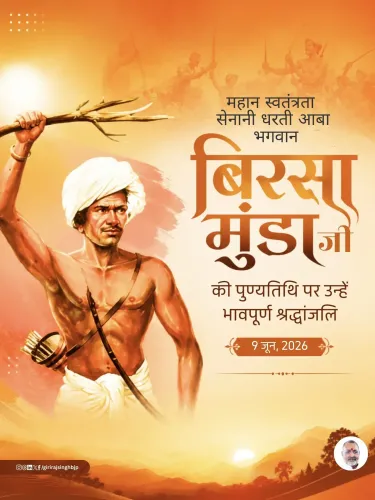
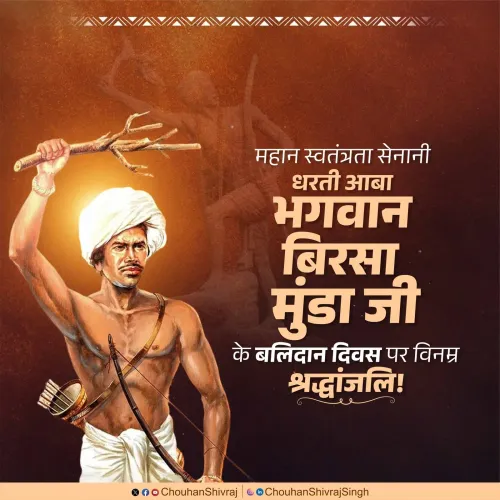
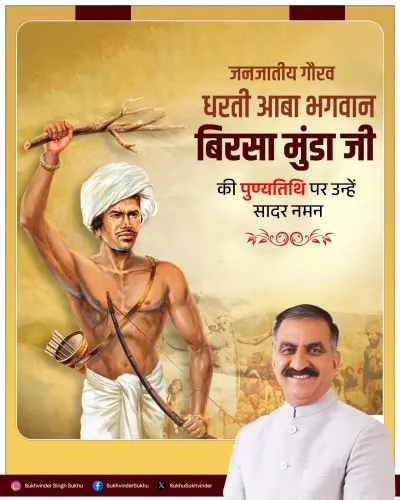
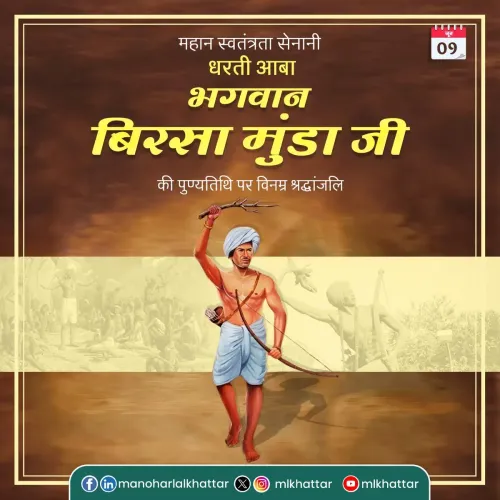
Rajnath Singh pays tribute to Birsa Munda on death anniversary
Synopsis
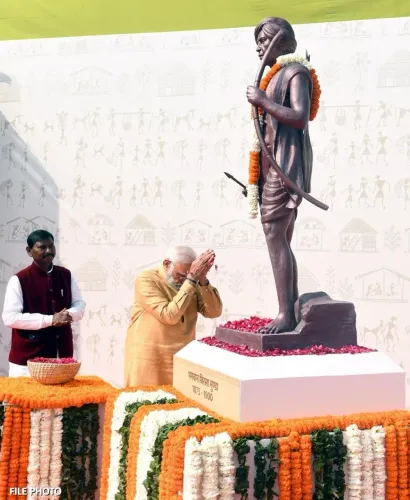
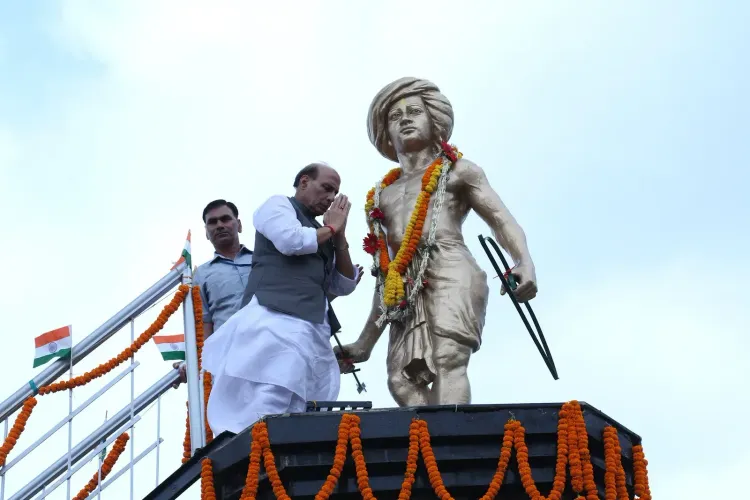
Union Defence Minister Rajnath Singh on 9 June 2026 paid homage to tribal icon Birsa Munda on his death anniversary, saluting his struggle for jal, jungle and zameen rights and calling his courage an enduring inspiration for future generations.
Key Takeaways
Rajnath Singh paid tribute to Birsa Munda on his death anniversary, 9 June 2026 , calling him Dharti Aaba and a jannayak .
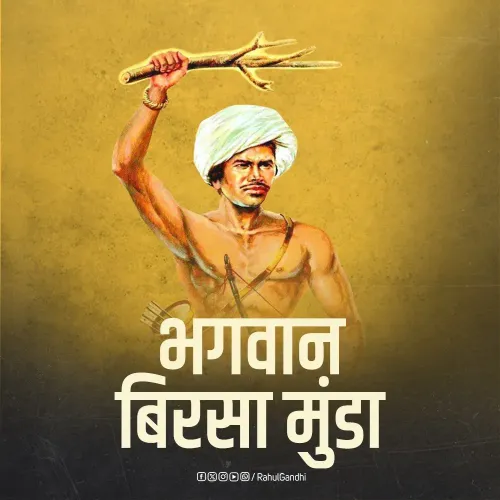
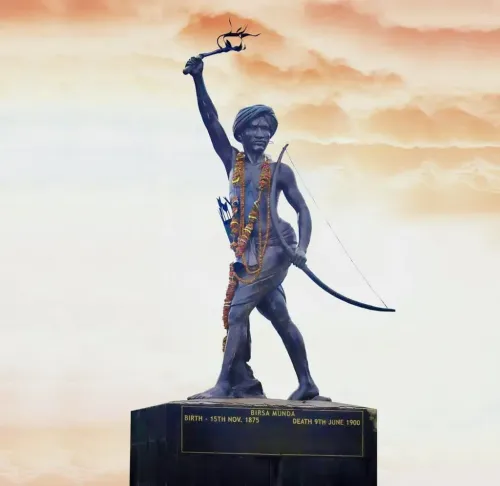
Birsa Munda (1875–1900) led the Ulgulan movement in the Chota Nagpur region, fighting for tribal rights over water, forests, and land against British colonial rule.
The Defence Minister highlighted Munda's role in awakening tribal society and said his courage and sacrifice would guide future generations.
The Government of India declared 15 November as Janjatiya Gaurav Diwas in 2021 to recognise tribal contributions to India's freedom struggle.
The Forest Rights Act, 2006 provided statutory recognition to the land and forest rights demands first raised during Munda's movement.
The tribute is part of a broader governmental effort to integrate tribal icons into the national freedom narrative and connect historical memory to current tribal welfare policy.
Union Defence Minister Rajnath Singh on Tuesday, 9 June 2026, paid homage to tribal freedom fighter Birsa Munda on his death anniversary, hailing him as 'Dharti Aaba' (Father of the Earth) and saluting his lifelong struggle for the rights of indigenous communities against British colonial rule.
Context
In his post, Rajnath Singh offered 'koti-koti naman' (countless salutations) to Birsa Munda, describing him as a 'jannayak' (people's leader) who fought to his last breath for independence. He wrote that Birsa Munda awakened tribal society against the British and dedicated his life to protecting rights over 'jal, jungle aur zameen' — water, forests, and land — and to preserving the dignity of his people.
The Defence Minister added that Munda's struggle against foreign rule, injustice, and exploitation gave a new direction to public consciousness and delivered a message of patriotism that continues to inspire Indians today. He said Munda's 'indomitable courage, sacrifice, and martyrdom will continue to guide future generations.'
Policy Backdrop
Birsa Munda was born in 1875 in the Chota Nagpur region and led the Ulgulan (Great Tumult) movement, mobilising Adivasi communities to resist land alienation and forest exploitation by British colonial authorities. He died on 9 June 1900 in Ranchi at the age of 25, and is revered as a foundational figure in the tribal freedom narrative.
The grievances he championed found statutory recognition over a century later through the Forest Rights Act, 2006, which established individual and community rights of forest dwellers over land and resources. In 2021, the Government of India declared 15 November — Birsa Munda's birth anniversary — as Janjatiya Gaurav Diwas to formally commemorate tribal contributions to the freedom struggle.
Stakeholders and Impact
The tribute carries significance for India's estimated 10 crore Scheduled Tribe population, for whom Birsa Munda remains a symbol of resistance and cultural identity. Jharkhand, carved out of Bihar in 2000 and encompassing the historic Munda heartland, holds particular emotional connection to his legacy.
Senior leaders across the political spectrum routinely mark this anniversary, but the current government's commemoration is part of a sustained effort since 2014 to integrate tribal icons more prominently into the national freedom narrative, linking historical memory to contemporary assertions of indigenous identity and inclusive development in Scheduled Areas.
What's Next
Attention will turn to the annual Janjatiya Gaurav Diwas observances in November, which typically feature government programmes focused on tribal welfare and cultural recognition. Advocates for tribal rights continue to press for fuller implementation of the Forest Rights Act and new welfare schemes in Jharkhand and other states with significant Adivasi populations. The framing of 'jal, jungle aur zameen' as an enduring national concern is expected to remain central to government outreach in these regions.
Point of View
A strategy that simultaneously honours genuine historical grievance and builds political capital among Adivasi communities. By invoking 'jal, jungle aur zameen' — a phrase that carries both historical resonance and contemporary policy weight — Rajnath Singh signals continuity between Birsa Munda's 19th-century demands and the government's current tribal welfare agenda. The commemoration also arrives as political competition for Scheduled Tribe constituencies intensifies ahead of state elections in several Adivasi-heavy regions. Taken together, these tributes form a coherent cultural-nationalist arc that seeks to make tribal memory inseparable from the ruling party's governing identity.
NationPress
23 Oct 2026
Frequently Asked Questions
When did Birsa Munda die and why is 9 June observed?
Birsa Munda died on 9 June 1900 in Ranchi at the age of 25 while in British custody, making the date his death anniversary, observed annually to honour his sacrifice.
What is 'Dharti Aaba' and why is Birsa Munda called that?
'Dharti Aaba' means 'Father of the Earth' in the Munda language, a title given to Birsa Munda in recognition of his role as a protector of tribal land and a revered leader of the Munda community.
What was the Ulgulan movement led by Birsa Munda?
The Ulgulan, meaning 'Great Tumult,' was an armed uprising led by Birsa Munda in the late 1890s in the Chota Nagpur region, mobilising Adivasi communities against British land alienation, forced labour, and exploitation of forests.
What is Janjatiya Gaurav Diwas and when is it celebrated?
Janjatiya Gaurav Diwas is observed on 15 November, Birsa Munda's birth anniversary, declared a national day in 2021 by the Government of India to honour tribal contributions to the freedom struggle.
How does the Forest Rights Act relate to Birsa Munda's demands?
The Forest Rights Act of 2006 statutorily recognised individual and community rights of forest dwellers over land and resources, directly addressing the jal, jungle and zameen grievances that Birsa Munda championed more than a century earlier.