Rajnath Singh: Indian Army's strength lies in humanity, not just war
Synopsis
Defence Minister Rajnath Singh on 29 July 2026 declared that the Indian armed forces' identity rests equally on battlefield valour and humanitarian sensitivity, citing their consistent role in disaster relief and crisis response.
Key Takeaways
Rajnath Singh posted on 29 July 2026 that India's armed forces are defined as much by humanitarian service as by combat capability.
He stated that soldiers place 'service above all else' in war, natural disaster, and humanitarian crises alike.
The Indian Army has a documented HADR legacy including Operation Rahat (2013 Uttarakhand floods) and Operation Maitri (2015 Nepal earthquake).
India's disaster-prone geography — cyclones, earthquakes, and monsoon flooding — has made the military's civil-assistance role a structural necessity.
Integration of HADR into joint exercises with the NDMA and state agencies remains a key area of ongoing defence planning.
On the battlefield and in the flood-ravaged village alike, India's soldiers show up. Union Defence Minister Rajnath Singh underscored this dual identity of the armed forces on Wednesday, 29 July 2026, posting a pointed reflection on X that placed humanitarian service on equal footing with combat valour.
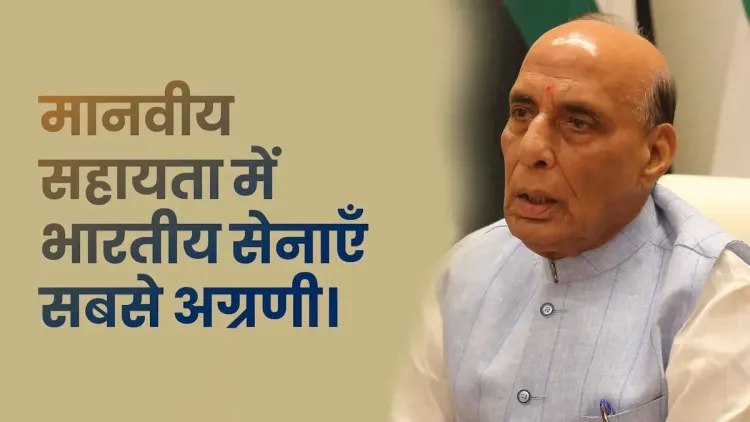
Writing in Hindi, the Minister stated: 'भारतीय सेनाओं की पहचान केवल रणभूमि में पराक्रम से नहीं, बल्कि मानवीय सहायता और आपदा राहत में उनकी संवेदनशीलता से भी है।' ('The identity of the Indian armed forces is defined not only by valour on the battlefield, but also by their sensitivity in humanitarian assistance and disaster relief. Whether it is war, a natural disaster, or a humanitarian crisis — our soldiers always place service above all else.')
A doctrine forged in floodwaters and rubble
The sentiment Singh articulates is not rhetorical — it is written into the operational history of the Indian Army, Navy, and Air Force. When the Uttarakhand floods of 2013 swallowed entire villages, the Army launched Operation Rahat, one of the largest HADR missions in the country's history, airlifting tens of thousands of stranded civilians. Two years later, Operation Maitri sent Indian forces into earthquake-devastated Nepal within hours of the tremors, delivering relief and rescuing survivors across the border.
India's geography — prone to cyclones on two coastlines, seismic activity in the Himalayan belt, and annual monsoon flooding across river plains — has made this dual mandate not a choice but a necessity. The armed forces, with their logistics backbone, air assets, and disciplined chain of command, consistently reach disaster zones faster than any civilian agency can.
Service as identity, not just duty
What makes Singh's post notable is its framing. He does not position HADR as a secondary or supplementary role — he places it at the core of what defines the Indian soldier's identity. The phrase 'सेवा को सर्वोपरि' ('service above all') echoes the ethos embedded in regimental traditions across the Army, where community service and national duty are treated as inseparable.
This framing has been consistent across governments and defence establishments. The integration of HADR into joint exercises with the National Disaster Management Authority (NDMA) and state agencies remains an area to watch as India deepens its civil-military coordination frameworks.
A soldier who can hold a rifle and extend a hand — that, Singh is saying, is the complete Indian warrior. The world is watching whether policy follows the philosophy.
Point of View
He signals a policy direction that could elevate the military's role in domestic crisis management. This also serves a softer strategic purpose: reinforcing public trust in the institution at a moment when defence budgets and modernisation plans face scrutiny. The message is calibrated — proud, apolitical, and aimed at a broad national audience.
NationPress
29 Jul 2026
Frequently Asked Questions
What did Rajnath Singh say about the Indian Army on 29 July 2026?
Rajnath Singh said the identity of the Indian armed forces is defined not only by battlefield valour but equally by their sensitivity in humanitarian assistance and disaster relief, adding that soldiers always place service above all else.
What is HADR and why does the Indian Army do it?
HADR stands for Humanitarian Assistance and Disaster Relief. The Indian Army conducts HADR operations because its logistics, air assets, and disciplined command structure allow it to reach disaster zones — floods, earthquakes, cyclones — faster than civilian agencies.
What are examples of Indian Army HADR operations?
Notable examples include Operation Rahat during the 2013 Uttarakhand floods, when the Army airlifted tens of thousands of civilians, and Operation Maitri after the 2015 Nepal earthquake, when Indian forces crossed the border to deliver relief and rescue survivors.
Is Rajnath Singh referring to a specific disaster or operation in his post?
No specific operation or triggering event is referenced in the post. It is a broader statement of principle about the dual identity of India's armed forces.
What is Rajnath Singh's role and background?
Rajnath Singh is India's Union Defence Minister and a senior BJP leader. He previously served as Chief Minister of Uttar Pradesh and as Union Home Minister .