Rajnath Singh Pays Tribute to APJ Abdul Kalam on Punyatithi
Synopsis
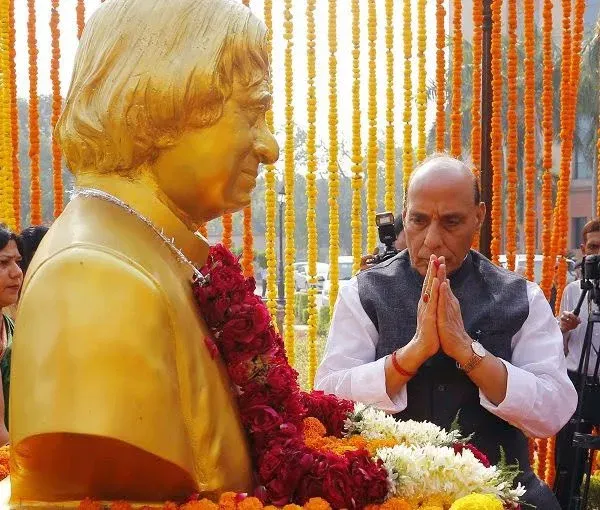
Union Defence Minister Rajnath Singh paid tribute to Dr. APJ Abdul Kalam on his Punyatithi, honouring the former President as the Missile Man of India whose IGMDP legacy continues to underpin India's indigenous strategic defence capabilities.
Key Takeaways
Rajnath Singh paid tribute to Dr.
APJ Abdul Kalam on his July 27 Punyatithi , calling him the 'People's President' and 'Missile Man of India.' Kalam served as India's 11th President from 2002 to 2007 and was awarded the Bharat Ratna in 1997 .
He was the chief architect of the Integrated Guided Missile Development Programme (IGMDP) , launched in 1983 , which produced the Prithvi and Agni missile families.
His work at DRDO established the institutional and engineering foundation for India's current indigenous strategic missile systems.
Singh highlighted Kalam's 'simplicity, integrity and unwavering dedication' as a continuing source of inspiration for generations of Indians.
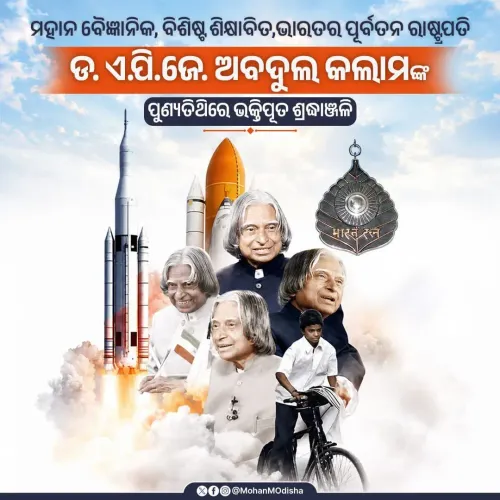
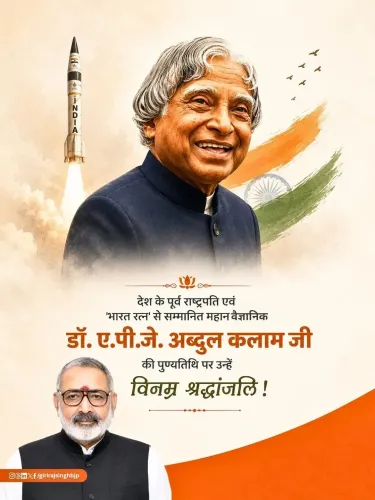
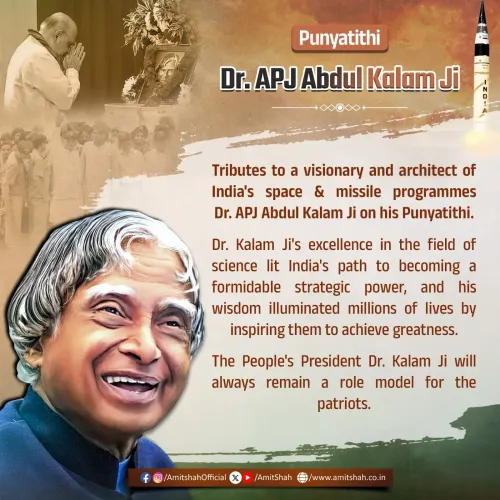
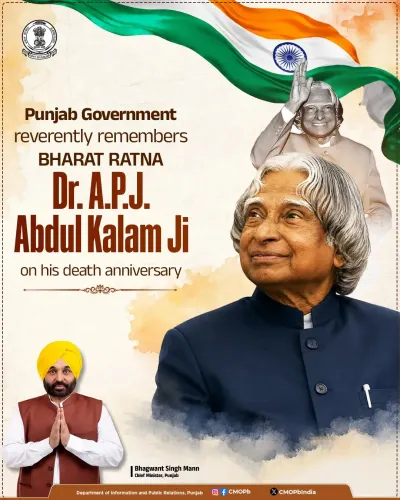
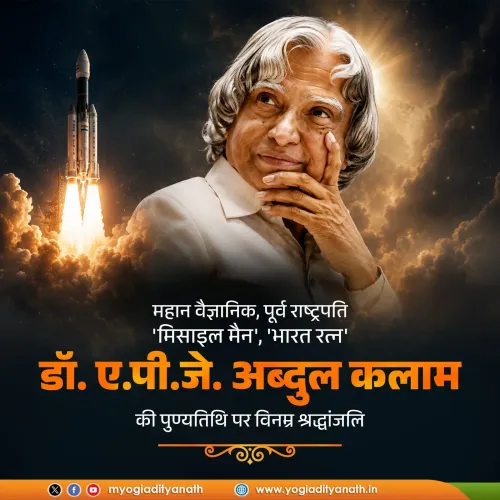
Union Defence Minister Rajnath Singh on Monday, July 27, paid tribute to former President and scientist Dr. A.P.J. Abdul Kalam on his death anniversary, honouring him as the 'People's President' and the 'Missile Man of India' for his foundational role in building the country's indigenous missile and strategic defence capabilities.
In his post, Singh described Kalam as 'an exceptional scientist and visionary' whose 'life of simplicity, integrity and unwavering dedication to the nation continues to inspire generations to dream big, innovate fearlessly and serve the country with selfless commitment.'
Context
Dr. Avul Pakir Jainulabdeen Abdul Kalam served as India's 11th President from 2002 to 2007 and spent decades prior as a scientist at the Defence Research and Development Organisation (DRDO). He passed away on July 27, 2015, while addressing students at the Indian Institute of Management, Shillong. His death anniversary is observed annually as his Punyatithi — a Sanskrit term for the day of a revered person's passing.
Kalam earned the title 'Missile Man of India' for his central role in developing ballistic and strategic missile systems that transformed India's defence posture. He was awarded the Bharat Ratna, India's highest civilian honour, in 1997.
Policy Backdrop
Kalam was the chief architect of the Integrated Guided Missile Development Programme (IGMDP), launched in 1983, which produced the Prithvi and Agni families of ballistic missiles — systems that remain the backbone of India's land-based strategic deterrent. The programme marked a decisive shift toward indigenous design and production at a time when India faced significant technology denial regimes from Western nations.
His scientific work at DRDO laid the engineering and institutional groundwork for the missile programmes that successive governments have built upon. The precision and longer-range systems under development today trace their lineage directly to the IGMDP architecture Kalam established.
Stakeholders and Impact
Kalam's legacy resonates most directly with India's defence science community — the researchers, engineers, and technicians at DRDO and allied laboratories who continue to advance indigenous weapons development. His emphasis on self-reliance in strategic technology has become a recurring reference point in policy debates around Atmanirbhar Bharat in defence.
For the armed forces, the missile systems developed under his leadership provided credible deterrence and gave India strategic depth it had previously lacked. His public persona as a scientist-president who remained accessible and unassuming also made him a rare figure who commanded respect across political lines and generations.
What's Next
Tributes to Kalam on his July 27 anniversary have become a fixture in India's political calendar, with leaders across parties invoking his legacy to frame contemporary defence and innovation priorities. Parliamentary references to his work tend to surface during defence budget debates and at roll-out milestones for new missile and aerospace systems derived from the IGMDP lineage.
As India accelerates exports of defence equipment and pushes for greater indigenous content in procurement, Kalam's foundational argument — that strategic autonomy begins with domestic technological capability — continues to shape the terms of that policy conversation.
Point of View
The homage implicitly reinforces the current government's Atmanirbhar Bharat narrative in defence by anchoring it to a legacy that predates any single political dispensation. Kalam's cross-party appeal makes such tributes low-risk and high-dividend, but the specific invocation of 'indigenous missile and strategic defence capabilities' signals a policy subtext beyond mere ceremony. The pattern of honouring Kalam on defence-linked terms reflects a broader effort to construct a continuous national narrative around strategic autonomy.
NationPress
27 Jul 2026
Frequently Asked Questions
When did APJ Abdul Kalam pass away?
Dr. APJ Abdul Kalam passed away on July 27, 2015 , while delivering a lecture at the Indian Institute of Management in Shillong . His death anniversary is observed as his Punyatithi .
Why is APJ Abdul Kalam called the Missile Man of India?
Kalam earned the title 'Missile Man of India' for leading the Integrated Guided Missile Development Programme (IGMDP) from 1983 , which developed the Prithvi and Agni ballistic missile families that form the core of India's strategic deterrent.
What was APJ Abdul Kalam's role as President of India?
Dr. APJ Abdul Kalam served as India's 11th President from 2002 to 2007 . He was widely known as the 'People's President' for his accessibility and his focus on inspiring youth and students across the country.
What is the IGMDP and what did it achieve?
The Integrated Guided Missile Development Programme (IGMDP) was launched in 1983 with Kalam as its chief architect. It produced India's Prithvi and Agni missile families, establishing indigenous ballistic missile capability and reducing dependence on foreign defence technology.
What did Rajnath Singh say about APJ Abdul Kalam?
Rajnath Singh described Kalam as 'an exceptional scientist and visionary' who played 'a pivotal role in strengthening India's indigenous missile and strategic defence capabilities,' adding that his 'life of simplicity, integrity and unwavering dedication' continues to inspire generations.