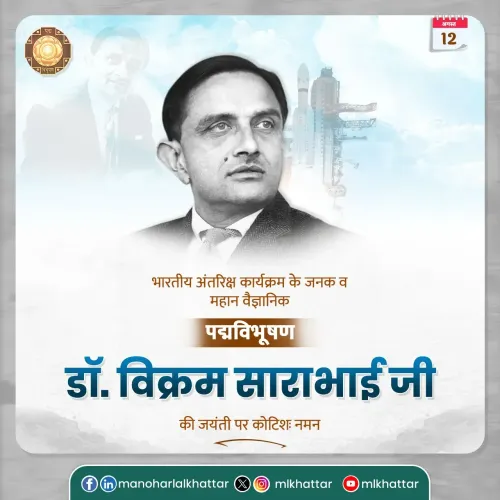
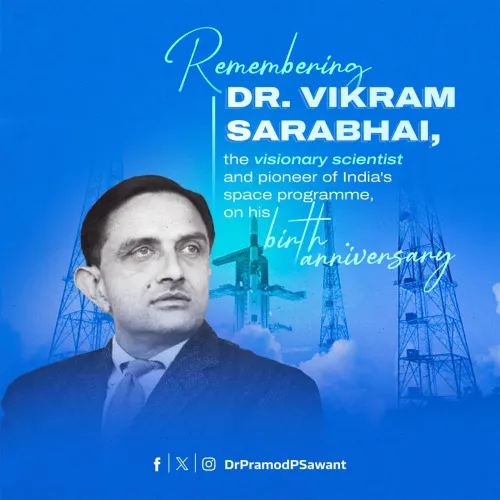
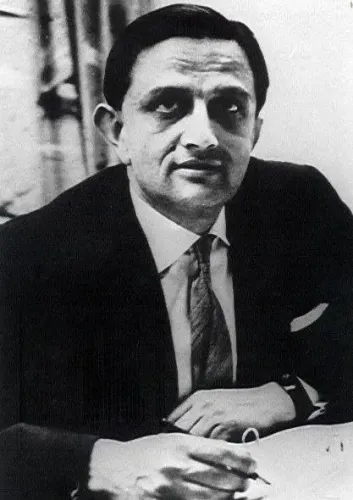
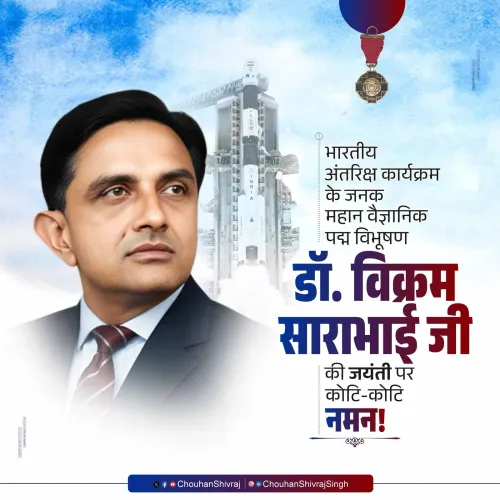
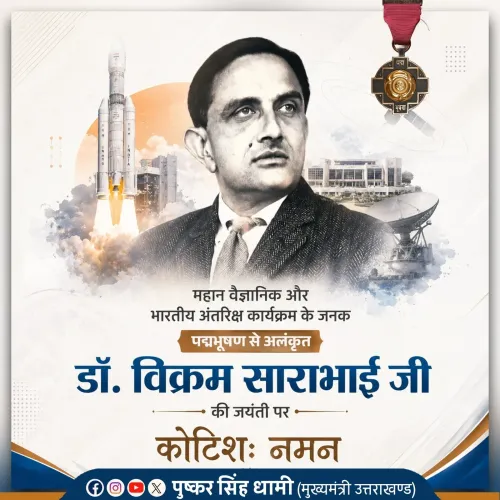
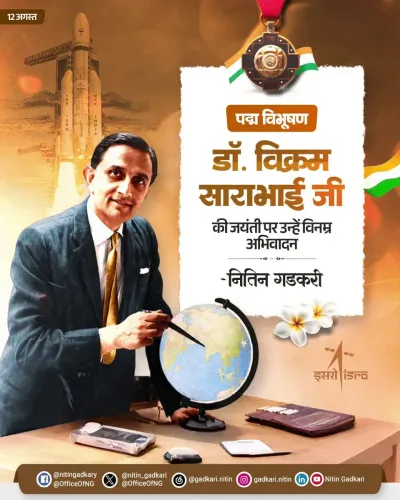
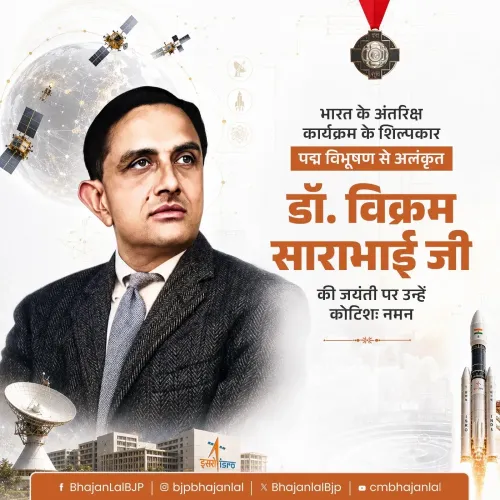
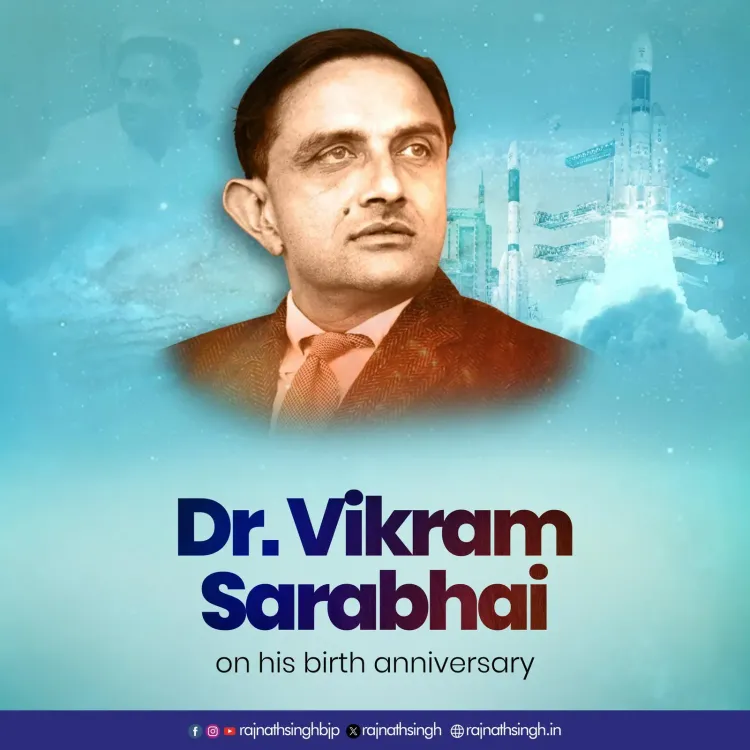
Rajnath Singh Pays Tribute to Dr. Vikram Sarabhai on Birth Anniversary
Synopsis
Union Defence Minister Rajnath Singh marked the birth anniversary of Dr. Vikram Sarabhai on August 12, honouring the ISRO founder's foundational belief that science must serve the nation — a vision he says India's soaring space programme has now profoundly vindicated.
Key Takeaways
Rajnath Singh paid tribute to Dr.
Vikram Sarabhai on his birth anniversary on August 12, 2026 .
Sarabhai chaired INCOSPAR from 1962 , laying the institutional groundwork for India's space programme.
ISRO was formally established in 1969 as the direct successor to Sarabhai's early institutional work.
India's first sounding rockets were launched from Thumba, Kerala , chosen for its proximity to the magnetic equator.
Sarabhai championed using space technology for practical national development — education, meteorology, and resource mapping.
India's current programmes, including the crewed Gaganyaan mission, trace their lineage directly to the framework he designed.
India's space story did not begin with a rocket — it began with a conviction. On the birth anniversary of Dr. Vikram Sarabhai, Union Defence Minister Rajnath Singh on Wednesday, August 12 paid tribute to the man who first argued, against considerable scepticism, that a newly independent nation had every reason to reach for the stars.
Singh wrote that Sarabhai's belief — that 'science must serve the nation and improve the lives of its people' — gave 'a new direction to India's pursuit of scientific excellence,' calling him one of 'the architects of India's scientific and space odyssey.'
The man who built India's launchpad from scratch
Dr. Vikram Sarabhai chaired INCOSPAR — the Indian National Committee for Space Research — from its establishment in 1962, years before a formal space agency existed. Working with almost no domestic infrastructure, he championed the idea that satellite technology could solve concrete Indian problems: broadcasting education to remote villages, predicting monsoons, mapping natural resources. The first sounding rockets were launched from Thumba, a fishing village on the Kerala coast chosen for its proximity to the magnetic equator — a decision that was equal parts scientific rigour and inspired improvisation. ISRO, the Indian Space Research Organisation, was formally established in 1969, the direct institutional heir to the framework Sarabhai had built. He did not live to see it mature — he died in 1971 — but the architecture he designed outlasted him by decades.From sounding rockets to the Moon — Sarabhai's arc completed
India's space programme has since expanded from those early sounding rockets into satellite communications, remote sensing, indigenous launch vehicles, and planetary exploration. The trajectory — from a borrowed church building at Thumba to missions that have orbited Mars and landed on the lunar south pole — is precisely the vindication Singh described as 'profound.' Successive governments across party lines have maintained institutional and financial continuity for the Department of Space, a rare bipartisan consensus in Indian policy. The programme now stands at another inflection point, with the crewed Gaganyaan mission in development and a liberalised Indian Space Policy opening the sector to private players — each of these a downstream consequence of the institutional foundations Sarabhai laid. Sixty-plus years on, the fishing village launchpad has become a symbol of what he insisted was possible: science, squarely in the service of the people.Point of View
And invoking Sarabhai reinforces that narrative. Sarabhai is a figure of genuine cross-party reverence, making such tributes a low-risk, high-resonance gesture for any senior minister. More substantively, the homage arrives as India's space sector undergoes its most significant structural reform in decades — the opening to private capital — making the founding philosophy of 'science for the people' a live ideological reference point, not merely a historical one. Whether the liberalisation honours or complicates that founding ethos is a question Indian policymakers have not yet fully answered.
NationPress
12 Aug 2026
Frequently Asked Questions
Who is Dr. Vikram Sarabhai and why is he important?
Dr. Vikram Sarabhai is widely regarded as the father of India's space programme. He founded INCOSPAR in 1962 and laid the groundwork for ISRO , which was established in 1969 . He believed space technology should directly serve national development and ordinary citizens.
When is Vikram Sarabhai's birth anniversary?
Dr. Vikram Sarabhai was born on August 12, 1919 . His birth anniversary is observed on August 12 each year and is marked by tributes from India's scientific and political communities.
What did Rajnath Singh say about Vikram Sarabhai?
Union Defence Minister Rajnath Singh called Sarabhai 'one of the architects of India's scientific and space odyssey' and said his conviction that science must serve the nation gave 'a new direction to India's pursuit of scientific excellence.'
What is INCOSPAR and how does it relate to ISRO?
INCOSPAR — the Indian National Committee for Space Research — was established in 1962 under Dr. Vikram Sarabhai to begin systematic space research. It was the direct precursor to ISRO , which was formally created in 1969 .
Where were India's first rockets launched from?
India's first sounding rockets were launched from Thumba , a fishing village near Thiruvananthapuram, Kerala . The site was chosen because of its proximity to the magnetic equator, making it scientifically ideal for upper-atmosphere research.