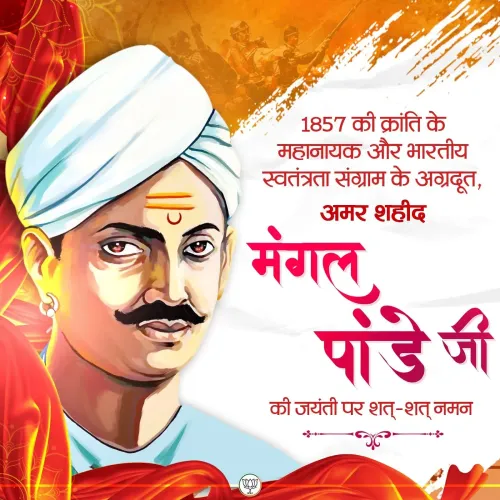
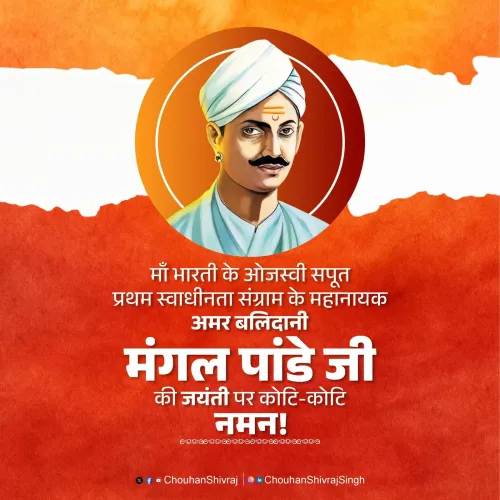
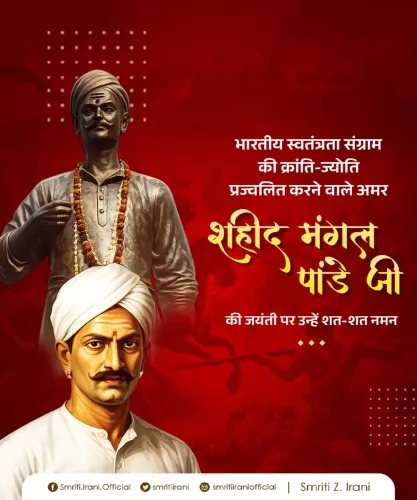
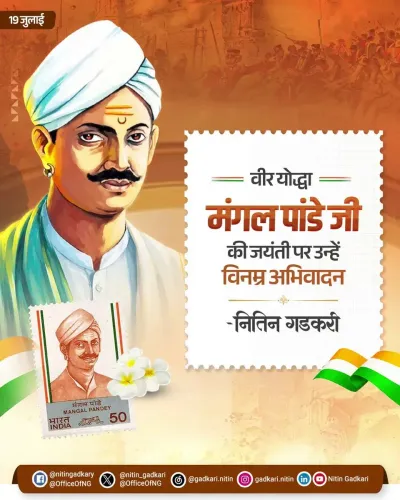
Rajnath Singh pays tribute to Mangal Pandey on his birth anniversary
Synopsis
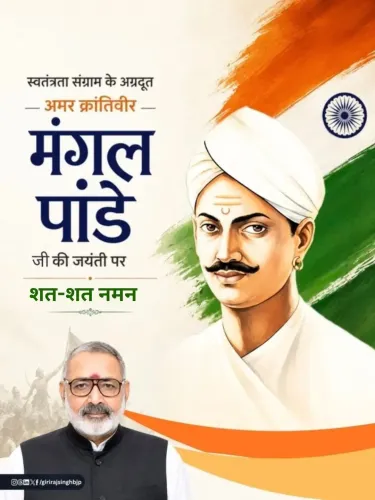
Union Defence Minister Rajnath Singh on 19 July 2026 honoured Mangal Pandey on his birth anniversary, calling the 1857 sepoy an immortal symbol of courage whose revolt against British rule ignited patriotism across India and continues to inspire national service.
Key Takeaways
Rajnath Singh posted a Hindi tribute to Mangal Pandey on 19 July 2026 , marking the martyr's birth anniversary.
Pandey was a sepoy in the 34th Bengal Native Infantry whose actions at Barrackpore in March 1857 are seen as a spark for the wider uprising against East India Company rule.
The Government of India officially designates the 1857 events as the First War of Indian Independence .
Singh described Pandey's sacrifice as a continuing inspiration for 'national service and nation-building.' The tribute aligns with the BJP-led government's broader pattern of honouring pre-20th century martial and nationalist icons since 2014 .
Potential 2027 bicentenary events may bring further institutional recognition of Pandey by the Defence Ministry .
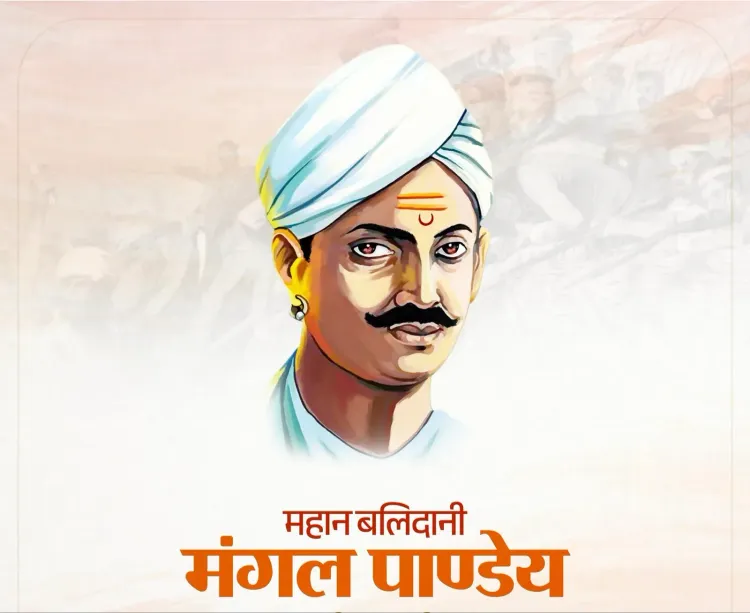
Union Defence Minister Rajnath Singh on Sunday, 19 July 2026, paid tribute to Mangal Pandey, the sepoy of the 34th Bengal Native Infantry whose revolt at Barrackpore in 1857 is widely regarded as a catalytic moment in India's First War of Independence, on the occasion of Pandey's birth anniversary.
Posting in Hindi on X, Singh described Pandey as a 'hero of the 1857 freedom struggle' and an 'immortal symbol of unparalleled courage and patriotism' — ('1857 के स्वाधीनता संग्राम के नायक तथा अद्वितीय साहस और राष्ट्रभक्ति के अमर प्रतीक'). He offered what he called a 'humble salute and crores of salutations' to the martyr.
Context
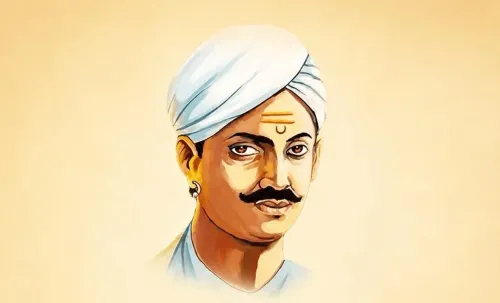
Mangal Pandey served as a sepoy in the 34th Bengal Native Infantry of the East India Company. His attack on British officers at Barrackpore in March 1857 is broadly considered the spark that ignited the wider uprising across northern and central India. The Government of India has officially designated the 1857 events as the First War of Indian Independence since shortly after independence in 1947.
Singh's post states that Pandey 'sounded the conch of revolution against foreign rule with fearlessness, which ignited the spirit of patriotism across all of India and inspired countless countrymen to struggle for the freedom of the motherland' — ('विदेशी शासन के विरुद्ध जिस निर्भीकता से क्रांति का शंखनाद किया, उसने पूरे भारत में देशभक्ति की भावना को प्रज्वलित किया').
Policy Backdrop
Successive Indian governments since 1947 have promoted official commemoration of 1857 figures, but public tributes to pre-20th century martial icons have intensified under the BJP-led government after 2014. The Defence Ministry, in particular, has consistently linked historical sepoy traditions to contemporary military ethos and national security values.
Singh concluded his post by saying Pandey's 'sacrifice, valour and unwavering dedication to the nation will always inspire us to move forward on the path of national service and nation-building' — ('उनका त्याग, पराक्रम और राष्ट्र के प्रति अटूट समर्पण सदैव हमें राष्ट्रसेवा और राष्ट्रनिर्माण के पथ पर आगे बढ़ने की प्रेरणा देता रहेगा').
Stakeholders and Impact
The tribute is directed broadly at Indian citizens and the Indian armed forces, for whom Pandey carries particular symbolic weight as an early military figure who defied colonial authority. Statements of this nature from a sitting Defence Minister carry institutional resonance within the services.
The BJP-led government has consistently used commemorations of pre-independence martial figures to reinforce a narrative of indigenous resistance, connecting historical sacrifice to present-day ideas of national service — a framing that resonates with both civilian audiences and military communities.
What's Next
Annual commemorations on 15 August and 26 January are likely to feature continued ministerial references to 1857 icons. With 2027 marking a potential bicentenary of Pandey's birth, institutional recognitions — including possible events organised by the Defence Ministry or state governments — may be scaled up in the months ahead.
Point of View
Particularly through the platform of the Defence Ministry. By framing Pandey's 1857 revolt as a call to 'nation-building' in the present tense, the minister draws a direct line between colonial-era resistance and contemporary ideas of national service — a rhetorical pattern that has become more pronounced since 2014. With a possible 2027 bicentenary on the horizon, such commemorations are likely to grow in institutional scale. The tribute also signals the government's continued investment in shaping a martial-nationalist historical narrative for both civilian and military audiences.
NationPress
19 Jul 2026
Frequently Asked Questions
Who was Mangal Pandey and why is he remembered?
Mangal Pandey was a sepoy in the 34th Bengal Native Infantry of the East India Company whose attack on British officers at Barrackpore in March 1857 is widely regarded as a catalytic moment in the First War of Indian Independence. He is remembered as an early symbol of armed resistance against British colonial rule.
What did Rajnath Singh say about Mangal Pandey?
Rajnath Singh called Mangal Pandey a 'hero of the 1857 freedom struggle' and an 'immortal symbol of unparalleled courage and patriotism,' saying his sacrifice and valour would always inspire Indians toward national service and nation-building.
When is Mangal Pandey's birth anniversary?
Rajnath Singh's tribute was posted on 19 July 2026, marking Mangal Pandey's birth anniversary. The exact birth date of Mangal Pandey remains a matter of some historical discussion.
What was the 1857 uprising?
The 1857 uprising began as a revolt by Indian sepoys against the East India Company and spread into a broader rebellion across northern and central India. The Government of India officially terms it the First War of Indian Independence.
Why does the Defence Ministry commemorate 1857 figures?
The Defence Ministry and BJP-led government have consistently honoured pre-independence martial icons to reinforce a narrative of indigenous resistance and connect historical military sacrifice to contemporary values of national service and military ethos.