Rijiju Backs PM Modi's Call for Domestic Tourism

Synopsis
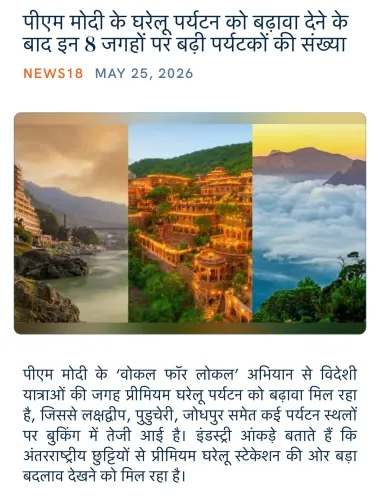
Union Parliamentary Affairs Minister Kiren Rijiju backed PM Modi's call for domestic tourism on 25 May 2026, saying it would boost local economies, conserve foreign exchange, and deepen cultural awareness — linking the appeal to India's broader self-reliance policy framework.
Key Takeaways
Kiren Rijiju publicly endorsed PM Modi 's appeal for domestic tourism on 25 May 2026 .
He argued the shift from foreign to domestic travel would boost local economies and reduce unnecessary foreign exchange outflows .
The Dekho Apna Desh scheme, launched in 2020 , is the Ministry of Tourism's flagship initiative promoting domestic travel.
The appeal aligns with the Atmanirbhar Bharat framework's emphasis on reducing dependence on foreign spending.
Key beneficiaries include tourism workers , local businesses, and heritage destinations across India.
Further policy action — new travel circuits or campaign announcements — may follow ahead of the monsoon session of Parliament .
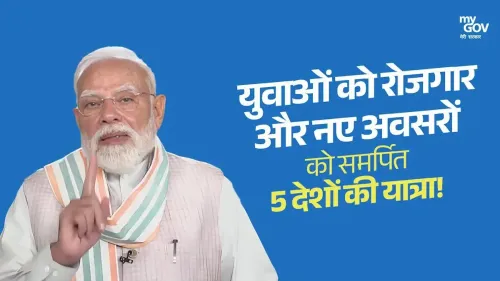
Union Parliamentary Affairs Minister Kiren Rijiju on Monday, 25 May 2026, backed Prime Minister Narendra Modi's appeal to Indians to choose domestic travel over foreign trips, calling it a step toward economic and cultural enrichment of the nation.
Context
Posting in Hindi on X, Rijiju wrote: 'अपने देश, इसकी विविध संस्कृति और समृद्ध सभ्यता को जानने का इससे बेहतर अवसर नहीं हो सकता' — ('There can be no better opportunity than this to know one's own country, its diverse culture and rich civilisation'). He added that promoting domestic tourism over foreign travel in the current global environment would boost local economies and prevent unnecessary outflow of foreign exchange.
The minister described PM Modi's appeal as one that would prove 'truly beneficial in the economic and cultural enrichment of the country' — framing it not merely as a travel preference but as a patriotic and economic imperative.
Policy Backdrop
The call echoes a well-established policy line. The Ministry of Tourism launched the Dekho Apna Desh initiative in 2020 to encourage Indians to explore domestic heritage sites and travel destinations after the COVID-19 pandemic brought international tourism to a halt. The scheme has since become a recurring instrument for channelling leisure spending toward Indian destinations.
The broader Atmanirbhar Bharat framework, also announced in 2020, included explicit calls to reduce foreign exchange outflows by prioritising domestic consumption — a logic that applies directly to the tourism sector, where overseas travel represents a significant drain on the current account.
Senior ministers amplifying the Prime Minister's messaging on domestic tourism has been a consistent pattern across periods of global economic uncertainty, reinforcing the government's self-reliance narrative through everyday citizen choices.
Stakeholders and Impact
The appeal directly benefits tourism industry workers, local hospitality businesses, transport operators, and artisans at heritage destinations across India. When domestic travellers opt for Indian circuits over foreign holidays, spending stays within the economy, supporting livelihoods at the grassroots level.
On the macroeconomic side, a sustained shift toward domestic tourism helps conserve foreign exchange reserves by reducing outbound leisure spending — a concern that gains urgency during periods of global currency or geopolitical volatility. India's tourism sector, which employs millions directly and indirectly, stands to gain substantially from such a behavioural shift.
What's Next
Attention will now turn to whether the Ministry of Tourism follows the Prime Minister's appeal with concrete announcements — new domestic travel circuits, promotional campaigns, or targeted allocations. Any related policy moves or budgetary provisions could feature in parliamentary discussions during the upcoming monsoon session. With senior ministers like Rijiju publicly amplifying the message, the political groundwork for a renewed domestic tourism push appears to be in place.
Point of View
Allowing the government to frame a leisure preference as an act of patriotism and self-reliance. It also quietly deflects attention from whatever global conditions are weighing on outbound travel, turning a constraint into a policy virtue. If the Tourism Ministry follows with concrete schemes or allocations, this social media moment could be a signal of a larger campaign in the making.
NationPress
20 Sept 2026
Frequently Asked Questions
What did Kiren Rijiju say about domestic tourism?
Kiren Rijiju endorsed PM Modi's appeal for domestic tourism on 25 May 2026, saying it would boost local economies, conserve foreign exchange, and help Indians discover their country's diverse culture and civilisation.
What is the Dekho Apna Desh scheme?
Dekho Apna Desh is a Ministry of Tourism initiative launched in 2020 to encourage Indians to travel within the country and explore domestic heritage sites, particularly after international tourism halted during the COVID-19 pandemic.
Why is the government promoting domestic tourism over foreign travel?
The government argues that domestic tourism keeps spending within the Indian economy, supports local livelihoods, and prevents unnecessary outflow of foreign exchange — concerns that are especially relevant during periods of global economic uncertainty.
How does domestic tourism connect to Atmanirbhar Bharat?
The Atmanirbhar Bharat framework, announced in 2020, explicitly called for reducing dependence on foreign goods and services including leisure travel abroad, making domestic tourism a natural fit for the self-reliance policy narrative.
Who benefits from a shift to domestic tourism in India?
Tourism industry workers, local hotels and restaurants, transport operators, artisans, and heritage site communities across India are the primary beneficiaries when Indians choose domestic destinations over foreign holidays.