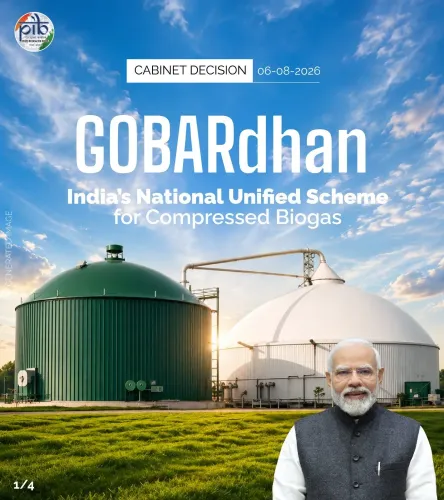
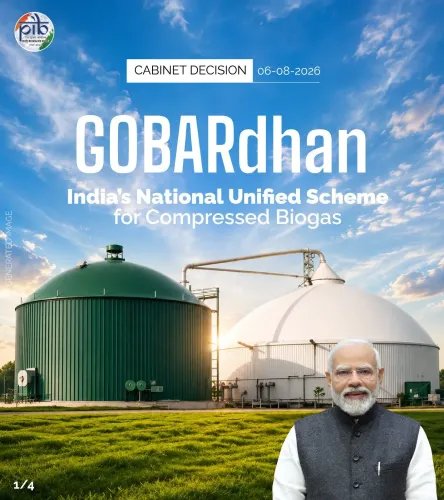
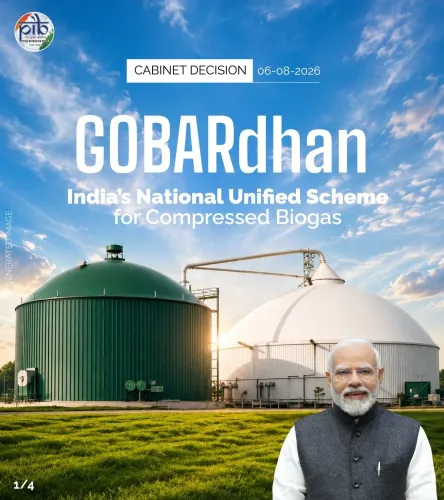
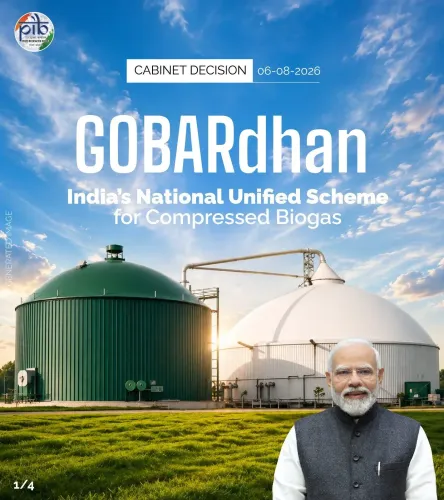
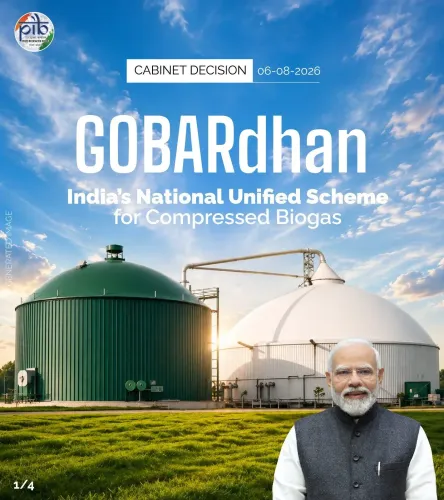
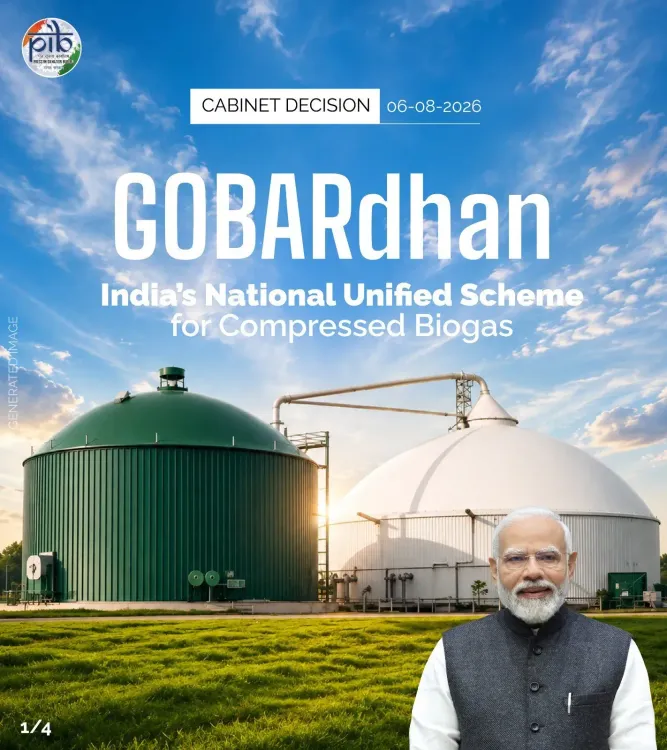
Rijiju: Cabinet clears GOBARdhan CBG scheme at ₹23,731 cr
Synopsis
India's Union Cabinet has approved the GOBARdhan National Unified Scheme for Compressed Biogas with a ₹23,731 crore outlay, targeting nearly ten-fold growth in domestic CBG production to reduce import dependence and strengthen energy security, Minister Kiren Rijiju announced on 6 August 2026.
Key Takeaways
The Union Cabinet approved GOBARdhan — India's National Unified Scheme for Compressed Biogas — on 6 August 2026 .
The scheme carries a financial outlay of ₹23,731 crore .
The target is nearly ten-fold growth in domestic CBG production.
GOBARdhan was originally launched in 2018 under Swachh Bharat Mission-Gramin; this Cabinet decision scales it into a unified national scheme.
The move builds on the SATAT initiative (2018) and the National Policy on Biofuels (2018) , aiming to reduce India's dependence on imported natural gas.
Key beneficiaries include rural farmers (feedstock suppliers) and CBG plant developers ; implementation details, state sanctions and SATAT integration are the next watch-points.
India's Union Cabinet has approved a sweeping overhaul of the country's biogas ambitions — backing GOBARdhan, the new National Unified Scheme for Compressed Biogas, with an outlay of ₹23,731 crore and a mandate to drive nearly ten-fold growth in domestic CBG (Compressed Biogas) production. Union Parliamentary Affairs and Minority Affairs Minister Kiren Rijiju announced the Cabinet decision on Thursday, 6 August 2026, crediting the push to Prime Minister Narendra Modi's leadership.
From cattle dung to energy security: what the Cabinet cleared
GOBARdhan — an acronym for Galvanising Organic Bio-Agro Resources Dhan — is not a new name in Indian policy circles. The scheme was first introduced in 2018 as a component of the Swachh Bharat Mission-Gramin, designed to convert cattle dung and agricultural waste into biogas and organic fertiliser for rural households. What the Cabinet has now approved is a far more ambitious, unified national architecture — consolidating earlier pilots into a single scheme with a defined financial commitment and a production target that signals intent at scale.
The ten-fold growth target in domestic CBG output is the headline number. India currently imports significant volumes of natural gas, and every unit of compressed biogas produced domestically chips away at that dependence. The logic is circular-economy at its most direct: organic waste in, clean fuel out, import bill down.
SATAT, biofuel policy, and why this moment is different
The Cabinet decision lands on ground already prepared by two earlier policy moves — the SATAT initiative (2018), which created offtake arrangements for CBG in the transport and industrial sectors, and the National Policy on Biofuels (2018), which set the broader framework for next-generation fuel alternatives. GOBARdhan's new unified structure is designed to plug the gaps those programmes exposed: fragmented implementation, inconsistent state-level uptake, and the absence of a single, well-funded national vehicle to drive project scale-up.
With ₹23,731 crore now committed, the scheme gives plant developers and state governments a credible financial signal — the kind that moves private capital off the sidelines. Rural farmers, who sit at the supply end of the feedstock chain, stand to gain from organised dung and crop-residue collection systems that the scheme is expected to formalise.
What the implementation road looks like
The Cabinet approval is the starting gun, not the finish line. The immediate watch-points are the release of detailed implementation guidelines, the pace of state-level project sanctions, and how smoothly the new scheme integrates with existing SATAT offtake arrangements already in place with city gas distribution companies. Those mechanics will determine whether the ten-fold production ambition translates from Cabinet resolution to running plants.
India's energy security calculus has never been more consequential — volatile global gas markets and the push toward net-zero commitments are squeezing from both sides. A domestically produced, waste-derived fuel that simultaneously cleans villages and cuts import bills is exactly the kind of policy that looks better the longer you look at it.
The dung-to-diesel story just got a ₹23,731 crore chapter. Whether the pipeline of plants follows is the only question that now matters.
Point of View
731 crore outlay is large enough to attract private developers who previously sat out smaller, fragmented pilots. Politically, the scheme lets the BJP speak simultaneously to farmers (waste monetisation, income), environmentalists (circular economy, emission cuts), and the energy-security constituency (import substitution) — a rare triple-audience win. The real test is implementation velocity: India's biofuel history is littered with well-designed policies that stalled at the state-sanction stage.
NationPress
6 Aug 2026
Frequently Asked Questions
What is the GOBARdhan scheme approved by the Cabinet in 2026?
GOBARdhan — Galvanising Organic Bio-Agro Resources Dhan — is India's new National Unified Scheme for Compressed Biogas, approved by the Union Cabinet on 6 August 2026 with a ₹23,731 crore outlay. It aims to convert cattle dung and organic waste into compressed biogas and organic fertiliser, targeting nearly ten-fold growth in domestic CBG production.
What is the budget outlay for the GOBARdhan CBG scheme?
The Union Cabinet approved a financial outlay of ₹23,731 crore for the GOBARdhan National Unified Scheme for Compressed Biogas.
How is the 2026 GOBARdhan scheme different from the original 2018 scheme?
The original GOBAR-Dhan scheme launched in 2018 was a component of Swachh Bharat Mission-Gramin focused on rural biogas units. The 2026 Cabinet approval creates a unified national scheme with a dedicated ₹23,731 crore outlay and an explicit ten-fold CBG production growth target, consolidating earlier pilots under a single, scaled-up framework.
How does GOBARdhan help India's energy security?
By scaling domestic production of Compressed Biogas from organic and agricultural waste, GOBARdhan reduces India's dependence on imported natural gas. Every unit of CBG produced locally substitutes for imported fuel, easing the import bill and improving energy self-reliance.
Who benefits from the GOBARdhan CBG scheme?
The primary beneficiaries are rural farmers, who gain an organised market for cattle dung and crop residue as feedstock, and CBG plant developers, who receive a credible financial framework to attract investment. Broader benefits flow to India's energy sector through reduced import dependence.