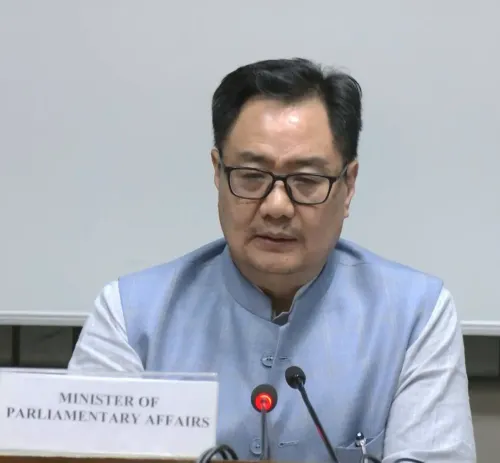
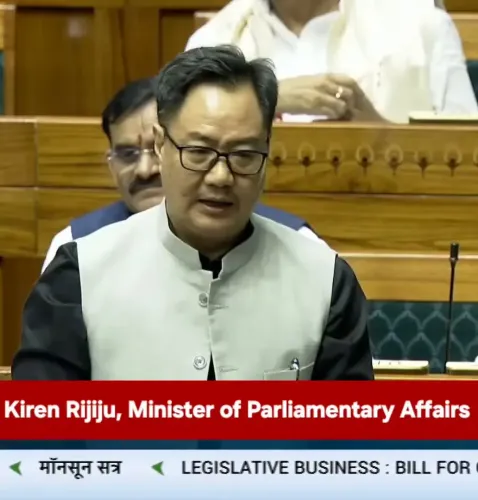
Rijiju praises Owaisi on national interest, labels some opposition 'Anti-India'
Synopsis
Union Minister Kiren Rijiju offered conditional praise to AIMIM chief Asaduddin Owaisi for speaking on India's national interest, then declared unnamed opposition leaders form the 'Anti-India gang' — a pointed political rebuke that redraws opposition fault lines ahead of the next parliamentary session.
Key Takeaways
Union Minister Kiren Rijiju posted on X on October 17, 2026 , praising Asaduddin Owaisi for occasionally speaking sensibly on India's national interest.
Rijiju maintained that the BJP still opposes Owaisi's 'hardcore Muslim-centric policies,' making the praise explicitly conditional.
He urged unnamed opposition leaders to 'learn from Owaisi' if they refuse to engage with the government's national-interest positions.
The post concluded in English: 'Now it's clear who're Anti-India gang,' framing non-compliant opposition voices as anti-national.
Rijiju holds dual portfolios as Union Minister of Parliamentary Affairs and Minority Affairs , giving the statement both legislative and minority-policy weight.
The specific trigger event for the post has not been publicly confirmed; the broader pattern fits recurring BJP rhetoric around parliamentary and electoral cycles.
A sharp cross-aisle salvo landed in Indian politics on Saturday, October 17, 2026, when Union Parliamentary Affairs and Minority Affairs Minister Kiren Rijiju offered conditional praise to AIMIM president Asaduddin Owaisi — then turned the compliment into a pointed rebuke of unnamed opposition leaders, declaring 'Now it's clear who're Anti-India gang.'
Rijiju's double-edged compliment for Owaisi
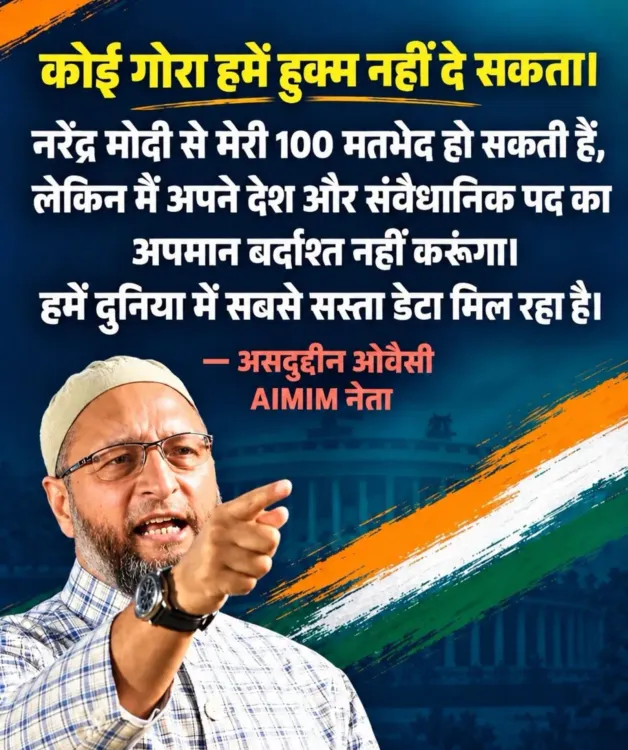
In a Hindi-English post on X, Rijiju wrote: 'Kabhi-kabhi Asaduddin Owaisi Bharat ke rashtriya hit se jude muddon par samajhdari baatein karte hain' — 'Sometimes Asaduddin Owaisi speaks sensibly on matters related to India's national interest.' He was careful to add that the BJP still opposes what he called Owaisi's 'hardcore Muslim-centric policies.' The praise, in other words, was surgical — a scalpel, not a handshake.
The minister then swung the argument at the wider opposition: 'If some opposition leaders do not want to listen to us, they should learn from Owaisi.' The implication was unmistakable — AIMIM, an outfit the BJP routinely frames as a communal rival, was being held up as a mirror to shame opposition figures who refuse to echo the government's national-interest line.
The 'Anti-India gang' frame and what it signals
The closing English sentence — 'Now it's clear who're Anti-India gang' — is where the post pivots from collegial nudge to political branding. Rijiju did not name the targets, but the framing is a well-worn BJP rhetorical device: if even Owaisi, a frequent government critic, can find common ground on sovereignty or security, then those who cannot are positioned as outliers by choice, not conviction.
Indian parliamentary discourse has a long record of such selective cross-aisle endorsements. Senior government figures occasionally cite opposition voices — particularly those ideologically distant from the BJP — when those voices align with government positions on national security. The endorsement magnifies the implied criticism of closer rivals who hold out.
Rijiju, Owaisi, and the geometry of Indian opposition politics
Rijiju, a senior BJP leader from Arunachal Pradesh, currently holds two cabinet portfolios — Parliamentary Affairs and Minority Affairs — giving him both a legislative management role and a direct brief on minority community policy. Owaisi, the Hyderabad MP who leads the All India Majlis-e-Ittehadul Muslimeen, has built his political identity around vigorous advocacy for Muslim community rights, often in sharp tension with the BJP's policy agenda.
Yet both men have, at different moments, staked out positions on Indian sovereignty that have found unlikely agreement across the aisle. The research context — without confirming the specific trigger for this October 2026 post — points to recurring cycles in parliamentary and electoral seasons where such alignments surface and are then weaponised for broader political messaging.
The real audience for Rijiju's post is not Owaisi. It is every opposition figure watching who gets named next — and every voter deciding what 'national interest' means at the ballot box.
Point of View
The framing implicitly raises the stakes for mainstream opposition parties. This tactic also serves Rijiju's Minority Affairs brief by signalling that engagement on national-interest terms is possible across community lines. The 'Anti-India gang' label, left deliberately vague, is designed to stick to whoever the next news cycle identifies — a pre-loaded political weapon.
NationPress
17 Oct 2026
Frequently Asked Questions
What did Kiren Rijiju say about Asaduddin Owaisi?
Rijiju said that Owaisi sometimes speaks sensibly on matters related to India's national interest, though he added that the BJP still opposes Owaisi's Muslim-centric policy positions.
Who is the 'Anti-India gang' Rijiju referred to?
Rijiju did not name specific individuals. He used the phrase to describe unnamed opposition leaders who, in his view, refuse to align with the government on national interest issues — in contrast to Owaisi's occasional alignment.
What portfolios does Kiren Rijiju hold?
Rijiju serves as Union Minister of Parliamentary Affairs and Minister of Minority Affairs . He is a senior BJP leader from Arunachal Pradesh.
Why did Rijiju single out Owaisi for praise if the BJP opposes AIMIM?
The praise was conditional and tactical — Rijiju used Owaisi's stance on national interest as a benchmark to heighten criticism of other opposition figures, not as a sign of ideological convergence between the BJP and AIMIM.