Centre Defends Sabarimala Restrictions in Supreme Court
Synopsis
The Union government argues before the Supreme Court that the restrictions at Sabarimala are not based on gender discrimination, citing various temples with unique practices based on faith. This assertion sparks a broader discussion on inclusivity in religious spaces.
Key Takeaways
Union government defends Sabarimala restrictions Claims not based on gender discrimination Cites various temples with unique practices Supreme Court explores religious freedom vs. rights Inclusivity stressed by Justices
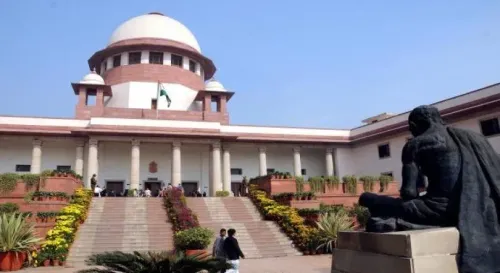
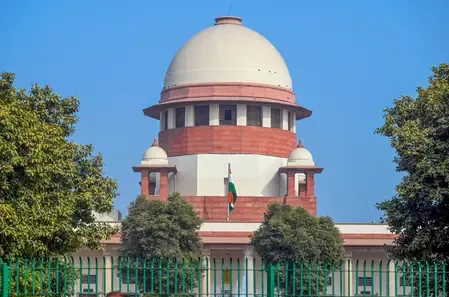
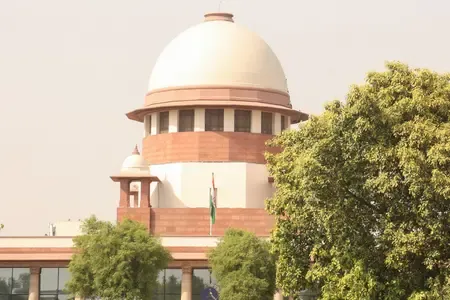
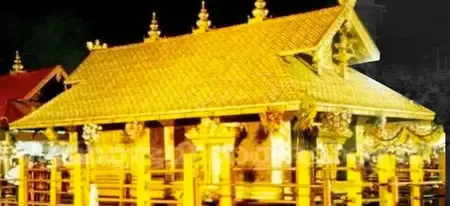
New Delhi, April 9 (NationPress) The Union government asserted before the Supreme Court that the limitations at the Sabarimala temple are not based on gender bias. The government argued that many temples throughout India uphold practices that are either male-focused or female-focused, rooted in faith and tradition.
During the proceedings before a nine-judge Constitution Bench led by Chief Justice of India (CJI) Surya Kant, Solicitor General (SG) Tushar Mehta argued that the 2018 ruling permitting women of all ages to enter the Sabarimala temple was made on the flawed premise that men enjoy superiority while women are relegated to a subordinate status.
"I have provided examples of temples where entry is restricted for men... Some temples require male priests to wash the feet of female worshippers. The Pushkar temple, the only Brahma temple in India, prohibits married men from entering. Additionally, there is a temple in Kerala where men dress as women. Thus, this is not merely about male-centric or female-centric beliefs. In this instance, it is predominantly woman-centric," SG Mehta informed the Bench, which includes Justices B.V. Nagarathna, M.M. Sundresh, Ahsanuddin Amanullah, Aravind Kumar, Augustine George Masih, Prasanna B. Varale, R. Mahadevan, and Joymalya Bagchi.
The Supreme Court is currently deliberating on broader constitutional issues related to the balance between religious freedom and fundamental rights.
Justice Nagarathna emphasized the need for inclusivity within religious spaces, stating that "everyone should have access to every temple and matha," clarifying that her comments were not specifically directed at the Sabarimala issue.
"If one claims that only members of their denomination should be allowed in their temple, that undermines the essence of Hinduism," she noted.
Justice Aravind Kumar warned that exclusionary practices could foster divisions within society.
Senior advocate C.S. Vaidyanathan, representing the case, argued that denominational temples, especially private ones, have historically limited access to certain groups. He contended that such entities, if not dependent on public finances or general foot traffic, may not necessarily breach constitutional norms.
"The question is whether this contradicts constitutional prohibitions. If it aligns with public order, morality, and health, what would be the practical implications?" he stated.
The Centre has persistently claimed that the Sabarimala judgment from 2018 should be reconsidered, asserting that the restrictions involved are based on the unique characteristics of the deity and religious customs, rather than any form of patriarchy or gender discrimination.
In his written statements, SG Mehta highlighted instances such as the Attukal Temple in Kerala, where men are barred from entry during specific rituals, and the Chakkulathukavu temple, where male priests carry out the ritual of washing women's feet. He also mentioned the Kottankulangara temple, where men wear women's clothing as a demonstration of faith.
Point of View
It is crucial to present an unbiased view on the Supreme Court's examination of the Sabarimala restrictions. The case represents a significant intersection of religious freedom and gender rights, deserving careful consideration from all perspectives. The focus should remain on fostering inclusivity while respecting diverse beliefs.
NationPress
19 Sept 2026
Frequently Asked Questions
What is the main argument of the Union government regarding Sabarimala restrictions?
The Union government argues that the restrictions at the Sabarimala temple are not based on gender discrimination but are rooted in the unique nature of the deity and religious practices.
What did the Solicitor General say about the 2018 verdict?
The Solicitor General claimed that the 2018 verdict allowing women of all ages into Sabarimala was based on a misguided understanding of gender superiority.
What examples did the government provide to support its stance?
Examples include temples where men are restricted from entry or required to perform rituals for women, showcasing that such practices are not uncommon across India.
How did the Supreme Court justices respond to the arguments?
Justice Nagarathna emphasized the need for inclusivity in religious spaces, while Justice Aravind Kumar warned of societal divisions due to exclusionary practices.
What is the significance of this case?
This case examines the balance between religious freedoms and fundamental rights, which is crucial for upholding constitutional values in a diverse society.