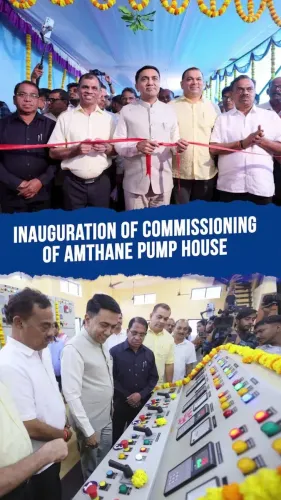
CM Sawant Commissions ₹201 Cr Water Pipeline in North Goa
Synopsis
Goa CM Pramod Sawant commissioned a ₹201 crore, 150 MLD Ductile Iron pipeline from Amthane to Cunchelim in Bicholim on July 28, 2026, supplying raw water to four treatment plants across North Goa under the Swayampurna Goa mission.
Key Takeaways
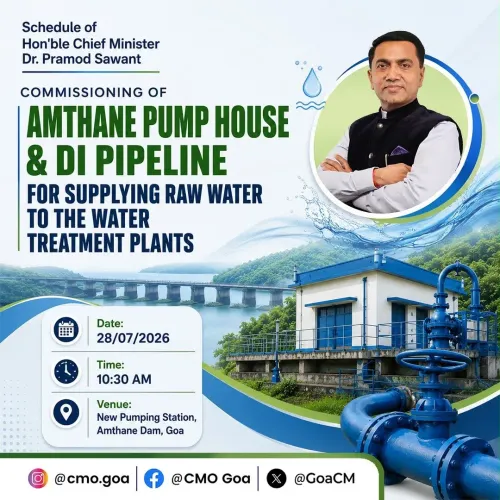
Goa CM Pramod Sawant commissioned the Amthane Pump House and twin DI pipeline (1200 mm and 1000 mm) from Amthane to Cunchelim on July 28, 2026 .
The project cost ₹201 crore and was executed by the Water Resources Department, Goa .
The system delivers 150 MLD of raw water to treatment plants at Assonora, Porvorim, Pilerne, and Assagao .
Beneficiary areas include Mapusa, Siolim, Porvorim, Bicholim , and neighbouring localities in North Goa.
The project is anchored in the Swayampurna Goa mission, with a stated planning horizon of 25–30 years .
Complementary measures include check dams, rainwater harvesting, groundwater recharge, well rejuvenation , and borewell registration.
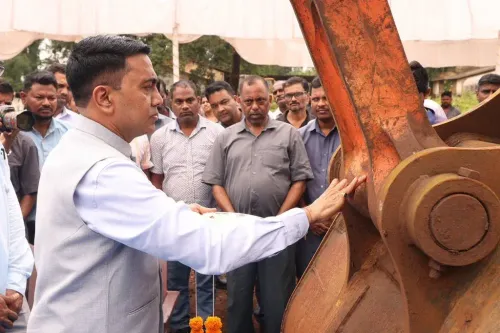
A ₹201 crore pipeline now runs beneath the hills of North Goa — and for hundreds of thousands of residents, it changes the calculus of daily water supply. Goa Chief Minister Pramod Sawant on Tuesday, July 28, 2026, commissioned the Amthane Pump House and a twin 1200 mm and 1000 mm Ductile Iron pipeline stretching from Amthane to Cunchelim in Bicholim, inaugurating what the state calls a dedicated 150 MLD Raw Water Conveyance System.
What the 150 MLD system actually does
The pipeline is not a standalone tap — it is the artery. Raw water drawn through this conveyance system feeds four Water Treatment Plants: Assonora (100 MLD), Porvorim (15 MLD), Pilerne (30 MLD), and Assagao (5 MLD). Together, those plants serve Mapusa, Siolim, Porvorim, Bicholim, and surrounding localities — a densely populated belt that carries the combined pressure of residential demand and Goa's year-round tourism load.
The Water Resources Department designed the system to deliver uninterrupted raw water even during lean monsoon months, when existing infrastructure has historically strained under the twin pressures of low river levels and peak consumption.
Swayampurna Goa's long-game on water
Sawant framed the commissioning explicitly within the state's Swayampurna Goa mission — a self-reliance initiative launched around 2020–21 that set ambitious targets across agriculture, energy, and water. 'This project reflects our Government's vision of planning 25–30 years ahead to make Goa Swayampurna in water security,' he said.
That planning horizon is deliberate. Goa's population has grown steadily, and its tourism footprint — one of the densest per square kilometre in India — creates seasonal demand spikes that stress supply systems built for a smaller state. Large conveyance infrastructure of this scale is designed to absorb that growth curve without emergency retrofits.
Beyond pipelines: check dams, wells, and citizen action
The CM also outlined a parallel soft infrastructure push: check dams, rainwater harvesting, groundwater recharge, well rejuvenation, and a borewell registration drive. The combination signals a two-track strategy — hard infrastructure for guaranteed bulk supply, community-level measures to reduce per-capita dependence and recharge aquifers that the state's coastal geology makes both vital and vulnerable.
The next test will be operational: whether the 150 MLD system performs at rated capacity through Goa's post-monsoon dry stretch, and whether the state budget that follows allocates matching funds for similar pipeline projects in South Goa — a region that has watched North Goa's infrastructure upgrade with considerable interest.
A pump house in Bicholim is now the foundation of Goa's water future. Whether that foundation holds will be measured not in ribbon-cutting photographs but in taps that run through April.
Point of View
At 150 MLD across a single conveyance corridor, signals that the BJP government is betting on centralised bulk infrastructure rather than distributed small-scale fixes. Framing a ₹201 crore project around a 25–30 year horizon is also a political manoeuvre: it positions the ruling party as the author of Goa's long-term resource security, making any future shortfall a story about execution rather than vision. The parallel push on check dams and rainwater harvesting, while genuinely sound hydrology, also serves to distribute credit and responsibility to citizens — a useful hedge if the hard infrastructure underperforms in dry years.
NationPress
27 Oct 2026
Frequently Asked Questions
What is the Amthane to Cunchelim pipeline project in Goa?
It is a ₹201 crore Water Resources Department project commissioning a 150 MLD Raw Water Conveyance System via Ductile Iron pipelines (1200 mm and 1000 mm) from Amthane to Cunchelim in Bicholim, supplying raw water to four treatment plants in North Goa.
Which areas will benefit from the new Goa water pipeline?
The pipeline supplies water treatment plants at Assonora, Porvorim, Pilerne, and Assagao , with end beneficiaries in Mapusa, Siolim, Porvorim, Bicholim , and surrounding North Goa localities.
What is Swayampurna Goa and how does it relate to water security?
Swayampurna Goa is a state self-reliance mission launched around 2020–21 by the BJP government to achieve self-sufficiency across key sectors. Water security is a central pillar, with CM Sawant citing a 25–30 year planning horizon for projects like the Amthane pipeline.
How much raw water will the new Goa pipeline supply?
The system is designed to convey 150 MLD (million litres per day) of raw water, split across four treatment plants: Assonora (100 MLD), Pilerne (30 MLD), Porvorim (15 MLD), and Assagao (5 MLD).
What other water conservation steps is the Goa government taking?
Alongside the pipeline, the Goa government is promoting check dams, rainwater harvesting, groundwater recharge, well rejuvenation , and a borewell registration programme, encouraging citizen participation in water conservation.