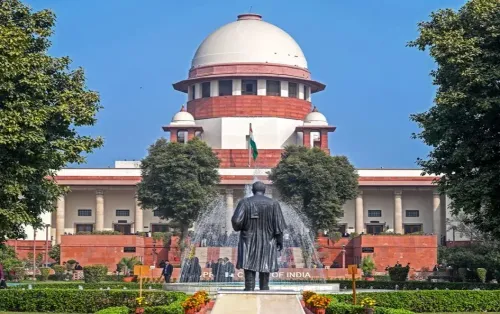
Supreme Court: Conviction valid on solitary reliable witness testimony
Synopsis
The Supreme Court has reinforced a foundational principle of Indian criminal law: one credible witness is enough to convict. In upholding a life sentence from a 1998 Gujarat murder case where multiple witnesses turned hostile, the bench drew a clear line — quality of evidence, not quantity, is what the law demands.
Key Takeaways
The Supreme Court upheld the life sentence of Mitesh alias T.V.
Vaghela in a 1998 Gujarat murder case on 12 May 2025 .
The bench ruled that a dying declaration , if truthful and voluntary, can alone form the basis of conviction without corroboration.
The court held that hostile witnesses do not automatically demolish a prosecution case if other reliable evidence is on record.
The Supreme Court of India has upheld the life sentence awarded to Mitesh alias T.V. Vaghela in a 1998 murder case from Gujarat, reaffirming that a conviction can rest on the testimony of even a single reliable witness — even when multiple prosecution witnesses have turned hostile during trial.
Background of the Case
The incident dates to 11 December 1998, when a quarrel broke out after the accused allegedly threw a half-burnt cigarette into a bucket used by Somabhai Rabari for washing tea cups at his stall in Ahmedabad's Khokara area. The following morning, Rabari was found in an injured condition near his stall. His brother, complainant Ishwarbhai Rabari, stated that upon reaching the spot, the deceased identified Mitesh as the person who had stabbed him.
According to the prosecution, Rabari repeated the allegation while being transported to hospital in an autorickshaw. He was later declared dead at the hospital. During the investigation, police recovered the alleged weapon — a knife — pursuant to information furnished by the accused.
Key Legal Arguments
Before the apex court, the appellant argued that the prosecution's case was unreliable since several independent witnesses and panch witnesses had turned hostile. He further contended that the alleged oral dying declaration could not be relied upon, and that the deceased was not in a fit condition to make any statement given the severity of his injuries.
A bench of Justices Aravind Kumar and Prasanna B. Varale dismissed the appeal filed by Vaghela against the Gujarat High Court judgment, which had affirmed his conviction under Section 302 of the Indian Penal Code and Section 135 of the Bombay Police Act. The trial court had sentenced him to life imprisonment along with a fine of ₹500 for murder, and 10 days' rigorous imprisonment with a fine of ₹250 under the Bombay Police Act.
What the Supreme Court Ruled
Rejecting the appellant's contentions, the Justice Aravind Kumar-led bench held that the prosecution had succeeded in proving the case beyond a reasonable doubt.
Point of View
In India, is often manufactured. The Supreme Court's emphasis on quality over quantity of evidence is especially significant in cases where witnesses are intimidated or bought off. The broader concern, however, is that the same principle, if applied loosely, could lower the evidentiary bar in cases where the sole witness is less reliable than assumed. The safeguard lies in the word 'sterling' — a standard the court has historically applied rigorously, but inconsistently across benches.
NationPress
19 Sept 2026
Frequently Asked Questions
What did the Supreme Court rule about convictions based on a single witness?
The Supreme Court ruled that a conviction can be sustained on the testimony of even a solitary witness, provided that testimony is found to be wholly reliable and of sterling quality. The court reiterated that Indian law emphasises the value and quality of evidence, not the number of witnesses.
What is a dying declaration and why did it matter in this case?
A dying declaration is a statement made by a person who believes they are about to die, identifying their assailant or describing the circumstances of an attack. In this case, the deceased Somabhai Rabari named Mitesh as his attacker both at the scene and again in an autorickshaw on the way to hospital — and the court found this declaration reliable enough to support conviction.
Why did multiple witnesses turning hostile not acquit the accused?
The Supreme Court held that hostile witnesses do not automatically demolish a prosecution case if reliable evidence establishing guilt is otherwise available on record. The testimony of the autorickshaw driver, who claimed to have witnessed the assault, remained consistent and unshaken under cross-examination.
What sentence did Mitesh alias T.V. Vaghela receive?
Mitesh was sentenced to life imprisonment and a fine of ₹500 for murder under Section 302 of the Indian Penal Code, along with 10 days' rigorous imprisonment and a ₹250 fine under Section 135 of the Bombay Police Act.
Can the convict seek early release?
Yes. The Supreme Court, noting that the appellant had already undergone a substantial part of his sentence, granted him liberty to move an application seeking remission in accordance with the applicable remission policy.