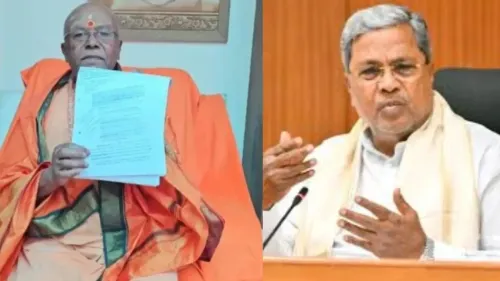
Karnataka seer alleges caste bias in Siddaramaiah's last-day ₹78 crore fund release
Synopsis
A seer heading a backward-class religious forum has alleged that ₹78 crore in welfare funds was released on Siddaramaiah's final day as Karnataka CM — with 60–70% reportedly going to Kuruba-linked organisations. The charge strikes at the heart of Siddaramaiah's AHINDA identity and puts the ruling Congress on the defensive.
Key Takeaways
Pranavananda Swamiji , president of the Forum of Heads of the Most Backward Class Maths , alleged caste-based favouritism in Karnataka's backward-class fund allocation on 11 June .
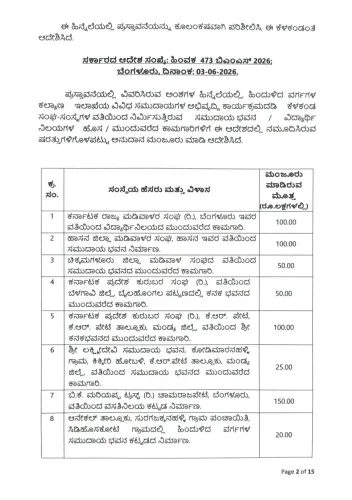
A Finance Department order reportedly released ₹75 crore to 171 organisations; out of ₹138 crore reserved for backward-class welfare, ₹78 crore was allegedly disbursed in a single day.
The seer claims 60–70% of funds went to Kuruba -linked bodies, with 89 Kuruba organisations receiving grants versus eight Madivala and two Yadava centres.
The Rakesh Siddaramaiah Trust in Gadag was allegedly sanctioned ₹50 lakh ; 13 community centres in T.
Narasipura taluk also reportedly received assistance.
Home Minister Priyank Kharge denied any intent to be unjust and said the government would rectify imbalances in the coming year.
A prominent religious leader has alleged that former Karnataka Chief Minister Siddaramaiah sanctioned a disproportionate share of backward-class welfare funds to organisations linked to his own Kuruba community on the final day of his tenure, raising questions about the government's stated commitment to social justice. The allegations were made in Bengaluru on Thursday, 11 June.
What the Seer Alleged
Pranavananda Swamiji, president of the Forum of Heads of the Most Backward Class Maths, told reporters he had obtained a copy of a Finance Department order under which ₹75 crore was released to 171 organisations and institutions. He alleged that out of ₹138 crore reserved for backward-class welfare, ₹78 crore was disbursed in a single day — the day before Siddaramaiah demitted office — with a majority reportedly flowing to Kuruba-linked bodies.
According to Pranavananda Swamiji, 89 organisations associated with the Kuruba community were sanctioned funds, while only eight Madivala community centres, two Yadava community centres, and one each from the Helava and Savita communities received grants. He claimed that 60 to 70 per cent of the total allocation went to Kuruba-linked entities, despite the backward-classes category comprising 104 communities including Ediga, Kumbara, Vishwakarma, Shivasimpi, and Pinjara.
Regional and Trust-Level Concerns
The seer also questioned the concentration of grants in Siddaramaiah's home region, alleging that 13 community centres in T. Narasipura taluk received assistance. He further claimed that the Rakesh Siddaramaiah Trust in Gadag was sanctioned ₹50 lakh. Rakesh Siddaramaiah, the elder son of the former Chief Minister, passed away on 30 July 2016 at the age of 39 due to multiple organ failure caused by acute pancreatitis, at Antwerp University Hospital in Brussels, Belgium.
Siddaramaiah's Record Under Scrutiny
Pranavananda Swamiji directly challenged Siddaramaiah's long-held positioning as a champion of the AHINDA coalition — an acronym representing minorities, backward classes, and Dalits in Karnataka politics. 'Former Chief Minister Siddaramaiah has always spoken about equality and social justice. He claims to be a representative of the AHINDA communities and particularly of Dalits. If that is the case, how does this allocation reflect the principles of AHINDA?' the seer said. Notably, Siddaramaiah hails from the Kuruba community, which falls within the backward-classes category.
The seer was careful to clarify that he was not opposed to government funding for any community. 'We are not against providing funds to any community. The government should support everyone. But nearly 60 per cent of the funds have gone to one community,' he said, calling for equitable distribution across all 104 backward-class communities.
Government Response
Karnataka Home Minister Priyank Kharge responded to the allegations in Bengaluru on Thursday, asserting that the government had no intention of being unjust to any community. 'We are not the government of any one community. Justice must be delivered to all communities... At times, some communities may receive more funds and others less. Our government is still in office, and if any imbalance exists, we will rectify it. Necessary corrections will be made in the coming year,' Kharge said.
The controversy comes amid broader scrutiny of last-minute administrative decisions made by outgoing state governments, and is likely to intensify political debate over welfare fund allocation practices in Karnataka ahead of future electoral cycles.
Point of View
And any evidence of intra-coalition favouritism is particularly damaging. What is striking is not just the quantum — ₹78 crore in a single day — but the specificity: named trusts, named taluks, named community counts. Kharge's response that 'corrections will be made' implicitly concedes that an imbalance may exist, which is a more significant admission than the government likely intended. With Karnataka's next electoral cycle on the horizon, the Congress will need to demonstrate that AHINDA is a governing principle, not just a campaign slogan.
NationPress
19 Sept 2026
Frequently Asked Questions
What is the fund allocation controversy involving Siddaramaiah?
A seer has alleged that former Karnataka Chief Minister Siddaramaiah released ₹78 crore in backward-class welfare funds on his last day in office, with an estimated 60–70% reportedly going to organisations linked to his own Kuruba community. The allegation is based on a Finance Department order releasing ₹75 crore to 171 organisations.
Who made the allegations and on what basis?
Pranavananda Swamiji, president of the Forum of Heads of the Most Backward Class Maths, made the allegations at a press conference in Bengaluru on 11 June. He claimed to possess a copy of the Finance Department order and said officials had confirmed the disbursement occurred a day before Siddaramaiah demitted office.
How has the Karnataka government responded?
Home Minister Priyank Kharge denied any intent to be unjust, saying the government serves all communities and would rectify any imbalance in the coming year. He did not directly address the specific figures cited by the seer.
What is the AHINDA coalition and why does it matter here?
AHINDA is a political coalition representing minorities, backward classes, and Dalits in Karnataka, and has been central to Siddaramaiah's political identity. The seer's allegation directly challenges this positioning by claiming that funds meant for all 104 backward-class communities were disproportionately directed to one — the Kuruba community, to which Siddaramaiah belongs.
Which communities were allegedly left out?
According to the seer, communities such as Uppara, Madivala, Yadava, Helava, Savita, Ediga, Kumbara, Vishwakarma, Shivasimpi, and Pinjara received far smaller allocations. He alleged that 89 Kuruba-linked organisations received grants versus only eight Madivala centres and two Yadava centres, out of 104 communities classified under the backward-classes category.