Amit Shah Calls for Ruthless Legal Action Against Internal Threats

Synopsis
Union Home Minister Amit Shah on 26 May 2026 posted a pointed directive calling for vigilant watch and ruthless legal action against those who create internal threats within India's borders, reinforcing the central government's zero-tolerance stance on domestic security.
Key Takeaways
Amit Shah on 26 May 2026 called for 'ruthless' legal action against those generating internal security threats within India.
The statement covers the full spectrum of domestic threats — radicalised networks, insurgencies, and cross-border operatives active inside Indian territory.
The UAPA, amended in 2019 , provides the primary legal framework for designating and prosecuting such threats.
Agencies including the NIA and CAPFs operate under the Ministry of Home Affairs and are the principal instruments for such enforcement.
The directive continues a consistent pattern of central government messaging on internal security dating back to 2014 .
Follow-up action — operational directives, state advisories, or legislative proposals — is expected to be watched closely by security and policy observers.
Union Home Minister Amit Shah on Tuesday, 26 May 2026 issued a sharp public directive calling for vigilant surveillance and unsparing legal action against those who generate internal threats within the country's borders, underscoring the central government's zero-tolerance posture on domestic security.
Context
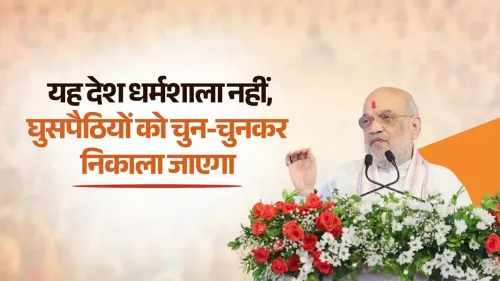
In a post on X, Shah wrote in Hindi: 'सीमा के भीतर आंतरिक खतरा पैदा करने वालों पर हमारी पैनी नजर हो, उन पर ruthlessly कानूनी कार्रवाई हो' — meaning, 'We must keep a sharp watch on those who create internal threats within our borders, and legal action against them must be taken ruthlessly.' The use of the English word 'ruthlessly' mid-sentence was deliberate, signalling an unambiguous tone of enforcement.
The statement is directed at the full spectrum of internal security actors — from radicalised networks and insurgent outfits to cross-border operatives functioning inside Indian territory. As the minister overseeing the Ministry of Home Affairs (MHA), Shah coordinates the country's central law enforcement and counter-terrorism apparatus.
Policy Backdrop
The message aligns with a legislative and operational posture the central government has maintained since 2014. The Unlawful Activities (Prevention) Act (UAPA), amended in 2019, expanded provisions for designating individuals as terrorists and streamlined prosecution of terror-related offences — giving agencies sharper legal tools for exactly the kind of action Shah is referencing.
Agencies under the MHA's oversight — including the National Investigation Agency (NIA) and the Central Armed Police Forces (CAPFs) — have been at the forefront of operations against Left-Wing Extremism, organised insurgencies in the northeast, and cross-border radical networks. Shah's statement reinforces that this operational tempo is to be sustained without letup.
Stakeholders and Impact
The directive is aimed squarely at security agencies and state police forces, which are the primary instruments of internal enforcement. For state governments — particularly those in conflict-affected regions — the message from the Union Home Minister carries both policy guidance and political weight.
Civil liberties groups and legal observers have, in the past, raised questions about the scope of UAPA application and due-process standards. Shah's framing of 'ruthless' legal action will likely renew those debates, even as security establishments interpret it as a mandate to act decisively against verified threats.
What's Next
Analysts will watch for follow-up action from the Ministry of Home Affairs — whether in the form of operational directives to agencies, advisories to state governments, or proposed legislative amendments in the next Parliament session. Any specific operations announced in the coming weeks will be read against the backdrop of this public statement.
The broader signal is consistent with the government's long-standing public messaging: internal security will be treated as a non-negotiable priority, and those who threaten it from within will face the full force of the law.
Point of View
As such statements often are, to signal resolve to both security agencies and potential adversaries. The deliberate use of 'ruthlessly' in an otherwise Hindi post suggests the word choice was intentional, designed to land with unmistakable clarity. Read against the arc of UAPA amendments, NIA expansion, and sustained anti-insurgency operations, this fits a pattern of the Home Ministry using high-visibility public statements to set the operational tone for agencies on the ground. The political dimension is equally clear: internal security remains one of the BJP's core governance narratives, and Shah is its most prominent custodian.
NationPress
11 Oct 2026
Frequently Asked Questions
What did Amit Shah say about internal security threats on 26 May 2026?
Shah posted on X calling for sharp surveillance and ruthless legal action against those who create internal threats within India's borders, using the Hindi phrase meaning 'We must keep a keen watch on those who generate internal threats within our borders, and act against them ruthlessly under the law.'
Which law is used against internal security threats in India?
The Unlawful Activities (Prevention) Act (UAPA), amended in 2019, is the primary law used to designate terrorists and prosecute those involved in terror-related and internal security offences in India.
Which agencies does the Ministry of Home Affairs oversee for internal security?
The Ministry of Home Affairs oversees the National Investigation Agency (NIA) and the Central Armed Police Forces (CAPFs), which are the principal agencies handling counter-terrorism and internal security operations across India.
What is India's policy on internal security threats under the current government?
Since 2014, the central government has maintained a zero-tolerance posture on internal security threats, including Left-Wing Extremism, insurgencies, and cross-border radical networks, backed by strengthened legal frameworks such as the amended UAPA.
What could follow Amit Shah's statement on internal threats?
Security analysts expect possible follow-up in the form of operational directives to central agencies, advisories to state governments, or proposed legislative changes in the next Parliament session, particularly if specific operations are announced in the coming weeks.