Amit Shah: India Is Not a Dharamshala, Infiltrators Will Be Removed
Synopsis
Union Home Minister Amit Shah on 20 June 2026 declared that India is 'not a dharamshala' and that infiltrators will be removed one by one. The statement reinforces the BJP-led government's long-standing enforcement posture on illegal immigration, underpinned by the NRC and CAA frameworks.
Key Takeaways
Amit Shah posted on 20 June 2026 that India is 'not a dharamshala' and infiltrators will be removed 'one by one.' The statement reinforces the government's enforcement stance on illegal immigration, particularly along the India-Bangladesh frontier.
The Assam NRC , finalised on 31 August 2019 , excluded approximately 1.9 million applicants from verified citizen rolls.
The Assam Accord of 1985 set 24 March 1971 as the legal cut-off for identifying illegal entrants in the state.
The Citizenship Amendment Act (CAA) of 2019 offers citizenship pathways to non-Muslim migrants from Pakistan , Bangladesh , and Afghanistan who entered before 2014 .
Observers will watch for follow-up action including a possible nationwide NRC rollout and bilateral repatriation talks with Dhaka .
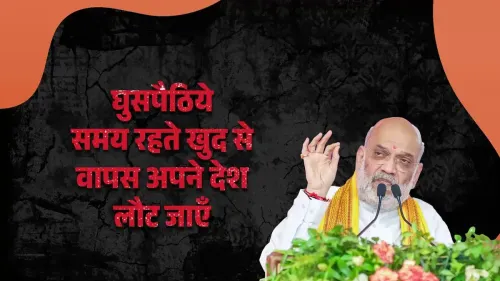
Union Home Minister Amit Shah on Saturday, 20 June 2026, issued a sharp warning on illegal immigration, declaring that India would systematically identify and expel infiltrators from its territory. The statement, posted on X, drew an unambiguous line on the government's intent regarding undocumented migrants.
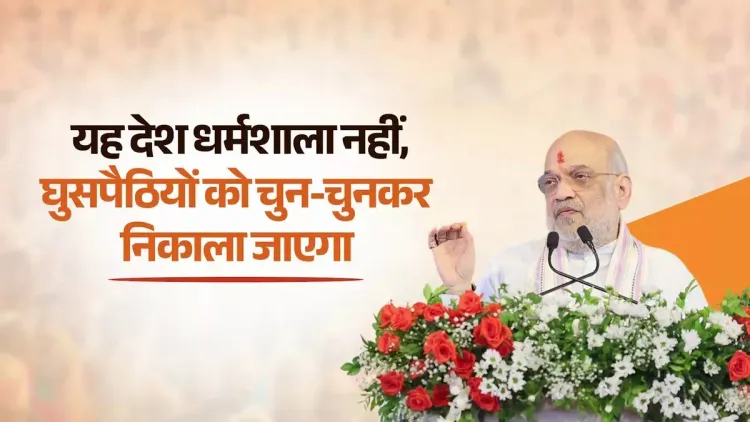
In his post, Shah wrote in Hindi: 'Yah desh dharamshala nahin hai; ghuspaithiyon ko chun-chunkar nikala jaega' — translated as, 'This country is not a rest house; infiltrators will be removed one by one.' The language was deliberate and pointed, signalling an active enforcement posture rather than a declaratory one.
Context
The statement comes against the backdrop of long-standing concerns over illegal immigration, particularly along India's northeastern frontier. Bangladesh has been cited repeatedly in official discourse as the primary source of undocumented entrants into states such as Assam, West Bengal, and Tripura. The phrase 'dharamshala' — a public rest house open to all — carries cultural resonance in India, and its use here frames the immigration question as one of national sovereignty rather than humanitarian policy.
The BJP-led central government has consistently linked demographic security in the northeast to the detection and removal of infiltrators, framing such actions as enforcement of existing citizenship and border laws.
Policy Backdrop
India's legislative and administrative architecture on this issue dates back decades. The Assam Accord of 1985 — a tripartite agreement between the Centre, the Assam government, and the All Assam Students' Union — set 24 March 1971 as the cut-off date for detecting and deporting foreign nationals from the state. The accord remains the foundational legal instrument for identifying post-1971 entrants as illegal migrants.
The National Register of Citizens (NRC) for Assam, whose final list was published on 31 August 2019, excluded approximately 1.9 million applicants from the verified citizen rolls. That same year, Parliament passed the Citizenship Amendment Act (CAA) in December 2019, which offered citizenship pathways to non-Muslim migrants from Pakistan, Bangladesh, and Afghanistan who had entered India before 2014. Together, the NRC and CAA form the twin pillars of the government's citizenship-verification framework.
Successive Indian governments since the 1980s have maintained border fencing and identification operations along the India-Bangladesh frontier. The current government has accelerated those efforts, with senior ministers framing them as non-negotiable enforcement rather than discretionary policy.
Stakeholders and Impact
The most direct impact of any expanded enforcement drive falls on border states, where undocumented populations are concentrated and where local political economies are intertwined with migration patterns. Residents in Assam and West Bengal — states that have seen sustained political contestation over the issue — will watch closely for any administrative follow-through.
Civil society groups and legal advocates who have represented excluded NRC applicants argue that the identification process has ensnared genuine Indian citizens, particularly among marginalised communities. The government, by contrast, maintains that robust verification mechanisms exist to protect bona fide citizens while removing those without legal status.
What's Next
Observers will track whether Shah's statement is followed by concrete administrative action — including any announcement of an expanded NRC exercise beyond Assam, fresh directives to state police and border agencies, or diplomatic engagement with Dhaka on repatriation mechanisms. The broader question of a nationwide NRC, which the government has indicated it intends to implement, remains unresolved in terms of timeline and modalities. Shah's forceful language suggests the issue will remain a central plank of the government's governance messaging in the months ahead.
Point of View
Functioning both as a political signal to the BJP's base and as a warning to state governments to align enforcement. Coming alongside the unresolved question of a nationwide NRC, the post suggests the government intends to keep citizenship and border security at the centre of its governance agenda. The emphasis on 'chun-chunkar' — selecting and removing one by one — implies a targeted, identity-verified operation rather than a broad sweep, which may be a deliberate rhetorical hedge against civil liberties criticism.
NationPress
19 Sept 2026
Frequently Asked Questions
What did Amit Shah say about infiltrators on 20 June 2026?
Amit Shah posted on X on 20 June 2026 that 'this country is not a dharamshala; infiltrators will be removed one by one,' signalling an active enforcement drive against illegal immigrants.
What is the NRC and how does it relate to Amit Shah's statement?
The National Register of Citizens (NRC) is a register of verified Indian citizens. The final NRC for Assam , published on 31 August 2019 , excluded approximately 1.9 million applicants. Shah's statement reinforces the government's intent to use such mechanisms to identify and remove undocumented migrants.
What is the Citizenship Amendment Act and is it connected to this statement?
The Citizenship Amendment Act (CAA) , passed in December 2019 , offers citizenship to non-Muslim migrants from Pakistan , Bangladesh , and Afghanistan who entered India before 2014 . It works alongside the NRC framework that Shah's statement invokes.
Which states are most affected by illegal immigration from Bangladesh?
Assam , West Bengal , and Tripura are the border states most cited in official statements as bearing the primary impact of illegal immigration from Bangladesh .
Will there be a nationwide NRC following Amit Shah's statement?
The government has previously indicated intent to implement a nationwide NRC, but no official timeline or modality has been confirmed. Shah's statement is expected to renew scrutiny on when and how such an exercise might be conducted.