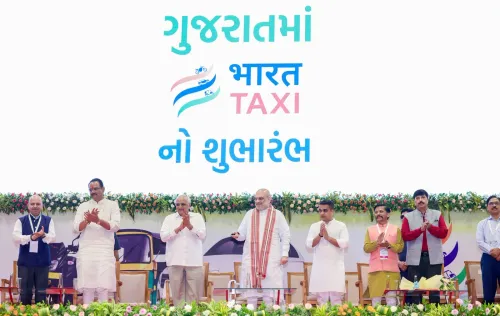
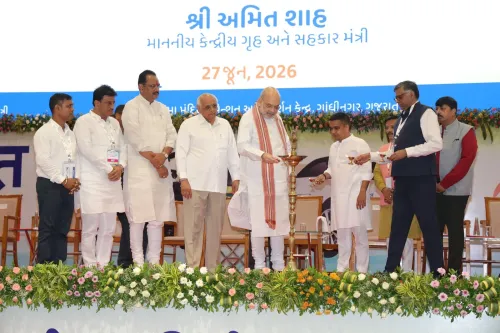
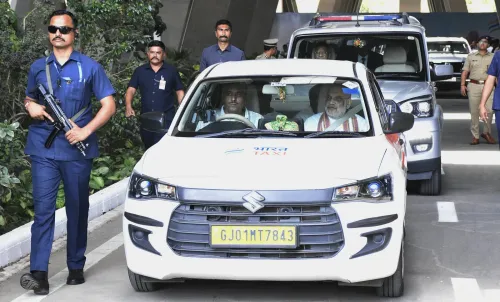
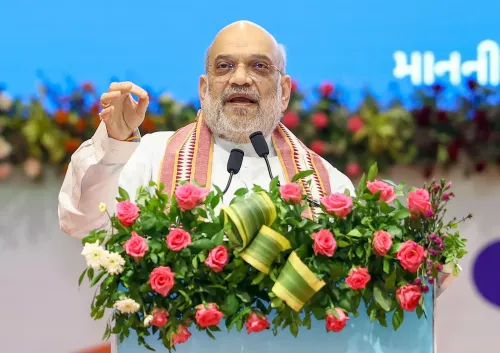
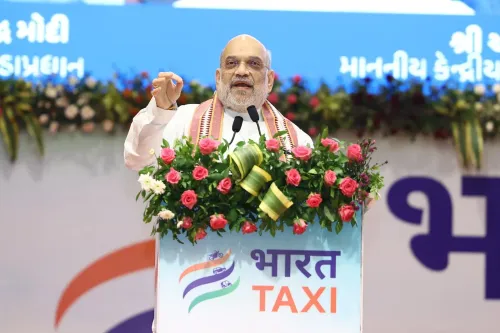
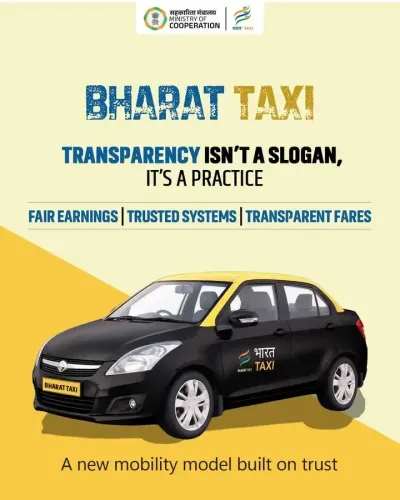
Amit Shah launches Bharat Taxi in Gujarat, calls drivers 'Sarathis' and co-owners
Synopsis
Amit Shah's launch of Bharat Taxi in Gandhinagar isn't just a new cab app — it's a direct ideological challenge to Ola and Uber. By making 7 lakh drivers co-owners and rebranding them as 'Sarathis', the cooperative model bets that dignity and ownership can outcompete algorithmic control in India's booming mobility sector.
Key Takeaways
Amit Shah launched Bharat Taxi in Gandhinagar, Gujarat on 27 June , addressing thousands of taxi operators.
The cooperative platform calls drivers 'Sarathis' — positioning them as stakeholders, not service providers.
Seven lakh drivers associated with Bharat Taxi hold shareholder status in the cooperative.
Shah framed the model as offering drivers 'dignity, security and prosperity' — in contrast to private app-based platforms.
The launch reflects the broader National Cooperation Policy framework Shah has championed as Cooperation Minister.
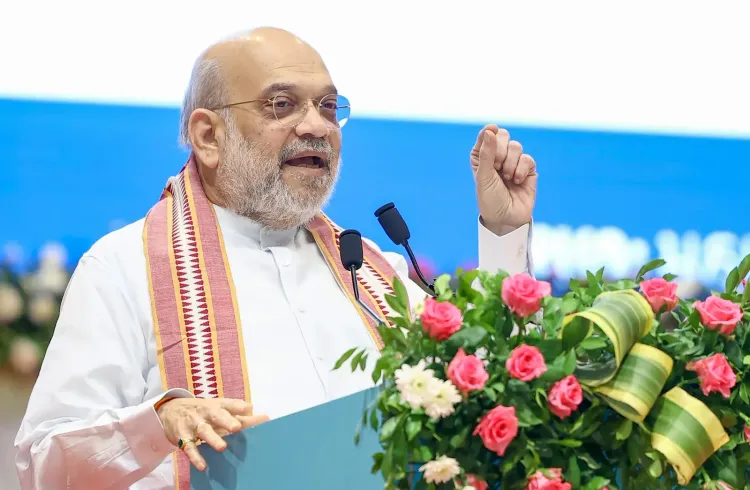
Union Home and Cooperation Minister Amit Shah on Saturday, 27 June launched Bharat Taxi in Gandhinagar, Gujarat, declaring the cooperative ride-hailing initiative a direct challenge to private app-based platforms — one built on a philosophy of driver ownership and dignity rather than algorithmic dependence. Addressing thousands of taxi operators at the launch event, Shah drew a sharp philosophical line between commercial platforms and the cooperative model.
The 'Sarathi' Distinction
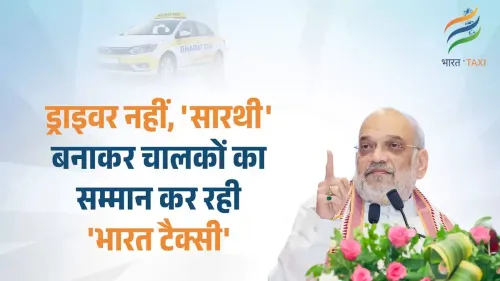
At the heart of Shah's address was a pointed contrast in terminology. Amit Shah said that while existing app-based companies refer to those behind the wheel as mere drivers, the Bharat Taxi cooperative calls them 'Sarathis' — a Sanskrit term connoting a charioteer or trusted guide, carrying connotations of honour and agency.
'As this expansion happened, different kinds of companies came in. These companies created different kinds of apps for taxi rentals. They call the taxi operators drivers; I call them Sarathis. That itself reflects the difference in our thinking,' Shah said.
He added: 'They consider the Sarathi merely a driver, whereas we regard the driver as a Sarathi. This is the difference between the two systems.'
Drivers as Shareholders, Not Service Providers
Shah emphasised that the cooperative structure makes drivers genuine stakeholders in the organisation. He stated that seven lakh Sarathis associated with Bharat Taxi hold shareholder status in the enterprise.
'Today I proudly say that the seven lakh Sarathis associated with Bharat Taxi are the owners of Bharat Taxi; they are shareholders. When you become a shareholder, the company becomes yours. The cooperative institution becomes your own,' he said.
Shah argued that ownership would deliver drivers 'dignity, security and, in the future, prosperity' — principles he described as foundational to the Bharat Taxi model. The cooperative approach, he said, aims to move transport workers from a position of dependence on private digital platforms to active participation in the enterprise itself.
India's Evolving Mobility Landscape
Shah contextualised the launch within the rapid transformation of India's mobility sector over the past three to four decades. He noted that taxis, once a niche service, had become embedded in everyday life across virtually every household.
Illustrating this evolution, he recalled an encounter at the Kumbh Mela in Prayagraj, where he observed motorcycles operating as taxis. 'I stopped the vehicle and asked him, 'Brother, how is this a taxi?' He replied that during the Kumbh, they transport people from the railway station to the Kumbh site on motorcycles because four-wheelers are not permitted inside,' Shah recounted.
He also pointed to Gujarat's auto-rickshaw ecosystem as an example of expanding taxi scope. 'In Gujarat's transport and mobility system, the rickshaw is the lifeline of mobility. Now rickshaws too have been converted into taxis. So both the use and the scope of taxis have increased,' he said.
What Bharat Taxi Signals for Gig Workers
The launch comes amid a broader national conversation about the rights and welfare of gig economy workers, particularly those on app-based platforms who lack formal employment status, benefits, or collective bargaining power. Bharat Taxi's cooperative structure — if implemented at scale — could offer a replicable alternative model for the sector. The National Cooperation Policy framework, which Shah has championed as Cooperation Minister, provides the institutional backdrop for this initiative. Whether the model can compete with entrenched private platforms on technology, pricing, and reach remains to be seen as Bharat Taxi expands beyond Gujarat.
Point of View
But the hard test lies in execution. Calling drivers 'Sarathis' and shareholders costs nothing; ensuring they receive competitive earnings, dispute resolution, and real governance rights in the cooperative is another matter entirely. Private platforms like Ola and Uber have spent billions building technology moats — a cooperative model backed by political will but limited tech investment will struggle to match them on user experience and driver earnings in the short run. The deeper question is whether Bharat Taxi becomes a genuine alternative for India's gig workforce or a symbolic launch that fades without scale. Shah's credibility as Cooperation Minister is now partially staked on the answer.
NationPress
25 Sept 2026
Frequently Asked Questions
What is Bharat Taxi and how is it different from Ola or Uber?
Bharat Taxi is a cooperative ride-hailing platform launched by Union Home and Cooperation Minister Amit Shah in Gandhinagar on 27 June. Unlike private app-based platforms such as Ola or Uber, it makes drivers co-owners and shareholders in the enterprise rather than treating them as independent contractors dependent on algorithmic systems.
What does 'Sarathi' mean in the context of Bharat Taxi?
'Sarathi' is a Sanskrit term meaning charioteer or trusted guide, used by Amit Shah to distinguish Bharat Taxi's approach from commercial platforms that refer to drivers simply as 'drivers'. Shah argued the terminology reflects a deeper philosophical difference — one of dignity and ownership versus service provision.
How many drivers are part of Bharat Taxi?
According to Amit Shah, seven lakh Sarathis are associated with Bharat Taxi and hold shareholder status in the cooperative. Shah said this ownership structure gives them a direct stake in the organisation's success.
Why was Bharat Taxi launched in Gujarat?
Gujarat served as the launch state for Bharat Taxi, with the event held in Gandhinagar. Shah noted that Gujarat's transport ecosystem — including its extensive auto-rickshaw network — makes it a fitting base, and highlighted how rickshaws have already been integrated into organised taxi services in the state.
What is the significance of the Bharat Taxi launch for gig workers in India?
The launch comes amid growing debate over the rights of gig economy workers who lack formal employment protections on private platforms. Bharat Taxi's cooperative model, if scaled, could offer an ownership-based alternative — though its ability to compete with established private platforms on technology and pricing remains an open question.