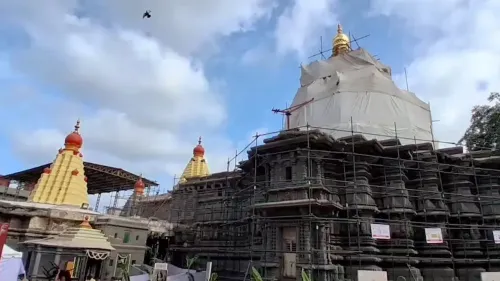
Amit Shah launches ₹1,445-crore Ambabai Temple development plan in Kolhapur
Synopsis
With ₹1,445.97 crore committed and three execution phases already mapped, the Ambabai Temple overhaul is Maharashtra's most ambitious religious heritage project in recent memory. The real test lies in land acquisition — nearly 19,500 sq metres of private land must be secured before the full vision can take shape.
Key Takeaways
Home Minister Amit Shah launched the ₹1,445.97 crore Shri Ambabai (Mahalaxmi) Temple Development Plan in Kolhapur on 20 June .
The Maharashtra Cabinet approved the funding on 6 May 2025 ; Phase 1 of ₹143.90 crore was sanctioned on 28 August 2025 .
Active works include ₹32.96 crore in structural restoration and a ₹23.05 crore electrification and CCTV project.
The plan covers restoration of 41 peripheral temples and development of amenities including a Darshan Mandap, Annachhatra, Vedic school, and amphitheatre.
Acquisition of 19,489 sq metres of private land is being fast-tracked under a high-level committee.
CM Devendra Fadnavis and Deputy CM Eknath Shinde were present at the foundation stone-laying ceremony.
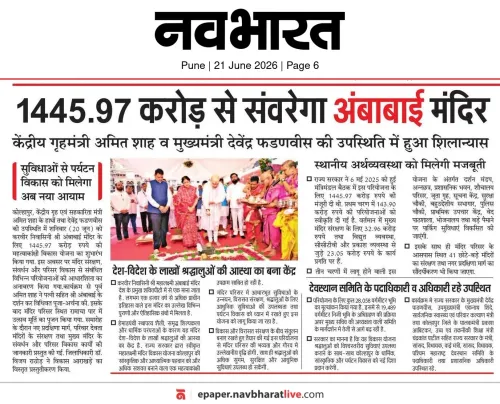
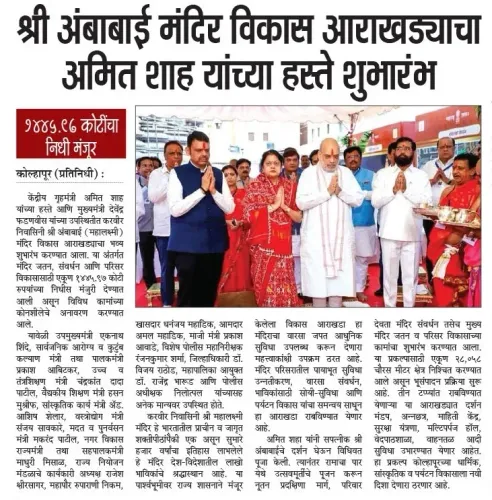
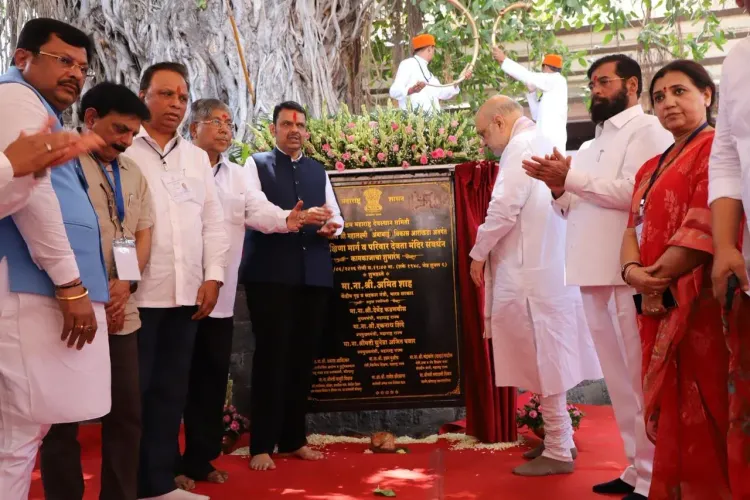
Home Minister Amit Shah on Saturday, 20 June launched the ₹1,445.97 crore Shri Ambabai (Mahalaxmi) Temple Development Plan in Kolhapur, marking the formal commencement of one of Maharashtra's largest temple conservation and tourism infrastructure projects. Maharashtra Chief Minister Devendra Fadnavis and Deputy Chief Minister Eknath Shinde were present at the foundation stone-laying ceremony.
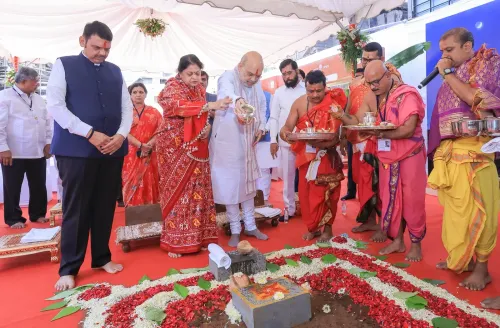
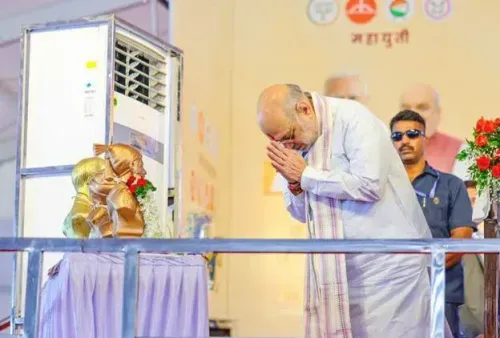
Prior to the ceremony, Shah and his wife offered prayers and performed a ritualistic puja at the historic temple. The dignitaries then performed the traditional breaking of a coconut (shrifal) and unveiled the commemorative plaque at 'Ramacha Paar' within the temple premises, officially inaugurating the development works.
What the Project Covers
The development plan is structured around four core objectives: structural conservation of the main temple, heritage preservation of peripheral shrines, creation of modern devotee amenities, and enhancement of regional tourism infrastructure. Key works include a new circumambulation (pradakshina) path, restoration of 41 smaller surrounding temples, and beautification of the city's traditional Nagar Pradakshina Marg.
Once complete, the complex will feature a large Darshan Mandap (mega-queue complex), a community kitchen (Annachhatra), a multi-purpose hall, an amphitheatre, an information centre, a Vedic school, modern utility blocks, structured marketplaces, expansive parking facilities, a police station, security checkpoints, and a first-aid medical centre.
Phased Execution and Funding
The Maharashtra Cabinet officially approved the ₹1,445.97 crore outlay on 6 May 2025. The project is being executed in three distinct phases. The Planning Department sanctioned ₹143.90 crore for the first phase on 28 August 2025, focused exclusively on structural conservation under strict archaeological guidelines.
Currently, ₹32.96 crore worth of structural restoration work is underway, alongside a ₹23.05 crore project covering advanced electrification, CCTV installation, and aesthetic lighting across the complex.
Land Acquisition Under Way
To support the infrastructure upgrade, a total of 28,058 square metres of land has been assessed. The acquisition of 19,489 square metres of private land is being fast-tracked under a high-level committee led by the Additional Chief Secretary (Urban Development). The pace of acquisition will be a key determinant of the project's overall timeline.
Significance of the Temple
The Shri Karveer Nivasini Mahalaxmi Temple is recognised as one of India's most ancient and prominent Shakti Peethas — seats of cosmic power in Hindu tradition. Built in the Hemadpanthi architectural style and boasting a history of over a thousand years, the temple draws millions of devotees annually from across India and abroad. The development plan aims to preserve this heritage while significantly elevating the visitor experience.
With land acquisition ongoing and phased disbursements already in motion, the project's execution over the coming years will determine whether Kolhapur emerges as a major religious tourism destination on par with Tirupati and Vaishno Devi.
Point of View
445.97 crore commitment is significant, but the project's credibility hinges on two pressure points: private land acquisition and phased disbursement discipline. Maharashtra has a mixed record on large-scale religious infrastructure — Shirdi and Pandharpur upgrades have seen cost and timeline overruns. The involvement of senior BJP leadership at the launch signals political priority, but that alone does not guarantee execution. With Kolhapur's Ambabai temple drawing millions annually, the upside for religious tourism is real — but so is the risk of a heritage site disrupted by a prolonged construction cycle.
NationPress
19 Sept 2026
Frequently Asked Questions
What is the Shri Ambabai Temple Development Plan in Kolhapur?
It is a ₹1,445.97 crore multi-phase project to conserve and modernise the Shri Karveer Nivasini Mahalaxmi Temple in Kolhapur. The plan covers structural restoration, heritage preservation of 41 surrounding temples, and creation of world-class devotee facilities including a Darshan Mandap, community kitchen, Vedic school, and amphitheatre.
Who launched the Ambabai Temple project and when?
Home Minister Amit Shah launched the project on 20 June at a foundation stone-laying ceremony in Kolhapur. Maharashtra Chief Minister Devendra Fadnavis and Deputy Chief Minister Eknath Shinde were also present at the event.
When did the Maharashtra government approve the ₹1,445.97 crore funding?
The Maharashtra Cabinet officially approved the funding on 6 May 2025. The Planning Department subsequently sanctioned ₹143.90 crore for the first phase on 28 August 2025, focused on structural conservation under archaeological guidelines.
What facilities will the developed Ambabai Temple complex include?
The completed complex will feature a mega-queue complex (Darshan Mandap), a community kitchen (Annachhatra), a multi-purpose hall, amphitheatre, information centre, Vedic school, modern utility blocks, structured marketplaces, parking facilities, a police station, security checkpoints, and a first-aid medical centre.
What is the significance of the Shri Karveer Nivasini Mahalaxmi Temple?
The temple is one of India's most ancient Shakti Peethas, built in the Hemadpanthi architectural style with a history spanning over a thousand years. It attracts millions of devotees from across India and the world each year, making it one of Maharashtra's foremost religious and heritage sites.