Shekhawat hails India's first hydrogen train launch on Jind-Sonipat route

Synopsis
Union Minister Gajendra Singh Shekhawat celebrated PM Modi's flagging-off of India's first hydrogen train on the Jind-Sonipat corridor in Haryana on 17 July 2026, placing India among a select group of nations to operationalise hydrogen rail technology and advancing the National Green Hydrogen Mission and Atmanirbhar Bharat goals.
Key Takeaways
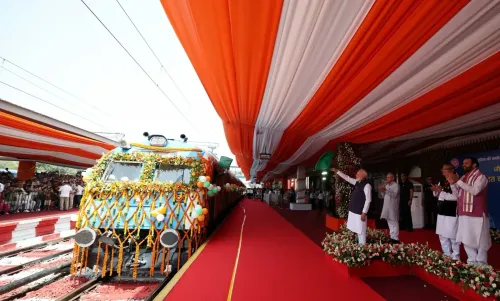
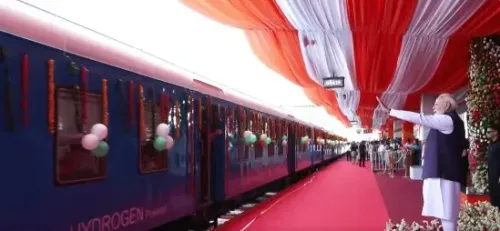
PM Narendra Modi flagged off India's first hydrogen-powered train on the Jind–Sonipat rail section in Haryana on 17 July 2026 .
India joins Germany , Japan and South Korea as one of a small group of countries to operationalise hydrogen technology in rail transport.
The launch is a key outcome of the National Green Hydrogen Mission , launched in January 2023 to promote hydrogen as a clean fuel across sectors.
Indian Railways is targeting net-zero emissions by 2030 , with hydrogen trains forming a central part of its decarbonisation strategy.
The project is framed under the Atmanirbhar Bharat framework, emphasising indigenous design and manufacture of the technology.
Hydrogen trains emit only water vapour, offering a cleaner alternative to diesel traction for passengers and communities along the route.
Union Culture and Tourism Minister Gajendra Singh Shekhawat on Friday, 17 July 2026, celebrated the flagging-off of India's first hydrogen-powered train by Prime Minister Narendra Modi on the Jind–Sonipat rail section in Haryana, calling it a new golden era for Indian Railways.
Context
Shekhawat's post, written in Hindi, declared: 'Bhaap se hydrogen tak: Bharatiya Railway ka naya swarnima yug!' ('From steam to hydrogen: Indian Railways' new golden era!'). He noted that Prime Minister Modi flagged off the country's first hydrogen train on the Jind–Sonipat corridor, placing India among a select group of nations to have operationalised hydrogen technology in rail transport. The minister described the development as a journey that is 'not just faster, but clean, modern and environment-friendly.'
The Jind–Sonipat route in Haryana was chosen as the pilot corridor for this landmark deployment, marking a significant milestone in the country's rail decarbonisation agenda.
Policy Backdrop
The hydrogen train launch is the most visible outcome so far of the National Green Hydrogen Mission, launched in January 2023, which set out to build domestic capabilities in hydrogen production and its application across transport sectors including railways. Indian Railways has outlined hydrogen fuel-cell train plans in successive vision documents since 2022 as part of its broader goal of achieving net-zero emissions by 2030.
The project also advances the Atmanirbhar Bharat framework, which encourages indigenous design and manufacture of advanced technologies. Shekhawat explicitly linked the launch to 'green transport, Atmanirbhar Bharat and a developed future,' underscoring the government's intent to position this as a homegrown achievement rather than an imported solution.
Stakeholders and Impact
Passengers on the Jind–Sonipat corridor in Haryana stand to benefit immediately from cleaner, quieter train operations, as hydrogen fuel-cell trains emit only water vapour rather than particulate matter or greenhouse gases. Renewable energy firms and domestic hydrogen producers are also key beneficiaries, as scaling up the programme will require substantial green-hydrogen production and refuelling infrastructure across the network.
India joins Germany, Japan and South Korea as one of a handful of countries to have moved hydrogen rail technology from pilot concept to operational deployment. This positioning carries diplomatic and trade significance, particularly as global demand for clean transport solutions intensifies.
What's Next
The immediate focus will be on monitoring the performance of the Jind–Sonipat hydrogen train service and building the associated green-hydrogen production and refuelling ecosystem. Policymakers and industry observers will watch whether the government expands the pilot to additional routes and how quickly it can commission the supply-chain infrastructure needed to support a wider rollout.
With Indian Railways targeting net-zero emissions by 2030, the hydrogen train programme is expected to become a central plank of that commitment, alongside the ongoing electrification drive that has already transformed large parts of the network.
Point of View
Two policy streams that have run largely in parallel since 2022. By framing the event through the dual lens of Atmanirbhar Bharat and the National Green Hydrogen Mission, the government is signalling that clean transport is now a domestic industrial project, not merely an imported technology adoption. Shekhawat's enthusiastic amplification from the Culture and Tourism portfolio — rather than from the Railways or Environment ministries — reflects the BJP's broader strategy of making green infrastructure a cross-government political narrative ahead of future electoral cycles. The real test will come in whether refuelling infrastructure and indigenous hydrogen supply chains can scale fast enough to move this beyond a single-corridor showcase.
NationPress
17 Jul 2026
Frequently Asked Questions
What is India's first hydrogen train and where does it run?
India's first hydrogen-powered train was flagged off by PM Narendra Modi on the Jind-Sonipat rail section in Haryana on 17 July 2026. It uses hydrogen fuel-cell technology and emits only water vapour, making it a zero-emission alternative to diesel trains.
Which countries have hydrogen trains in operation?
Germany, Japan and South Korea had already operationalised hydrogen rail technology before India joined this group with the Jind-Sonipat launch in July 2026, making India one of a small number of nations to deploy the technology at scale.
What is the National Green Hydrogen Mission?
The National Green Hydrogen Mission was launched by the Indian government in January 2023 to build domestic capabilities in hydrogen production and its application across sectors including transport, industry and energy storage.
What is Indian Railways' target for net-zero emissions?
Indian Railways has set a target of achieving net-zero carbon emissions by 2030, pursuing this through a combination of electrification, hydrogen fuel-cell trains and other clean-energy initiatives.
How does the hydrogen train connect to Atmanirbhar Bharat?
The hydrogen train project is framed under the Atmanirbhar Bharat self-reliance policy, which encourages indigenous design and manufacture of advanced technologies rather than importing finished solutions from abroad.