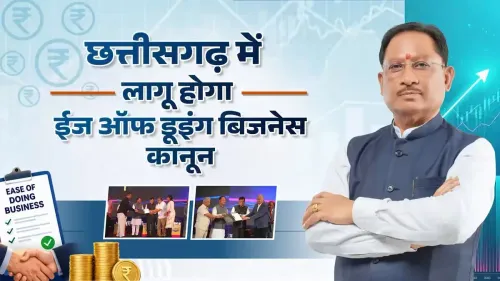
Chhattisgarh passes Ease of Doing Business Bill, 2026
Synopsis
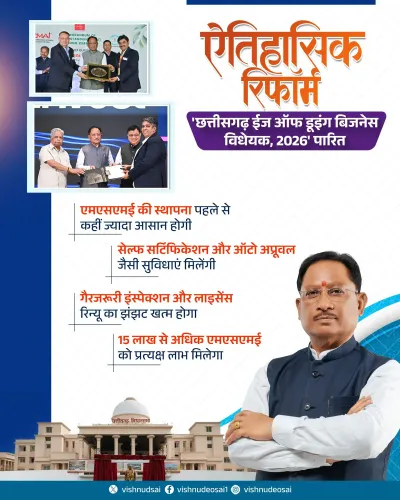
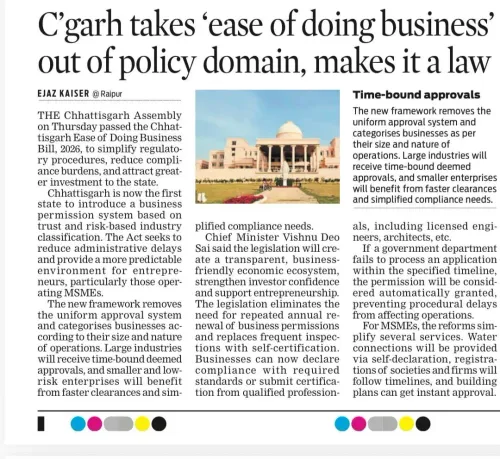
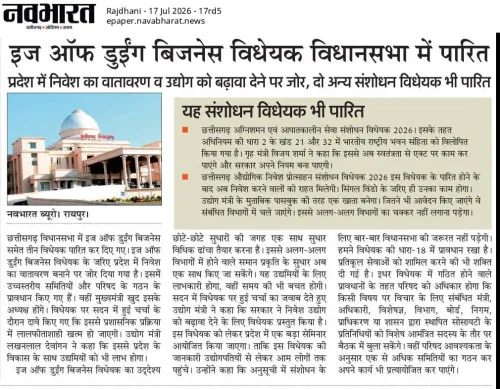
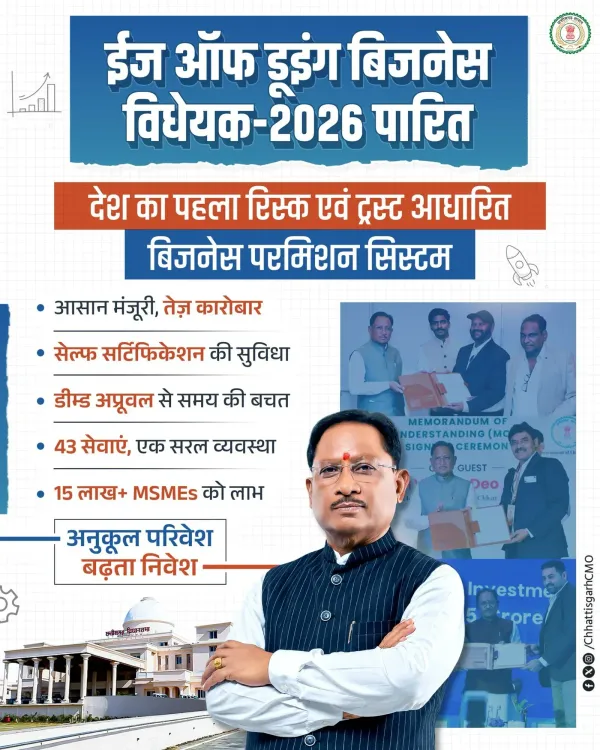
The Chhattisgarh Legislative Assembly has passed the Ease of Doing Business Bill, 2026, which the state government says will make Chhattisgarh the first in India to implement a risk- and trust-based business permission system, easing compliance for MSMEs and investors.
Key Takeaways
The Chhattisgarh Legislative Assembly passed the Ease of Doing Business Bill, 2026 on 17 July 2026 .
The state claims it will be the first in India to implement a risk- and trust-based business permission system.
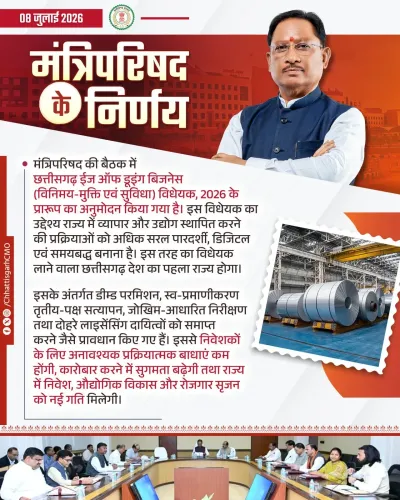
The framework replaces inspection-heavy approvals with self-certification and deemed approvals calibrated by risk category.
Primary beneficiaries include the MSME sector and prospective investors in Chhattisgarh.
The reform aligns with the national DPIIT State Business Reform Action Plan competitive ranking framework active since 2015 .
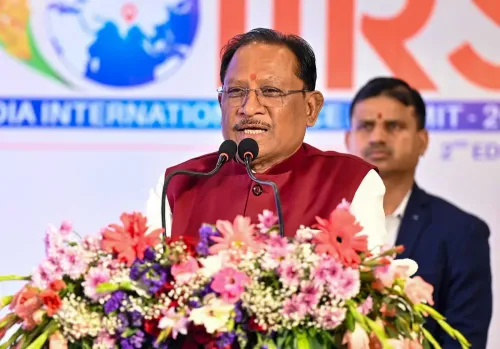
Chief Minister Vishnu Deo Sai has made investment promotion a governance priority since taking office in December 2023 .
The Chief Minister's Office of Chhattisgarh announced on Friday, 17 July 2026 that the Chhattisgarh Legislative Assembly has passed the Ease of Doing Business Bill, 2026, positioning the state as a pioneer in risk- and trust-based business permission systems in India.
Context
The CMO's post declared: 'छत्तीसगढ़ देश का पहला रिस्क एवं ट्रस्ट आधारित बिजनेस परमिशन सिस्टम लागू करने की दिशा में अग्रसर है' — 'Chhattisgarh is moving towards implementing the country's first risk- and trust-based business permission system.' The bill, once enacted, is intended to replace the conventional inspection-heavy approval regime with a framework built on self-certification, deemed approvals, and calibrated risk assessment. The announcement was accompanied by the hashtags #EaseOfDoingBusiness, #MSME, and #Investment, signalling the state government's intent to attract both domestic and foreign capital.
Policy Backdrop
India's competitive federalism on business reforms traces back to 2015, when the Department for Promotion of Industry and Internal Trade (DPIIT) launched the State Business Reform Action Plan (BRAP), which ranks states annually on ease of doing business parameters. This ranking system has prompted states across the country to introduce single-window clearances, self-certification mechanisms, and reduced compliance burdens. The national Make in India initiative, announced in 2014, further accelerated this trend by tying investment promotion to measurable regulatory improvements. Chhattisgarh's legislation fits squarely within this decade-long pattern of states competing to shed inspector-raj-era frameworks in favour of trust-based governance models.
Stakeholders and Impact
The bill's most immediate beneficiaries are expected to be micro, small and medium enterprises (MSMEs), which have historically faced disproportionate compliance costs relative to their size. By shifting the burden of proof from the entrepreneur to the regulator — classifying businesses by risk category rather than subjecting all to uniform inspection — the framework aims to cut the time and cost of obtaining operational permissions. Larger investors eyeing Chhattisgarh's mineral-rich and agriculturally diverse economy are also likely to view the legislation as a credible signal of the Vishnu Deo Sai government's commitment to predictable, rule-based governance. The state has been actively positioning itself as an investment destination since Chief Minister Vishnu Deo Sai assumed office in December 2023.
What's Next
The passage of the bill through the assembly is a legislative milestone, but the reform's real test will come during implementation. Observers will watch for the notification of specific risk categories, the operationalisation of a digital permissions platform, and measurable reductions in compliance timelines for businesses. Investment inflows and DPIIT's next BRAP ranking cycle will serve as early indicators of whether the trust-based model delivers on its promise. If the rollout is smooth, Chhattisgarh's framework could become a template that other states adapt in subsequent legislative sessions.
Point of View
2026 is part of a broader competitive federalism dynamic that has reshaped state-level regulation since DPIIT began ranking states in 2015. By staking a claim to being India's 'first' trust-based permission system, the Sai government is making a deliberate branding move to differentiate Chhattisgarh in the crowded investment-attraction market. The real political dividend, however, will only materialise if implementation matches legislative ambition — a gap that has undermined similar reform announcements in other states. For the BJP-led government in Raipur, a credible DPIIT ranking improvement before the next state election cycle would validate the reform's political logic.
NationPress
17 Jul 2026
Frequently Asked Questions
What is the Chhattisgarh Ease of Doing Business Bill 2026?
The Chhattisgarh Ease of Doing Business Bill, 2026 is a state legislation passed by the Chhattisgarh Legislative Assembly that introduces a risk- and trust-based business permission system, replacing traditional inspection-heavy approval processes with self-certification and deemed approvals calibrated to the risk level of each business.
Is Chhattisgarh the first state in India to have a trust-based business permission system?
The Chhattisgarh government has claimed that the state will be the first in India to implement a risk- and trust-based business permission system under the Ease of Doing Business Bill, 2026. Independent verification of this 'first' claim will depend on the bill's final enactment and rollout details.
How will the Ease of Doing Business Bill 2026 benefit MSMEs in Chhattisgarh?
MSMEs are expected to benefit from reduced compliance costs and faster approvals, as the new framework classifies businesses by risk category rather than subjecting all enterprises to uniform inspections, cutting the time and paperwork needed to obtain operational permissions.
Who is Vishnu Deo Sai and what is his role in this reform?
Vishnu Deo Sai is the Chief Minister of Chhattisgarh, in office since December 2023. His government has prioritised investment promotion and governance reforms, and the Ease of Doing Business Bill, 2026 is a key legislative outcome of that agenda.
What is the DPIIT State Business Reform Action Plan and how does it relate to this bill?
The DPIIT State Business Reform Action Plan, launched in 2015, ranks Indian states annually on ease of doing business parameters. Chhattisgarh's new legislation is aligned with this national framework, and an improved DPIIT ranking is one of the expected outcomes if the reform is implemented effectively.