Shekhawat Hails QDENGA as India's First Indigenous Dengue Vaccine
Synopsis
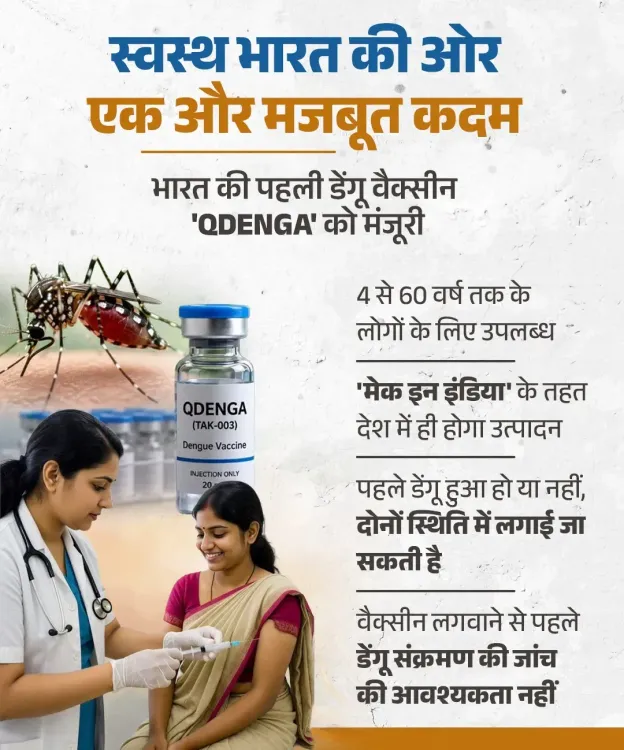
Union Culture and Tourism Minister Gajendra Singh Shekhawat on 21 July 2026 celebrated QDENGA as India's first indigenous dengue vaccine, linking its domestic manufacture under Make in India to the country's broader Atmanirbhar Bharat health-security ambitions.
Key Takeaways
Gajendra Singh Shekhawat posted on 21 July 2026 welcoming QDENGA as India's first indigenously produced dengue vaccine.
Domestic manufacturing of QDENGA is to proceed under the Make in India initiative, reducing import dependence.
The minister described the vaccine as 'a new assurance of protection and a healthy future for crores of Indians.' The development is framed within the Atmanirbhar Bharat Abhiyan , announced in May 2020 to advance self-reliance in pharmaceuticals.
Regulatory approval and possible inclusion in national immunisation or vector-borne disease programmes remain the key next steps.
Dengue is a major public health burden in India, making an indigenous vaccine a significant potential shift in disease management capacity.
Union Culture and Tourism Minister Gajendra Singh Shekhawat on Tuesday, 21 July 2026, welcomed what he described as a landmark milestone in India's public health journey — the arrival of QDENGA, billed as the country's first indigenously produced dengue vaccine, with domestic manufacturing to follow under the Make in India initiative.
Context
Posting in Hindi on X, Shekhawat called it a historic step toward a 'dengue-free India' (Dengue Mukt Bharat). He wrote that QDENGA is 'not merely a medicine, but a new assurance of protection and a healthy future for crores of Indians.' The minister framed the development as a symbol of India's 'growing capability and self-reliance (atmanirbharta) in the field of health security.'
Dengue fever, transmitted by the Aedes aegypti mosquito, is a major public health burden in India, with hundreds of thousands of reported cases each year across tropical and subtropical regions. A domestically produced vaccine would mark a significant shift in the country's capacity to manage the disease at scale.
Policy Backdrop
The post explicitly links the vaccine's domestic production to the Make in India programme, the flagship manufacturing initiative launched in September 2014 to reduce import dependence and build industrial capacity across sectors, including pharmaceuticals. The Atmanirbhar Bharat Abhiyan, announced in May 2020 in the wake of the COVID-19 pandemic, further accelerated the push for self-reliance in health and vaccine manufacturing.
India's experience producing COVID-19 vaccines at scale — including Covaxin and the locally manufactured Covishield — reinforced the strategic importance of domestic biologics capacity. Policymakers and industry have since sought to extend that model to other infectious diseases, including dengue, typhoid, and tuberculosis.
Stakeholders and Impact
The primary beneficiaries, if the vaccine enters broad deployment, would be crores of Indian citizens in dengue-endemic states such as Uttar Pradesh, Kerala, Delhi, West Bengal, and Rajasthan. The domestic pharmaceutical industry stands to gain from manufacturing contracts and technology transfer linked to indigenised production.
Regulatory pathways through India's drug authority and potential inclusion in national vector-borne disease control programmes will determine how quickly the vaccine reaches the public. Health officials and public health advocates are expected to scrutinise efficacy data, cold-chain logistics, and pricing before any large-scale rollout.
What's Next
Formal regulatory clearances from Indian authorities and a government decision on whether to include QDENGA in national immunisation schedules will be the critical next steps. Any announcement on subsidised or free distribution through public health infrastructure would significantly shape the vaccine's reach, particularly among lower-income populations most exposed to dengue risk.
The broader signal from Shekhawat's post — a minister from the Culture and Tourism portfolio amplifying a health-sector milestone — reflects the ruling dispensation's cross-ministerial effort to project Make in India and Atmanirbhar Bharat as whole-of-government achievements ahead of the political calendar.
Point of View
Not departmental ones. The choice to frame QDENGA as a civilisational achievement ('historic step,' 'self-reliance') mirrors the BJP's established communication playbook of linking policy outputs to national pride. If QDENGA's domestic production is confirmed and scales, it would represent a concrete deliverable in the post-COVID push to indigenise critical biologics — a policy arc that began with COVID vaccines and is now extending to endemic diseases. The political salience will depend heavily on whether the vaccine reaches public health programmes at subsidised cost, or remains confined to private markets.
NationPress
22 Jul 2026
Frequently Asked Questions
What is QDENGA and why is it significant for India?
QDENGA is described as India's first indigenously produced dengue vaccine, significant because it would reduce dependence on imported vaccines and strengthen domestic health security under the Make in India programme.
What did Gajendra Singh Shekhawat say about the dengue vaccine?
On 21 July 2026, Minister Shekhawat called QDENGA a 'historic step' toward a dengue-free India, saying it represents India's growing self-reliance in health security and offers 'a new assurance of protection for crores of Indians.'
How does QDENGA relate to Make in India?
Shekhawat stated that QDENGA's production will take place domestically under the Make in India initiative, aligning with the government's goal of building indigenous pharmaceutical manufacturing capacity.
Is QDENGA approved for use in India?
Regulatory clearances from Indian drug authorities and a government decision on inclusion in national immunisation programmes are the pending steps before QDENGA can be widely deployed.
What is Atmanirbhar Bharat and how does it connect to the dengue vaccine?
Atmanirbhar Bharat Abhiyan, launched in May 2020, is India's self-reliance initiative covering health and pharmaceuticals; the domestic production of QDENGA is seen as an extension of this policy drive accelerated after the COVID-19 pandemic.