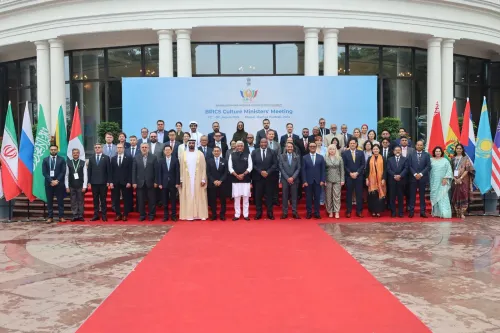
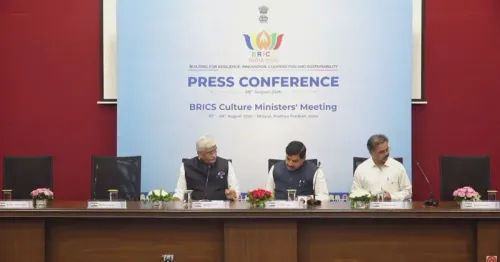
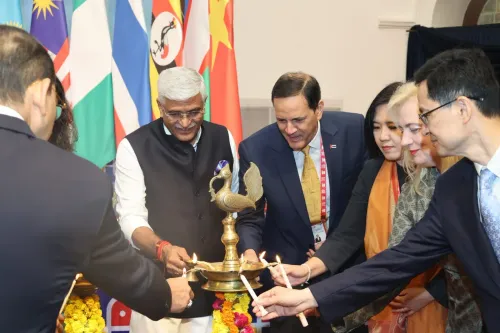
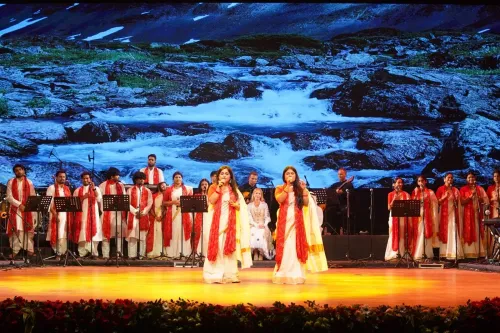
Shekhawat: India's heritage can elevate BRICS cultural ties
Synopsis
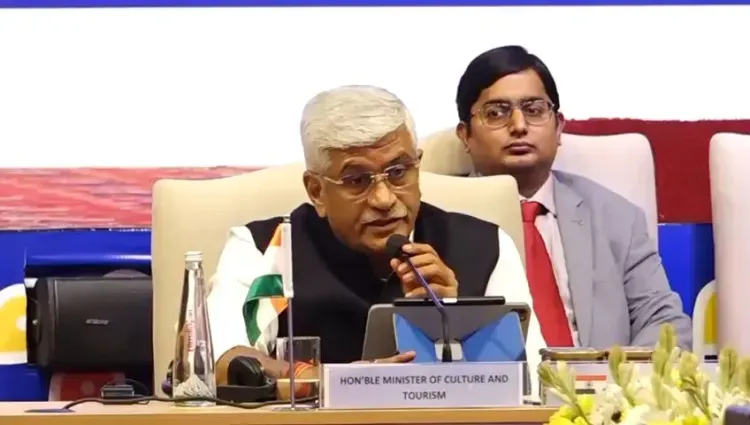
Union Culture and Tourism Minister Gajendra Singh Shekhawat has called India's civilisational heritage and cultural diversity a key driver for deeper BRICS cooperation, positioning soft power as a strategic bridge among the five-nation grouping's diverse member states.
Key Takeaways
Gajendra Singh Shekhawat , Union Minister of Culture and Tourism, posted on 8 August 2026 that India's civilisational heritage can elevate BRICS cooperation.
BRICS — comprising Brazil, Russia, India, China and South Africa — was formally launched at its first summit in 2009 .
Shekhawat positioned cultural diversity, not just economic or strategic interests, as a binding force within the multilateral grouping.
India has consistently used soft-power assets — classical arts, yoga, heritage tourism — as diplomatic instruments in multilateral forums.
Cultural cooperation outcomes at the next BRICS summit or ministerial meetings will determine whether this framing enters the formal agenda.
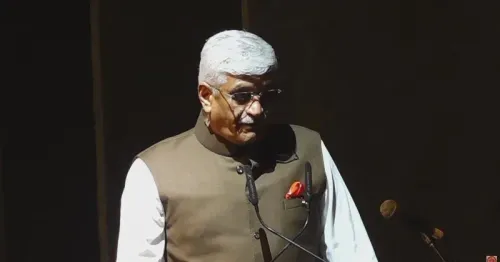
India's civilisational depth — thousands of years of art, philosophy, and living tradition — could be the very glue that binds BRICS nations into a deeper, more durable partnership. That is the case Union Culture and Tourism Minister Gajendra Singh Shekhawat made on Saturday, 8 August 2026, in a post on X that placed India's soft power squarely at the centre of multilateral diplomacy.
Shekhawat wrote, 'Bharat ki samridh sabhyagat virasat aur saanskritik vividhata BRICS deshon ke beech sahyog ko nayi unchaiyon tak le jaane mein mahatvapurna bhumika nibha sakti hai' — 'India's rich civilisational heritage and cultural diversity can play an important role in taking cooperation among BRICS nations to new heights.'
Why culture, and why BRICS now
BRICS — the grouping of Brazil, Russia, India, China and South Africa, formally convened at its first summit in 2009 — was built on the premise that emerging economies could reshape global governance together. For most of its life, the bloc's headlines have been about trade corridors, reserve currencies, and geopolitical positioning. Shekhawat's framing is a deliberate pivot: culture, not just commerce, as the connective tissue. India has long leaned on this argument in multilateral settings. From yoga diplomacy at the United Nations to the promotion of classical arts at G20 cultural tracks, successive governments have treated civilisational heritage as a strategic asset. Shekhawat, as the minister responsible for both culture and tourism, is the natural voice for that argument inside BRICS deliberations.Soft power as a BRICS bridge
The logic is straightforward. Trade and security agreements bind governments; cultural exchanges bind people. Within a grouping as geopolitically diverse as BRICS — spanning the Amazon basin, the Eurasian steppe, the Gangetic plain, the Pearl River Delta, and the Cape — shared economic interest alone has limits. People-to-people links, built through festivals, heritage tourism, performing arts, and academic exchanges, create a floor of goodwill that outlasts any single summit communiqué. India's position is particularly strong here. Its classical music, dance, cinema, cuisine, and millennia-old philosophical traditions carry genuine global recognition across all BRICS member states. That is the specific leverage Shekhawat is pointing to — not a vague appeal to heritage, but a concrete diplomatic instrument. The minister's post arrives as BRICS continues to evolve in membership and ambition. Cultural cooperation outcomes at the next BRICS summit or related ministerial meetings will be the real test of whether this framing translates into a formal agenda.Point of View
The minister is signalling that India intends to shape the bloc's people-to-people agenda, not merely participate in it. This is also a soft counter to the perception that BRICS is primarily a China-Russia-led geopolitical vehicle — India inserts its own distinctive value proposition. The real test will be whether cultural cooperation gets a dedicated track at the next BRICS ministerial, or remains aspirational rhetoric.
NationPress
22 Sept 2026
Frequently Asked Questions
What did Gajendra Singh Shekhawat say about BRICS?
Shekhawat said India's rich civilisational heritage and cultural diversity can play an important role in taking cooperation among BRICS nations to new heights, positioning culture as a strategic diplomatic bridge.
What is BRICS and which countries are members?
BRICS is an intergovernmental grouping of Brazil, Russia, India, China and South Africa, formally launched at its first summit in 2009 to promote economic, political and cultural cooperation among major emerging economies.
How does India use culture as a diplomatic tool in BRICS?
India promotes its classical arts, heritage tourism, yoga, and philosophical traditions as soft-power assets to build people-to-people links with BRICS partners, complementing trade and security discussions.
Who is Gajendra Singh Shekhawat?
Gajendra Singh Shekhawat is India's Union Minister of Culture and Tourism, a senior BJP leader and Lok Sabha MP from Jodhpur, Rajasthan.
Why is cultural cooperation important for BRICS nations?
Cultural exchanges create people-to-people goodwill that outlasts single summits; within a geographically and politically diverse grouping like BRICS, shared cultural engagement can provide cohesion beyond economic agreements.