Agri Minister Shivraj hails farmer growing chia, kasturi bhindi
Synopsis
Union Agriculture Minister Shivraj Singh Chouhan congratulated farmer Banke Bihari for cultivating kasturi bhindi and chia seeds, saying such innovation can multiply farm incomes and serve as inspiration for entire farming communities across India.
Key Takeaways
Union Agriculture Minister Shivraj Singh Chouhan publicly congratulated farmer Banke Bihari on 20 June 2026 via X.
Banke Bihari cultivated two high-value non-traditional crops: kasturi bhindi (musk okra) and chia seeds .
The Minister said crop innovation can multiply a farmer's income 'several times over,' echoing the government's long-standing income-doubling policy goal set in 2016 .
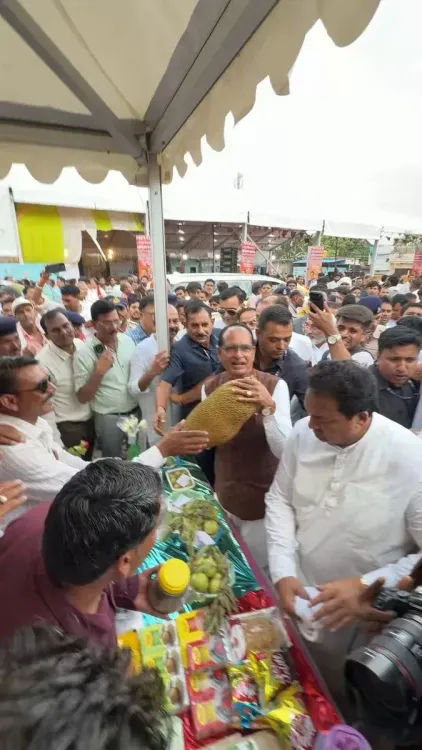
The post was accompanied by a video documenting the farmer's fields and methods.
The episode illustrates a broader ministerial communications strategy of amplifying individual farmer success stories to drive peer adoption of high-value crops.
Next steps to watch include state-level seed-distribution schemes and potential Union Budget provisions for specialty crop support.
Union Agriculture Minister Shivraj Singh Chouhan on Saturday, 20 June 2026 congratulated progressive farmer Banke Bihari for cultivating mooshan dana (kasturi bhindi, or musk okra) and chia seeds, calling him an inspiration for the entire farming community and proof that innovation in agriculture can multiply a farmer's income several times over.
Posting on X, the Minister wrote: 'Kisan Banke Bihari ji ne mooshan dana (kasturi bhindi) aur chia seed ki kheti kar yah siddh kiya hai ki kheti mein navachar apnakar kisan apni aay mein kai guna vriddhi kar sakte hain.' In English: 'Farmer Banke Bihari has proved, through the cultivation of musk okra and chia seeds, that by embracing innovation in farming, a farmer can multiply his income many times over. Such progressive farmers are an inspiration for the entire region — heartiest congratulations to you.'
Context
The post spotlights Banke Bihari, a farmer who moved beyond conventional staple crops to grow two commercially high-value alternatives: kasturi bhindi (musk okra, prized for its aromatic seeds used in perfumery and food processing) and chia seeds, a globally sought superfood with rising domestic demand. Minister Chouhan used the example to make a broader point — that crop diversification is a practical, replicable route to higher farm incomes, not merely a policy slogan.
The post is accompanied by a video, which the Minister shared to give visual evidence of the farmer's fields and methods, lending credibility to the success story.
Policy Backdrop
The celebration of individual farmer success stories sits squarely within a policy framework the central government has championed for nearly a decade. In 2016, the government set a national target of doubling farmers' income through crop diversification, value addition, and technology adoption — a goal that has since shaped agriculture ministry communications and scheme design.
Ministerial social-media posts highlighting non-traditional crops such as chia and specialty okra form part of a deliberate communications strategy to popularise high-value alternatives to staple cereals. The approach is intended to raise per-hectare returns for smallholders who might otherwise remain locked into low-margin commodity farming.
Stakeholders and Impact
For progressive farmers across India, the visibility given to Banke Bihari's experiment carries practical significance: it signals that state and central agriculture departments are receptive to non-traditional crops, which can encourage peer adoption at the village level. Kasturi bhindi commands a premium in both domestic and export markets for its aromatic seed oil, while chia seeds have seen surging urban demand driven by health-conscious consumers.
Smallholder farmers in rain-fed or semi-arid regions — where staple cereal yields are thin — stand to benefit most if such models are replicated with adequate seed supply, training, and market linkages. The Minister's public endorsement adds institutional weight to what might otherwise remain isolated experiments.
What's Next
Attention will now turn to whether state agriculture departments follow up with concrete seed-distribution programmes or farmer-training modules for chia and kasturi bhindi cultivation. Any provisions in forthcoming Union Budget allocations or agriculture ministry guidelines that formalise support for such specialty crops will be closely watched by farming communities and agri-business stakeholders alike.
If the ministry scales this communications model — identifying and amplifying individual innovators — it could accelerate grassroots adoption of diversified cropping patterns, moving the needle on farm-income growth in a way that broad policy announcements alone have struggled to achieve.
Point of View
The ministry humanises a policy goal that has often struggled to translate from announcement to field-level change. The choice of chia seeds — a globally traded superfood — alongside the domestically rooted kasturi bhindi signals an intent to connect Indian farmers to both premium domestic and export markets. Whether such social-media amplification converts into institutional support (seed access, price assurance, market linkages) will determine whether this remains optics or becomes genuine policy momentum.
NationPress
19 Sept 2026
Frequently Asked Questions
What crops did farmer Banke Bihari grow that earned praise from the Agriculture Minister?
Farmer Banke Bihari cultivated kasturi bhindi (musk okra) and chia seeds, both high-value non-traditional crops, which Union Agriculture Minister Shivraj Singh Chouhan highlighted as examples of income-boosting agricultural innovation.
What is kasturi bhindi and why is it valuable?
Kasturi bhindi, or musk okra, is a specialty variety of okra whose aromatic seeds are used in perfumery, food processing, and traditional medicine. It commands a premium over conventional vegetable crops in both domestic and export markets.
What is India's policy on doubling farmers' income?
In 2016, the Indian government announced a national target to double farmers' income by 2022 through crop diversification, value addition, and technology adoption. The goal has continued to shape agriculture ministry schemes and communications since then.
Why does the Agriculture Ministry highlight individual farmer success stories?
Amplifying individual success stories is a deliberate strategy to popularise high-value and non-traditional crops at the grassroots level, encouraging peer adoption among smallholders who may be reluctant to move away from familiar staple cereals.
What should farmers watch for if they want to grow chia seeds or kasturi bhindi?
Farmers interested in these crops should watch for state agriculture department seed-distribution programmes, training modules, and any Union Budget provisions that formalise support for specialty crop cultivation and market linkages.