Shivraj Reviews Bengal's Farm & Rural Schemes in Kolkata
Synopsis
Union Agriculture Minister Shivraj Singh Chouhan met West Bengal's Chief Minister and senior officials in Kolkata on 14 July 2026, announcing one lakh PMAY-G houses, an Rs 8,508 crore rural development budget, a Malda Clean Plant nursery, an MoU on seed production, and plans to make West Bengal eastern India's seed hub.
Key Takeaways
One lakh rural houses sanctioned for West Bengal under Pradhan Mantri Awas Yojana-Gramin .
Rs 8,508 crore allocated for implementation of the Viksit Bharat – Gram Jee programme in the state.
A modern nursery system to be established under the Malda Clean Plant initiative for export-quality horticulture produce.
MoU signed with the West Bengal government for potato seed, hybrid maize seed production, and value chain strengthening.
Chinsurah Rice Research Station to be upgraded into a Centre of Excellence with central government support.
West Bengal to implement Pradhan Mantri Fasal Bima Yojana and accelerate Farmer ID creation under the Digital Agriculture Mission .
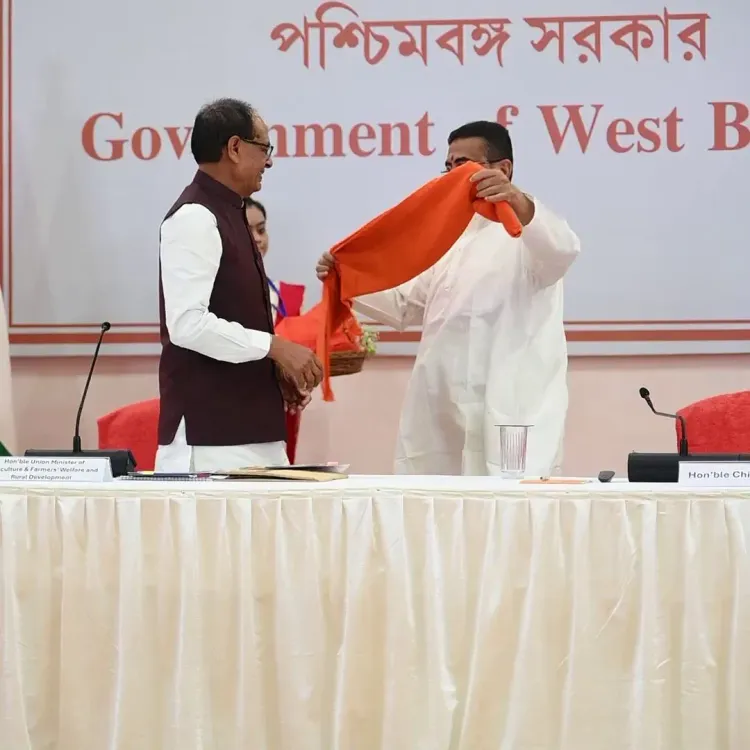
Union Agriculture Minister Shivraj Singh Chouhan held a comprehensive review meeting in Kolkata on Tuesday, 14 July 2026 with West Bengal's Chief Minister, senior ministers, and top officials to assess the implementation of the state's agriculture and rural development programmes. The meeting covered a wide range of decisions spanning rural housing, seed systems, crop insurance, and digital agriculture.
Context
Posting on X in Hindi, Chouhan described the Kolkata meeting as a 'vyapak samiksha' (comprehensive review) conducted alongside the state's Chief Minister and senior officials. He stated that under the guidance of Prime Minister Narendra Modi and the leadership of the state government, West Bengal is moving towards new heights of progress and development. The minister framed the meeting as part of a 'double-engine government' working in step with the Centre.
Among the headline decisions announced, one lakh rural houses have been sanctioned under Pradhan Mantri Awas Yojana-Gramin (PMAY-G). A budget of Rs 8,508 crore has been allocated for the effective implementation of the Viksit Bharat – Gram Jee programme in the state.
Policy Backdrop
PMAY-G, launched in 2015, provides financial assistance to eligible rural households for construction of pucca houses and has been a flagship welfare delivery instrument of the central government. The scheme's expansion to cover one lakh homes in West Bengal signals a significant push in a state that has historically seen friction between the Centre and state administration over scheme implementation.
On the agriculture side, a modern nursery system is to be set up under the Malda Clean Plant initiative to provide farmers with better planting material, higher yields, and export-quality fruit. A special project has also been approved for nutrition enhancement, value chain development, and processing facilities in West Bengal's 'Rice Bowl' regions — the state's high-productivity paddy belts. Chinsurah Rice Research Station will be developed into a Centre of Excellence with full support from the Government of India.
Separately, a Memorandum of Understanding (MoU) has been signed with the state government to strengthen potato seed production, hybrid maize seed production, and the associated value chains. Chouhan also pledged to make West Bengal the 'Seed Hub of Eastern India' through a scientific agriculture roadmap.
Stakeholders and Impact
Small and marginal farmers — who form the backbone of West Bengal's agricultural economy — stand to benefit most directly from the seed system upgrades, the Malda Clean Plant nursery, and the rice-belt processing projects. Rural households awaiting housing assistance under PMAY-G are the other primary beneficiary group.
The minister congratulated the Chief Minister and his team for agreeing to implement Pradhan Mantri Fasal Bima Yojana (PMFBY) — the Centre's flagship crop insurance programme launched in 2016 — as well as for committing to accelerate Farmer ID creation under the Digital Agriculture Mission. Implementation of the Pradhan Mantri Dhan-Dhanya Yojana and the National Natural Farming Mission were also highlighted as priorities agreed upon at the meeting.
PMFBY's adoption in West Bengal is notable because the state had previously opted out of the scheme, leaving its farmers without central crop insurance cover. A formal re-entry would extend protection against natural calamity losses to millions of cultivators across the state.
What's Next
Chouhan said the Government of India will leave no stone unturned in West Bengal's development, adding: 'Kadam se kadam aur kandhe se kandha milakar double engine ki sarkar chalegi' ('The double-engine government will march in step, shoulder to shoulder'). He expressed the ambition of making West Bengal the number-one state in the country in terms of progress and development.
Key milestones to watch include the pace of Farmer ID enrolment under the Digital Agriculture Mission, the operationalisation of the Malda Clean Plant nursery, progress on the Chinsurah Centre of Excellence, and the formal rollout of PMFBY in the state. These commitments are likely to be tracked through subsequent centre-state review meetings and reflected in upcoming budget and programme implementation reports.
Point of View
Using welfare scheme delivery as a vehicle for visibility. The emphasis on PMFBY adoption and Farmer ID rollout signals that the Centre is prioritising data infrastructure and insurance coverage as measurable governance benchmarks in the state. The framing of a 'double-engine government' is a well-established BJP political narrative that ties central scheme delivery to the alignment of state and national administrations. Progress on commitments such as the Chinsurah Centre of Excellence and the Malda Clean Plant nursery will be the real test of whether this high-level review translates into on-ground outcomes for Bengal's farmers.
NationPress
14 Jul 2026
Frequently Asked Questions
What was decided at Shivraj Singh Chouhan's Kolkata meeting on West Bengal agriculture?
Key decisions included the sanction of one lakh houses under PMAY-G, an Rs 8,508 crore allocation for the Viksit Bharat – Gram Jee programme, establishment of a Malda Clean Plant nursery, an MoU on potato and maize seed production, and development of Chinsurah Rice Research Station as a Centre of Excellence.
What is the Malda Clean Plant initiative in West Bengal?
The Malda Clean Plant initiative involves setting up a modern nursery system in Malda district to provide farmers with disease-free, high-quality planting material that can support better yields and export-quality fruit production.
Will West Bengal implement Pradhan Mantri Fasal Bima Yojana?
Yes, implementing PMFBY in West Bengal was highlighted as a key commitment at the 14 July 2026 Kolkata review meeting, which would extend central crop insurance coverage to farmers in the state.
What is the significance of making West Bengal a seed hub of eastern India?
A seed hub designation would mean West Bengal anchors seed production — including potato and hybrid maize — for the entire eastern region, boosting farm incomes, reducing seed import dependence, and creating agri-processing value chains.
What is the Digital Agriculture Mission Farmer ID and why does it matter for Bengal farmers?
Farmer ID is a unique digital identity for cultivators being created under the Digital Agriculture Mission; it enables targeted delivery of subsidies, insurance, and credit, and the Centre has urged West Bengal to accelerate its enrolment.