Shivraj Singh Chouhan: Cabinet Clears NIPU-2026 Urea Policy
Synopsis
The Union Cabinet on 15 July 2026 cleared NIPU-2026, a new urea investment policy offering 12-16% return on equity to spur gas-based domestic plants, cut import reliance, and save over ₹250 crore per plant versus the 2012 policy framework.
Key Takeaways
The Union Cabinet approved the National Urea Investment Policy-2026 (NIPU-2026) on 15 July 2026 .
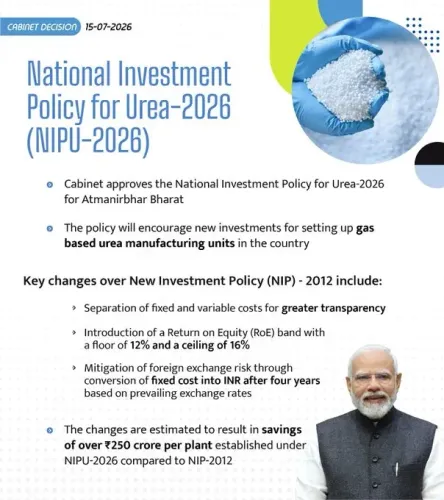
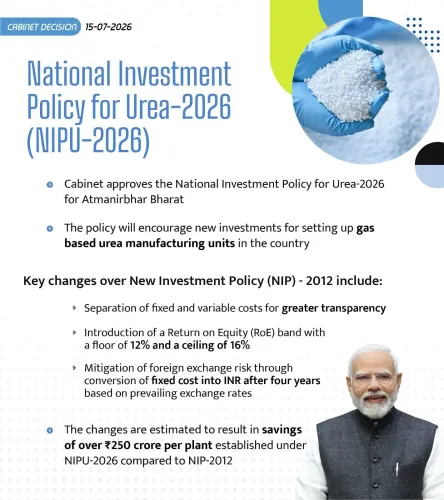
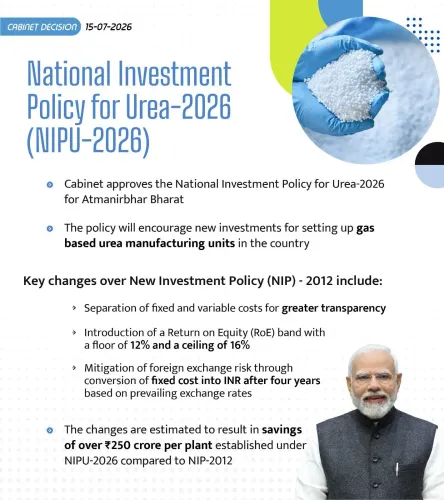
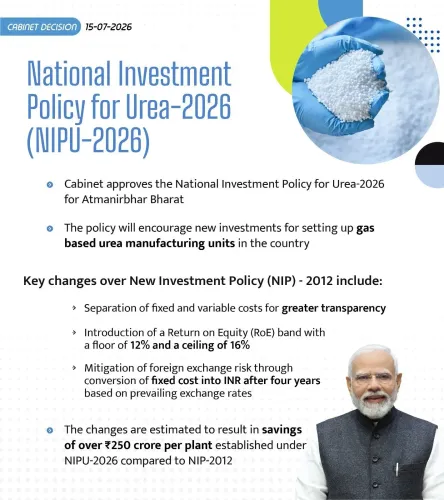
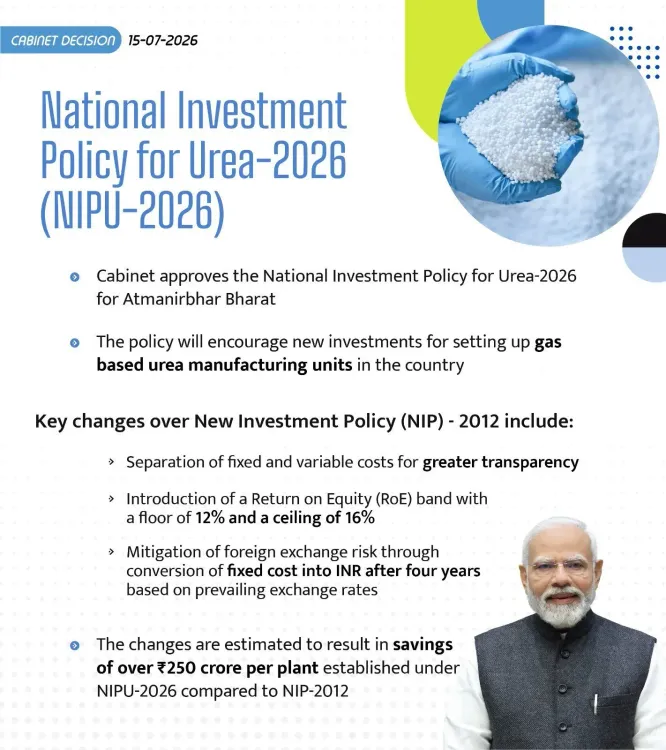
The policy offers investors a viable Return on Equity of 12% to 16% for new gas-based urea plants.
Each new plant under NIPU-2026 is estimated to deliver savings of more than ₹250 crore compared to the 2012 policy.
Provisions include greater cost transparency and mechanisms to reduce foreign exchange exchange risk for investors.
The policy aims to reduce India's urea import dependence, which has historically stood at 20–30% of total demand .
The decision is framed as advancing the Atmanirbhar Bharat agenda in the critical fertiliser sector.
Union Agriculture Minister Shivraj Singh Chouhan announced on Wednesday, 15 July 2026 that the Union Cabinet, under the leadership of Prime Minister Narendra Modi, has approved the National Urea Investment Policy-2026 (NIPU-2026), a framework designed to attract fresh capital into domestic gas-based urea manufacturing and reduce India's dependence on imported fertiliser.
Posting on X, Chouhan stated: 'Aatmanirbhar Bharat ke sankalp ko sakar karne ki disha mein' ('In the direction of realising the resolve of a self-reliant India'), the Cabinet has cleared a policy that will incentivise new gas-based urea plants, improve cost transparency, and offer a viable Return on Equity (RoE) of 12% to 16%. The policy also includes provisions to reduce foreign exchange risk for investors.
Context
India has historically relied on imports to meet 20–30% of its urea demand, leaving the sector exposed to global price volatility and supply disruptions from key exporters such as China and countries in the Middle East. Every spike in international urea prices translates into higher subsidy burdens for the government and potential input-cost stress for farmers.
The last major policy intervention in this space was the New Investment Policy (NIP) of 2012, which sought to revive domestic urea capacity through natural-gas-linked pricing. NIPU-2026 is positioned as a successor that addresses the limitations of that framework, with the government estimating a potential saving of more than ₹250 crore per new plant compared to the 2012 policy.
Policy Backdrop
Prime Minister Modi launched the Atmanirbhar Bharat initiative in May 2020 with fertilisers among the critical sectors earmarked for domestic capacity expansion. Since then, successive budget cycles have allocated higher outflows toward fertiliser subsidies while simultaneously pushing for supply-side investment to contain long-term subsidy growth.
NIPU-2026 builds on this arc by making new urea projects commercially attractive through a guaranteed RoE band, clearer cost-pass-through mechanisms, and hedging provisions against currency risk — factors that investors and manufacturers had flagged as deterrents under the older policy regime.
Stakeholders and Impact
Fertiliser manufacturers stand to benefit from a more predictable return structure, which could unlock stalled or greenfield gas-based plant investments. For Indian farmers, expanded domestic urea production is expected to improve supply security and reduce the risk of shortages that periodically disrupt the kharif and rabi sowing seasons.
The government also expects the policy to ease the foreign exchange outgo associated with urea imports, strengthening the current account position. With each new plant potentially saving over ₹250 crore relative to the 2012-era cost structure, the fiscal argument for scaling up domestic capacity is reinforced.
What's Next
The immediate steps will involve the identification and selection of project sites, allocation of natural gas linkages, and the award of new plant licences under the NIPU-2026 framework. Parliament is expected to receive updates on production targets and budgetary allocations in the coming sessions.
If the policy succeeds in attracting multiple new gas-based urea units, India could substantially close the gap between domestic production and total demand — a milestone that would mark a structural shift in the country's fertiliser security and reduce the subsidy bill over the medium term.
Point of View
The government is directly addressing the commercial deterrents that kept private capital away from the 2012 policy. The ₹250-crore-per-plant savings claim, if borne out in actual plant economics, could make this the most investor-friendly urea framework India has produced. The real test, however, will be in execution — how quickly gas linkages are awarded and whether new capacity is commissioned before the next global urea price shock.
NationPress
15 Jul 2026
Frequently Asked Questions
How does NIPU-2026 differ from the 2012 urea policy?
NIPU-2026 offers greater cost transparency, a structured return-on-equity band of 12-16%, and foreign exchange risk mitigation, with the government estimating potential savings of over ₹250 crore per plant compared to the 2012 New Investment Policy framework.
Why does India need a new urea investment policy?
India has historically imported 20-30% of its urea requirement, leaving it exposed to global price shocks and supply disruptions. A new policy is needed to attract private investment into domestic gas-based plants and reduce this import dependence.
Who announced the Cabinet approval of NIPU-2026?
Union Agriculture Minister Shivraj Singh Chouhan announced the Cabinet approval of NIPU-2026 on 15 July 2026 via a post on X, crediting Prime Minister Narendra Modi's leadership for the decision.
How will NIPU-2026 benefit Indian farmers?
By expanding domestic urea production capacity, NIPU-2026 aims to improve fertiliser supply security for Indian farmers, reducing the risk of shortages during critical kharif and rabi sowing seasons and limiting exposure to global price volatility.