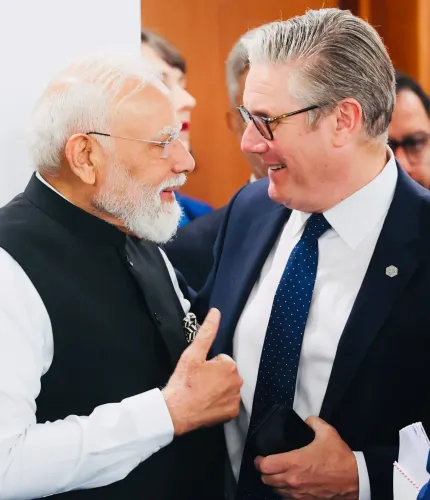
Shivraj Singh Chouhan Hails India-UK Trade & Security Pact

Synopsis
Union Agriculture Minister Shivraj Singh Chouhan on 15 July 2026 hailed the launch of the India-UK Comprehensive Economic and Trade Agreement and a Social Security Agreement, saying the pacts will benefit farmers, exporters, MSMEs, startups and skilled professionals and advance the Viksit Bharat vision.
Key Takeaways
The India-UK Comprehensive Economic and Trade Agreement (CETA) and a Social Security Agreement were announced as beginning on 15 July 2026 .
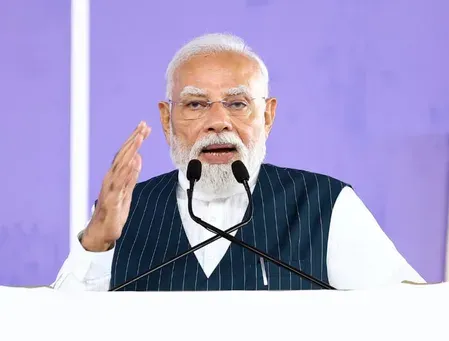
Union Agriculture Minister Shivraj Singh Chouhan credited the milestone to PM Narendra Modi's leadership.
The agreements are expected to benefit farmers, exporters, MSMEs, startups and skilled professionals .
A dedicated Social Security Agreement addresses double taxation and portability of benefits for Indian professionals in the UK .
The deal advances India's Viksit Bharat goal of becoming a developed economy by 2047 .
The UK joins the UAE and Australia as major economies with comprehensive bilateral trade frameworks with India.
Union Agriculture Minister Shivraj Singh Chouhan on Wednesday, 15 July 2026, welcomed the launch of the India-UK Comprehensive Economic and Trade Agreement (CETA) and a Social Security Agreement, calling it the opening of 'a new chapter' in the India-UK Comprehensive Strategic Partnership. The minister credited the milestone to the 'visionary leadership' of Prime Minister Narendra Modi, saying the twin agreements would unlock 'immense opportunities' for Indian farmers, exporters, MSMEs, startups and skilled professionals.
Context
Chouhan's post, shared on 15 July 2026, coincides with what the government has described as the formal commencement of the landmark bilateral agreements between India and the United Kingdom. The minister stated that the pacts would 'deepen bilateral ties and accelerate India's journey towards inclusive growth and a #ViksitBharat' — the government's vision to transform India into a developed economy by 2047. The #IndiaUKFTA hashtag used in the post signals the government's intent to frame the agreement as a defining trade achievement.
The India-UK trade relationship had been on a diplomatic fast track since negotiations were formally relaunched in January 2022 following a virtual summit between PM Modi and UK leadership. The conclusion of these agreements places the UK alongside the UAE and Australia as major economies with which India has secured comprehensive bilateral trade frameworks in recent years.
Policy Backdrop
India's pursuit of bilateral free trade agreements accelerated sharply after 2021, driven by a strategic goal of diversifying export markets, attracting foreign investment and integrating Indian industry into global supply chains. The Comprehensive Economic Partnership Agreement with the UAE, signed in February 2022, and the Economic Cooperation and Trade Agreement with Australia, concluded in April 2022, established the template: tariff concessions on goods, expanded market access for services and investment provisions.
The India-UK CETA follows a similar architecture but adds a dedicated Social Security Agreement — a provision that addresses double taxation of contributions and the portability of social security benefits for Indian professionals working in the UK. Such clauses have been a longstanding demand of the Indian diaspora and the IT and services sector, which sends a significant number of skilled workers to British employers annually.
The agreement also fits within the broader Viksit Bharat framework — the government's roadmap to lift India to developed-nation status by 2047, the centenary of independence — which places trade expansion and technology partnerships at its core.
Stakeholders and Impact
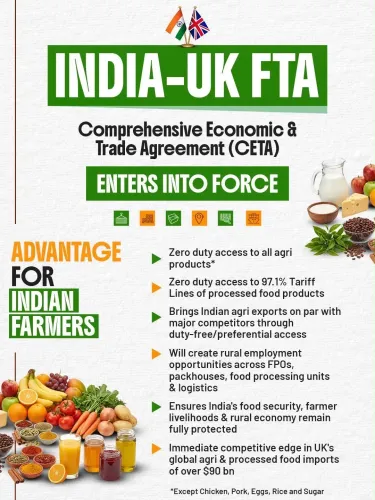
Chouhan specifically named farmers, exporters, MSMEs, startups and skilled professionals as the primary beneficiaries, reflecting the agreement's multi-sectoral scope. For the agriculture sector — Chouhan's own ministerial portfolio — market access to the UK for Indian agri-produce and food-processing goods is expected to be a key deliverable, though the precise tariff schedules and rules of origin will determine the actual gains once published.
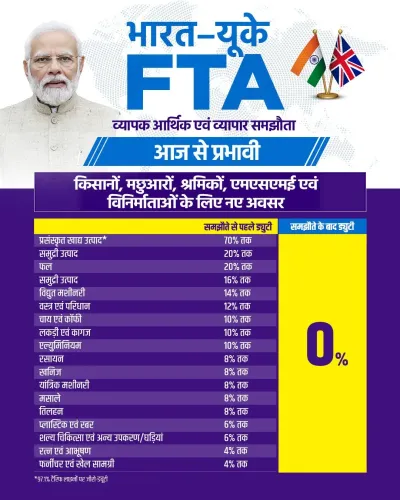
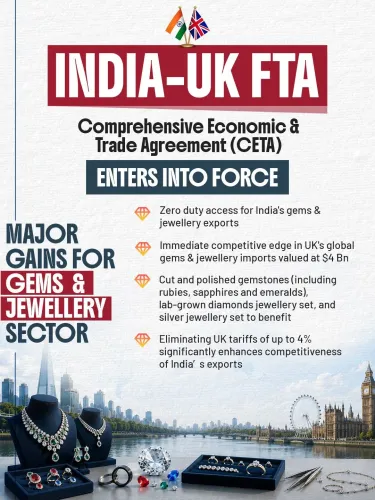
MSMEs and startups stand to benefit from reduced tariff barriers on manufactured goods and from provisions strengthening technology and innovation partnerships between the two countries. Skilled professionals — particularly those in IT, healthcare and financial services — are expected to see more streamlined mobility arrangements and, crucially, relief from paying into both the Indian and British social security systems simultaneously under the new Social Security Agreement.
What's Next
The agreements will now move through parliamentary and administrative processes in both countries, including the publication of detailed tariff schedules, rules of origin and sector-specific annexures. The Commerce Ministry is expected to release impact assessments covering key export categories. Any joint review mechanism established under the CETA will also be closely watched by industry bodies and trade associations on both sides.
For India, the successful conclusion of the India-UK CETA adds significant momentum to its trade diplomacy and signals that the government's strategy of pursuing bilateral deals — rather than waiting for multilateral frameworks — continues to yield results. The depth of implementation, particularly on agriculture market access and professional mobility, will be the true measure of the agreement's transformative potential.
Point of View
Which has increasingly favoured deal-by-deal agreements over slower multilateral routes. For Shivraj Singh Chouhan, championing a trade pact that explicitly names farmers as beneficiaries reinforces his political identity as an agrarian advocate even within a trade-policy context. The inclusion of a Social Security Agreement is a pointed signal to India's large skilled-professional diaspora in the UK — a constituency that has lobbied for such protections for years. Together, the agreements represent a consolidation of the Modi government's economic-nationalist trade strategy: expanding market access while insisting on provisions that protect Indian workers and sensitive domestic sectors.
NationPress
15 Jul 2026
Frequently Asked Questions
What is the India-UK Comprehensive Economic and Trade Agreement?
The India-UK Comprehensive Economic and Trade Agreement (CETA) is a bilateral trade pact between India and the United Kingdom that covers tariff concessions on goods, expanded market access for services, investment provisions, and technology and innovation partnerships. It was announced as entering into force on 15 July 2026.
How does the India-UK Social Security Agreement benefit Indian professionals?
The Social Security Agreement between India and the UK is designed to prevent Indian professionals working in the UK from paying into both countries' social security systems simultaneously, and to allow portability of benefits — a key demand of the Indian IT and services sector diaspora.
What did Shivraj Singh Chouhan say about the India-UK trade deal?
Union Agriculture Minister Shivraj Singh Chouhan said the agreements open 'a new chapter' in the India-UK Comprehensive Strategic Partnership and will unlock 'immense opportunities' for farmers, exporters, MSMEs, startups and skilled professionals under PM Modi's leadership.
How does the India-UK FTA fit into India's broader trade strategy?
The India-UK CETA is part of India's accelerated bilateral trade diplomacy since 2021, which has also produced agreements with the UAE and Australia. The strategy prioritises diversifying export markets and integrating Indian industry into global supply chains in support of the Viksit Bharat 2047 vision.
What sectors in India will benefit from the India-UK trade agreement?
Agriculture, export-oriented manufacturing, MSMEs, the startup ecosystem and skilled professionals — particularly in IT, healthcare and financial services — are the primary sectors expected to benefit from the India-UK CETA and the accompanying Social Security Agreement.