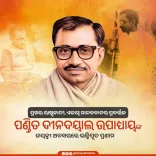
Shivraj Singh Chouhan Pays Tribute to Deendayal Upadhyay on Birth Anniversary

Synopsis
Union Agriculture Minister Shivraj Singh Chouhan marked Pandit Deendayal Upadhyay's birth anniversary on 25 September 2026, honouring the founding philosopher of the BJP and connecting his Antyodaya and Integral Humanism principles to the government's Viksit Bharat and Atmanirbhar Bharat agenda.
Key Takeaways
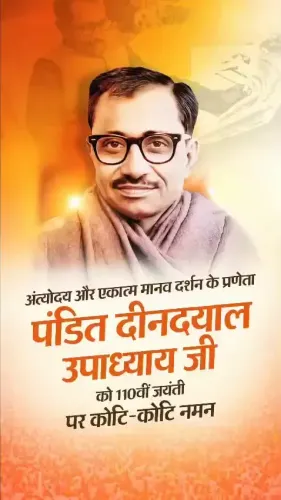
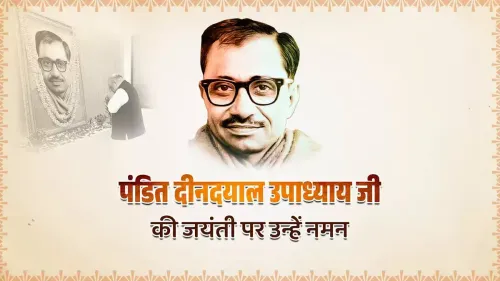
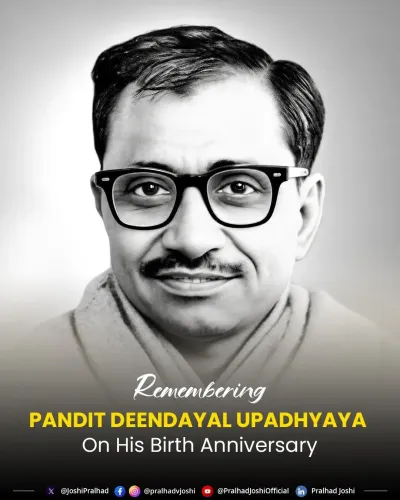
Shivraj Singh Chouhan offered tribute to Pandit Deendayal Upadhyay on his birth anniversary, 25 September 2026 .
Upadhyay was a founding member of Bharatiya Jana Sangh (1951), precursor to the BJP, and architect of Antyodaya and Integral Humanism .
Chouhan quoted Upadhyay directly on serving the poor as a form of divine service.
The minister linked Upadhyay's philosophy to the government's Viksit Bharat and Atmanirbhar Bharat goals.
Antyodaya Anna Yojana (launched 2000) is a direct policy expression of Upadhyay's principle of uplifting the poorest households.
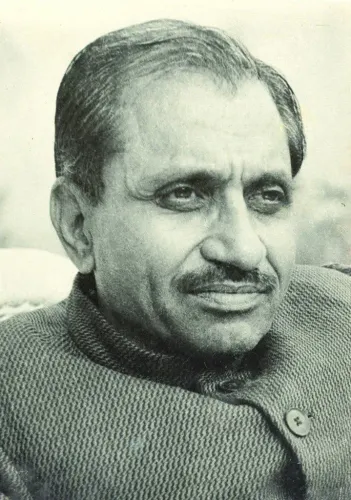
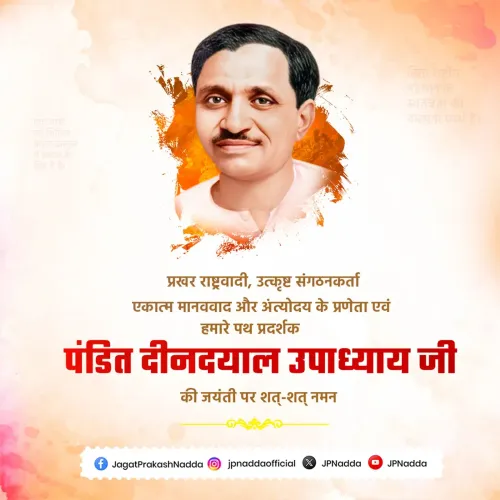
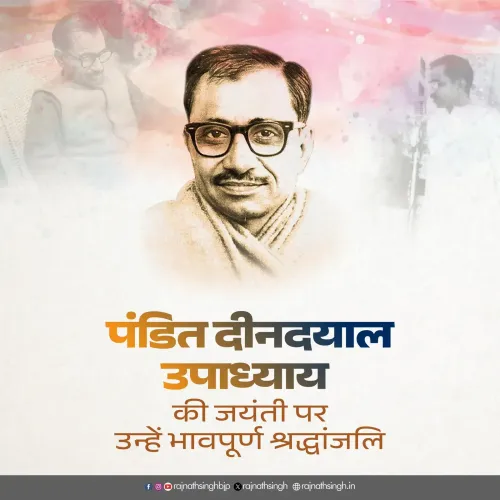
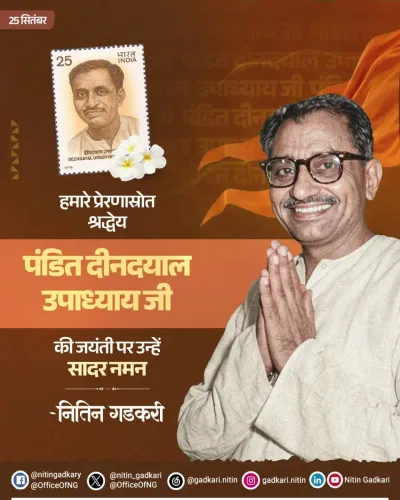
On the birth anniversary of Pandit Deendayal Upadhyay, Union Agriculture Minister Shivraj Singh Chouhan on Friday, 25 September 2026, offered a deeply felt tribute to the philosopher-politician whose ideas continue to shape the ideological spine of Indian conservatism — and, the minister made clear, the government's own welfare agenda.
Chouhan's tribute, posted in Hindi, opened with reverence: 'कोटि-कोटि नमन' — 'a billion salutations' — to the man he called a 'beacon of inspiration.' He quoted Upadhyay directly: 'If you serve the poor and the wretched, and wipe their tears, you will see God himself in their eyes.' That quote, the minister wrote, is the guiding light behind the government's work for the poor.
The man behind Antyodaya and Integral Humanism
Pandit Deendayal Upadhyay was a founding member of the Bharatiya Jana Sangh, established in 1951 as the precursor to the Bharatiya Janata Party. His two landmark intellectual contributions — Antyodaya (upliftment of the last person in society) and Ekatma Manavaad (Integral Humanism) — were not abstract ideals. Integral Humanism was articulated in a famous series of lectures in 1965, proposing a third path for India: neither Soviet collectivism nor Western capitalism, but a civilisational model rooted in Indian thought and the welfare of the marginalised.
The BJP formally adopted Integral Humanism as its official doctrine, making Upadhyay's philosophy the party's intellectual cornerstone. His birth anniversary, 25 September, is observed each year by BJP leaders across the country as a moment to reconnect with that founding vision.
Antyodaya as the thread linking past to present policy
Chouhan's post was more than ceremonial. He explicitly drew a line from Upadhyay's Antyodaya principle to the government's stated goals of Viksit Bharat (Developed India) and Atmanirbhar Bharat (Self-Reliant India), calling Integral Humanism 'the foundation' of those ambitions. That connection has real policy weight: the Antyodaya Anna Yojana, launched in 2000, extended subsidised foodgrains specifically to the poorest households — the ideological lineage is direct and acknowledged.
For a Union Minister who oversees Agriculture and Rural Development, invoking Antyodaya is a signal about whose welfare the ministry considers its primary mandate — the rural poor, the small farmer, the last household at the end of the last lane.
On his birth anniversary, Upadhyay's ideas feel less like history and more like a live policy brief. That may be exactly the point Chouhan intended.
Point of View
The Agriculture Minister frames large-scale rural welfare not as populism but as doctrinal commitment — a distinction that matters in political messaging. The invocation carries particular weight from a minister overseeing agriculture and rural development, signalling that Upadhyay's 'last person' principle is the organising logic of his portfolio. Ahead of any budget cycle, such signals often foreshadow rhetorical emphasis — if not actual allocation — toward the rural poor.
NationPress
25 Sept 2026
Frequently Asked Questions
Who was Pandit Deendayal Upadhyay?
Pandit Deendayal Upadhyay was a founding member of the Bharatiya Jana Sangh (1951) and the thinker behind Antyodaya (upliftment of the poorest) and Integral Humanism, a philosophy the BJP adopted as its official doctrine. His birth anniversary falls on 25 September.
What is Antyodaya and why does it matter in Indian politics?
Antyodaya means 'upliftment of the last person in society.' Upadhyay proposed it as the moral core of governance. It directly inspired schemes like Antyodaya Anna Yojana (2000), which provides subsidised food to the poorest households, and remains a touchstone for BJP welfare messaging.
What is Integral Humanism (Ekatma Manavaad)?
Integral Humanism is Deendayal Upadhyay's political philosophy, articulated in lectures in 1965. It proposed a distinctly Indian development model rooted in civilisational values, rejecting both Western capitalism and Soviet collectivism. The BJP formally adopted it as its guiding ideology.
Why did Shivraj Singh Chouhan pay tribute to Deendayal Upadhyay?
Chouhan posted a tribute on 25 September 2026, Upadhyay's birth anniversary, quoting his philosophy on serving the poor and connecting his ideas to the government's Viksit Bharat and Atmanirbhar Bharat goals. BJP leaders observe this date annually as an ideological milestone.
What is the connection between Deendayal Upadhyay and the BJP?
Upadhyay was a founding member of the Bharatiya Jana Sangh, which dissolved in 1977 and re-emerged as the Bharatiya Janata Party in 1980. The BJP officially adopted his philosophy of Integral Humanism, making him the party's foremost ideological ancestor.