Shivraj Singh Chouhan Witnesses Modern Paddy Transplanter Demo
Synopsis
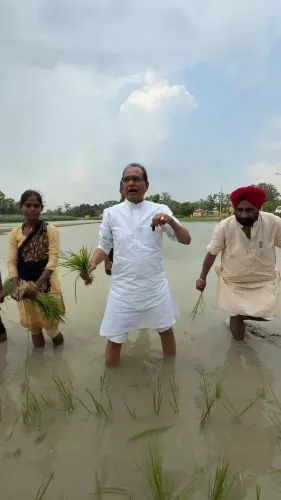
Union Agriculture Minister Shivraj Singh Chouhan on June 14, 2026, witnessed a live field demonstration of a modern paddy transplanting machine, noting its ability to plant uniform rows of young seedlings, improve air circulation, reduce disease, and raise yield potential for India's paddy farmers.
Key Takeaways
Union Agriculture Minister Shivraj Singh Chouhan witnessed a modern paddy transplanter demonstration on June 14, 2026 .
The machine plants seedlings at uniform spacing and correct depth , improving crop development and reducing disease risk through better air circulation.
Transplanting 10-to-15-day-old seedlings mechanically increases tiller count, raising the probability of higher paddy production.
The demonstration is consistent with the Sub-Mission on Agricultural Mechanization (SMAM) , a central scheme running since 2014-15 that subsidises such equipment.
Small and marginal farmers can access rice transplanters through Custom Hiring Centres under SMAM without bearing the full purchase cost.
The event signals likely policy focus on expanding mechanisation targets ahead of the 2026 kharif transplanting season .
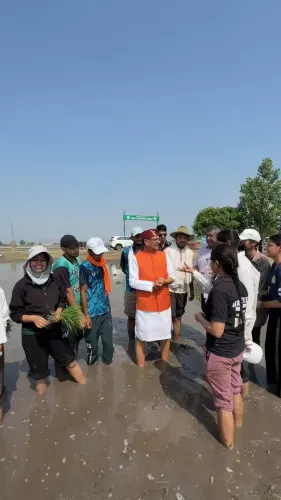
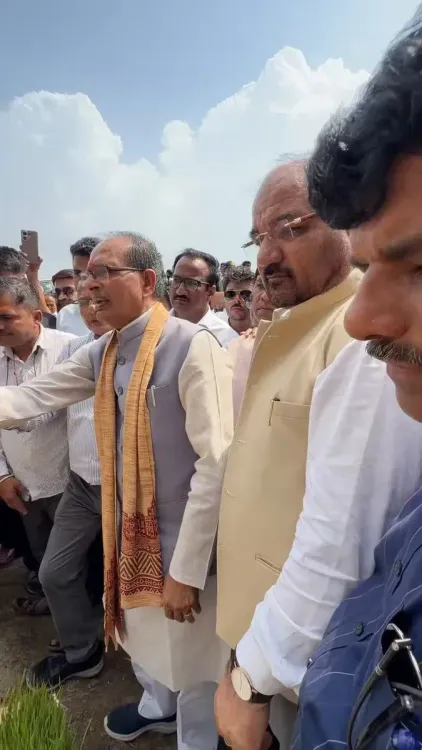
Union Agriculture Minister Shivraj Singh Chouhan on Sunday, June 14, 2026, witnessed a live field demonstration of a modern mechanical rice transplanter, sharing his observations on the technology's potential to boost paddy yields and reduce crop disease.
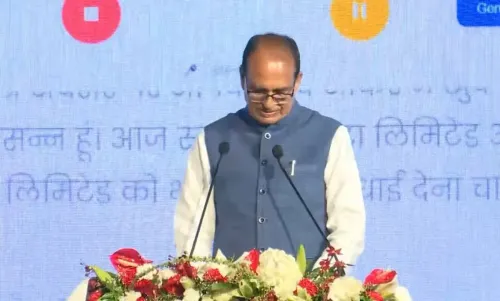
Posting on X, the Minister described the demonstration in Hindi: 'आज खेत में धान रोपाई की आधुनिक मशीन का प्रदर्शन देखा' — 'Today I witnessed a demonstration of a modern paddy transplanting machine in the field.' He noted that the machine plants saplings at uniform spacing and correct depth, enabling better crop development, and that transplanting 10-to-15-day-old seedlings increases the number of tillers, thereby raising the probability of higher production.
Context
Manual paddy transplantation is one of the most labour-intensive operations in Indian agriculture, typically performed during a narrow monsoon window when rural labour demand peaks sharply. The Minister highlighted that row-wise mechanical planting improves air circulation within the crop canopy, which in turn reduces the incidence of fungal and pest diseases — a recurring challenge in high-humidity paddy belts.
Field demonstrations by senior Union Ministers serve a dual purpose: they accelerate farmer awareness of available technology and signal political commitment to mechanisation at the ground level.
Policy Backdrop
The demonstration aligns with the Sub-Mission on Agricultural Mechanization (SMAM), a central scheme launched in 2014-15 under the Ministry of Agriculture to subsidise modern farm equipment and reduce drudgery in operations including paddy transplantation. Under SMAM, rice transplanters have been promoted across eastern and central Indian states where manual transplanting remains dominant.
Successive governments have prioritised farm mechanisation to offset rising rural labour costs and seasonal shortages. Custom Hiring Centres set up under SMAM allow small and marginal farmers — who cannot afford to purchase machinery outright — to rent transplanters at subsidised rates, extending the reach of the technology beyond large landholdings.
Stakeholders and Impact
Small and marginal farmers, who collectively account for the majority of India's paddy cultivators, stand to gain the most from mechanical transplanting. The uniform row spacing the machine ensures is not merely an aesthetic improvement: it allows tractors and sprayers to move between rows for inter-culture operations, cutting subsequent labour costs as well.
The agronomic case the Minister outlined — that younger, 10-to-15-day-old seedlings transplanted mechanically produce more tillers — is consistent with research on high-yielding paddy varieties, where early transplanting is associated with longer vegetative periods and higher panicle counts per plant.
What's Next
Attention will now turn to whether the Ministry translates this demonstration into expanded state-level targets under SMAM for the 2026 kharif season, particularly for self-propelled rice transplanters. Enhanced subsidies or revised guidelines for Custom Hiring Centres could follow as the government looks to scale mechanisation ahead of the peak transplanting window. Broader adoption of such machinery could meaningfully reduce India's dependence on seasonal agricultural labour while supporting the government's goal of raising rice productivity across rain-fed and irrigated belts alike.
Point of View
Disease control, uniform depth — rather than purely economic ones, the Minister is pitching mechanisation as a productivity tool, not merely a labour substitute. This matters politically as the BJP seeks to consolidate its standing among farming communities ahead of state elections in key paddy-growing states. The demonstration also puts quiet pressure on state agriculture departments to ramp up Custom Hiring Centre coverage, where implementation has been uneven.
NationPress
14 Sept 2026
Frequently Asked Questions
What is a paddy transplanting machine and how does it work?
A paddy transplanting machine, or rice transplanter, mechanically picks young seedlings from a mat nursery and plants them in a flooded field at uniform row spacing and consistent depth, replacing the manual process of hand-transplanting. This reduces labour time significantly and ensures agronomically optimal plant geometry.
What is the Sub-Mission on Agricultural Mechanization (SMAM)?
SMAM is a central government scheme launched in 2014-15 under the Ministry of Agriculture that provides subsidies for modern farm machinery, including rice transplanters, and funds Custom Hiring Centres so small farmers can rent equipment they cannot afford to buy outright.
Why did Shivraj Singh Chouhan attend a paddy transplanter demonstration?
As Union Agriculture Minister, Chouhan attended the demonstration to promote modern farm mechanisation among paddy farmers, highlighting the machine's ability to improve yields, reduce disease, and ease the labour burden during the peak kharif transplanting window.
How does mechanical transplanting increase paddy yield?
Transplanting younger, 10-to-15-day-old seedlings mechanically allows the plant a longer vegetative period, which increases the number of tillers — the shoots that each bear a grain panicle — thereby raising the potential grain count per plant and overall field productivity.
Can small farmers in India afford rice transplanters?
Most small farmers cannot purchase rice transplanters outright due to the cost, but under SMAM's Custom Hiring Centre model, they can rent subsidised machinery during the transplanting season, making the technology accessible without full ownership.