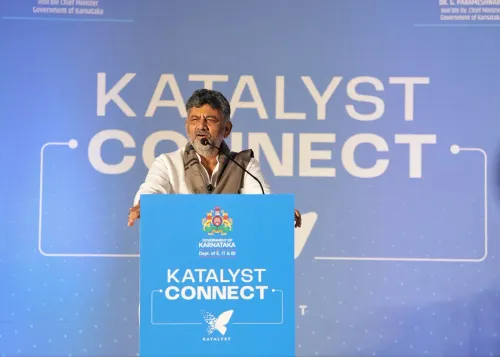
CM Siddaramaiah Launches Karnataka's First Govt-Owned Command Centre

Synopsis
Chief Minister Siddaramaiah on 25 May 2026 inaugurated India's first fully government-owned Integrated Command and Control Centre in Karnataka, marking a landmark step in the state's push for data-sovereign, technology-led urban governance.
Key Takeaways
Chief Minister Siddaramaiah inaugurated India's first fully government-owned Integrated Command and Control Centre on 25 May 2026 .
The centre is described as the country's first of its kind under direct state ownership, distinguishing it from public-private partnership models used elsewhere.
The facility is designed to integrate urban local bodies and emergency services under a single real-time monitoring and coordination platform.
Karnataka's model prioritises data sovereignty , keeping sensitive civic and surveillance data within government control rather than with private vendors.
The initiative fits a national pattern of states upgrading governance infrastructure under the Smart Cities Mission framework launched in 2015 .
Potential expansion to other Karnataka cities and linkage with national e-governance platforms is anticipated.
The Chief Minister's Office of Karnataka announced on Monday, 25 May 2026 that Chief Minister Siddaramaiah inaugurated the country's first government-owned state-of-the-art Integrated Command and Control Centre, marking a significant milestone in Karnataka's digital governance push.
The post, shared by the official Chief Minister's Office account, captured the moment of the inauguration, describing it as 'deshada modala sarkari swamyada atyaadhunika maadari samgra command mattu control centre' — 'the country's first government-owned, state-of-the-art, Integrated Command and Control Centre' — being dedicated to the public by Chief Minister Siddaramaiah.
Context
Integrated Command and Control Centres (ICCCs) have become a cornerstone of urban governance modernisation across India, enabling real-time monitoring of traffic, emergency services, civic utilities, and public safety infrastructure from a single hub. What distinguishes this facility is its fully government-owned model, in contrast to most existing ICCCs that operate through public-private partnerships. This positions Karnataka as a pioneer in asserting direct state ownership over critical urban data infrastructure.Policy Backdrop
The policy lineage of such centres traces back to the Smart Cities Mission, launched in 2015 by the Union Ministry of Housing and Urban Affairs, which mandated the creation of ICCCs in designated smart cities as nerve centres for urban management. Dozens of Indian cities subsequently built such facilities, typically with private technology partners. Karnataka's decision to develop a fully government-owned facility reflects a deliberate emphasis on data sovereignty — ensuring that sensitive civic and surveillance data remains within state control rather than with private vendors. This aligns with a broader pattern visible across Indian states since the mid-2010s, where administrations have increasingly sought to indigenise and internalise digital governance infrastructure rather than outsource it.Stakeholders and Impact
The primary beneficiaries of the centre will be urban local bodies and emergency services, which will gain an integrated platform to coordinate responses to civic incidents, traffic disruptions, and public safety events. Citizens in the operational jurisdiction stand to benefit from faster emergency response times and more coordinated civic service delivery. The government-ownership model also has implications for accountability: with no private intermediary, the state bears direct responsibility for the centre's performance and data governance standards. For Karnataka's technology and governance ecosystem, the inauguration signals continued state investment in AI-enabled and digitally integrated administration.What's Next
The inauguration raises expectations of a potential rollout of similar government-owned command centres to other cities across Karnataka, as the state seeks to standardise its urban governance architecture. Observers will watch whether this model is linked to national e-governance platforms or reflected in future state budget allocations for digital infrastructure. The centre's operational mandate, technology architecture, and coverage area are expected to be detailed in follow-up official communications from the Chief Minister's Office.Point of View
Signalling that Karnataka intends to control its own urban data stack at a time when data sovereignty is an increasingly live debate in Indian governance. By breaking from the dominant public-private model, the state is betting that direct ownership yields better accountability and security — a calculation that will be tested in the centre's operational years. This move also reinforces Karnataka's positioning as a technology-forward state, consistent with its history of anchoring India's IT economy, and could set a template that other state governments choose to emulate or contest. The political dividend for Siddaramaiah lies in framing a technocratic achievement as a governance reform with tangible public-safety benefits.
NationPress
21 Oct 2026
Frequently Asked Questions
What is the Integrated Command and Control Centre inaugurated by CM Siddaramaiah?
It is a state-of-the-art facility that integrates urban monitoring, emergency services, traffic management, and civic utilities under a single real-time command hub. Karnataka's version is notable for being the first such centre in India under full government ownership, without any private partner.
Why is Karnataka's command centre different from others in India?
Most Integrated Command and Control Centres across India were built under public-private partnerships as part of the Smart Cities Mission. Karnataka's centre is fully government-owned, which the state says ensures greater data sovereignty and direct accountability.
What is the Smart Cities Mission and how does it relate to this centre?
The Smart Cities Mission was launched by the Union government in 2015 to modernise urban infrastructure, with ICCCs as a key component. Karnataka's new centre builds on that national framework but goes further by eliminating private ownership of the facility.
Who will benefit from the new command and control centre in Karnataka?
Urban local bodies and emergency services are the primary beneficiaries, gaining a unified platform for real-time coordination. Citizens in the covered area can expect faster emergency response and more efficient civic service delivery.
Will similar command centres be set up in other Karnataka cities?
The state government has not made a formal announcement yet, but the inauguration is widely seen as a pilot that could be replicated across other Karnataka cities, potentially with linkages to national e-governance platforms.