Dr. Jitendra Singh Highlights Vikram-1 Launch, Olympiad Wins
Synopsis
Union Science Minister Dr. Jitendra Singh shared PM Modi's Mann Ki Baat praise for the Vikram-1 rocket launch and India's international science Olympiad results, underscoring the government's push for indigenous space capability and competitive STEM education under the Atmanirbhar Bharat framework.
Key Takeaways
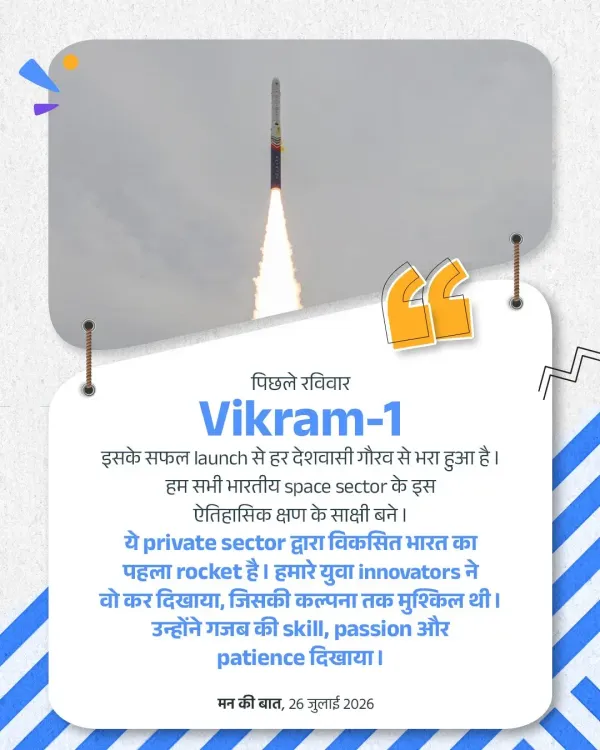
Jitendra Singh shared PM Modi's Mann Ki Baat remarks on 27 July 2026 highlighting India's science milestones.
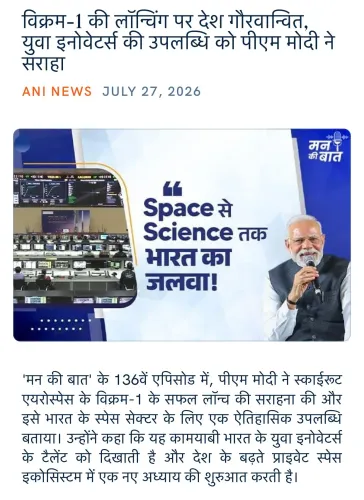
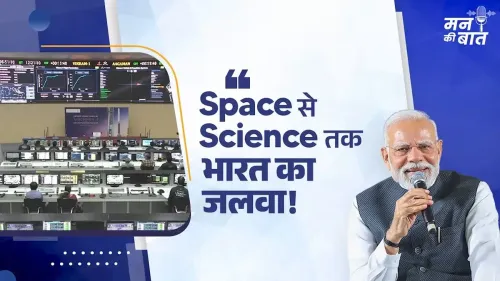
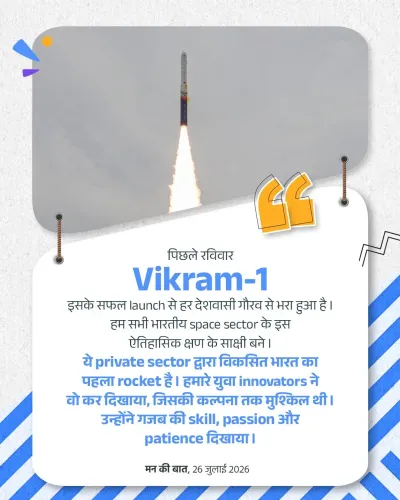
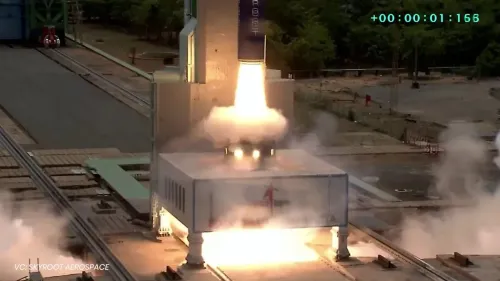
PM Modi specifically cited the Vikram-1 launch vehicle as evidence of India's growing private space capability.
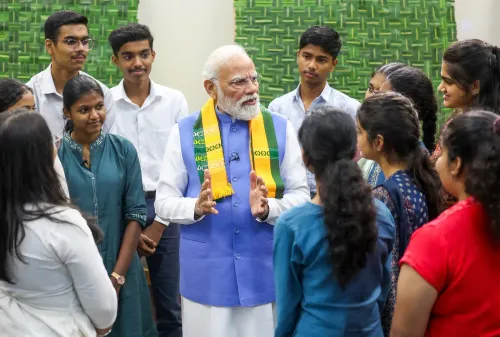
Indian students' performance at international science Olympiads was highlighted as a marker of STEM education progress.
IN-SPACe , established in 2020 , underpins the regulatory framework enabling private-sector space launches like Vikram-1.
The National Education Policy 2020 has strengthened Olympiad training infrastructure, contributing to India's competitive results.
Both milestones align with the government's Atmanirbhar Bharat push for self-reliance in critical technologies.
Union Science and Technology Minister Dr. Jitendra Singh on Sunday, 27 July 2026 shared remarks by Prime Minister Narendra Modi highlighting two milestones in India's science and innovation journey — the successful launch of the Vikram-1 rocket and the country's strong performance in international science Olympiads — as cited during the Prime Minister's monthly Mann Ki Baat radio address.
Context
Dr. Singh quoted PM Modi's observation that India 'continues to make its mark in science and innovation,' pointing specifically to the Vikram-1 launch vehicle and Indian students' performance at international science Olympiads. The remarks were drawn from Mann Ki Baat, the Prime Minister's monthly public broadcast that frequently spotlights achievements in science, technology, and grassroots innovation. By amplifying the statement on X, the Science Minister signalled the government's intent to keep these achievements in the public eye.
Policy Backdrop
The reference to Vikram-1 sits within a broader policy architecture that India has built around private-sector participation in space. The government established IN-SPACe (Indian National Space Promotion and Authorisation Centre) in 2020 to regulate and promote commercial launch activity, opening the sector to startups and private enterprises for the first time. This followed the landmark Chandrayaan-3 lunar landing in 2023, which demonstrated India's orbital and landing capabilities and generated significant momentum for the domestic space industry.
On the education front, the National Education Policy (NEP) 2020 included specific provisions to strengthen STEM education and the infrastructure supporting Olympiad training. India has historically secured medals across mathematics, physics, chemistry, and biology Olympiads, and the government has framed competitive performance in these contests as a direct indicator of the quality of its scientific talent pipeline.
Stakeholders and Impact
The most immediate stakeholders are India's private space startups, for whom a successful Vikram-1 mission represents a proof-of-concept for indigenous orbital capability and could accelerate licensing and investment flows. A validated commercial launch vehicle lowers the cost and timeline for satellite deployment, benefiting sectors from agriculture to telecommunications. For STEM students and educators, the Prime Minister's public acknowledgement of Olympiad performance reinforces the value of competitive science education and may influence future government funding for training programmes.
The remarks also carry symbolic weight under the Atmanirbhar Bharat framework, which positions self-reliance in critical technologies — including space — as a national strategic priority. Consistent ministerial amplification of such achievements helps sustain public and investor confidence in India's technology trajectory.
What's Next
Observers will watch for formal updates on private launch licensing timelines and any policy announcements that may follow from the attention generated by PM Modi's Mann Ki Baat remarks. India's performance in the 2026–27 international Olympiad cycle will also be closely tracked as a benchmark for the NEP's impact on STEM outcomes. The government's next steps in expanding the IN-SPACe regulatory framework could determine how quickly private launch activity scales beyond demonstration missions.
Point of View
Framing India's scientific rise as both a grassroots and a frontier-technology story. This messaging serves the Atmanirbhar Bharat agenda by signalling to investors and international partners that India's innovation pipeline runs from school competitions to orbital launches. The post also reflects the growing political salience of private space, a sector that has moved from a niche concern to a headline priority in under five years.
NationPress
26 Oct 2026
Frequently Asked Questions
What is Vikram-1 and why is it significant for India?
Vikram-1 is a privately developed Indian launch vehicle representing a milestone in India's commercial space sector. Its successful launch signals that Indian startups can develop indigenous orbital capability, complementing ISRO's government-led missions and advancing the Atmanirbhar Bharat goal of self-reliance in space technology.
What did PM Modi say about science in Mann Ki Baat?
PM Modi noted that India 'continues to make its mark in science and innovation,' specifically citing the successful launch of Vikram-1 and India's impressive performance in international science Olympiads during his monthly Mann Ki Baat radio address.
What are international science Olympiads and how has India performed?
International science Olympiads are global student competitions in subjects including mathematics, physics, chemistry, and biology. India has historically secured medals across these contests, and the government has cited strong Olympiad performance as evidence that STEM education reforms under the National Education Policy 2020 are yielding results.
What is IN-SPACe and what role does it play in India's space sector?
IN-SPACe, or the Indian National Space Promotion and Authorisation Centre, was established in 2020 to regulate and promote private participation in India's space sector. It provides the licensing and oversight framework that enables commercial entities to develop and launch vehicles like Vikram-1.
Why did Dr. Jitendra Singh share PM Modi's Mann Ki Baat remarks on X?
As Union Minister of State (Independent Charge) for Science and Technology, Dr. Jitendra Singh regularly amplifies government achievements in science on social media. Sharing the Prime Minister's remarks underscores the ministry's alignment with the broader Atmanirbhar Bharat narrative and keeps science milestones in public discourse.