Dr. Jitendra Singh hails Vikram-1 launch, PM Modi's Mann Ki Baat spotlight

Synopsis
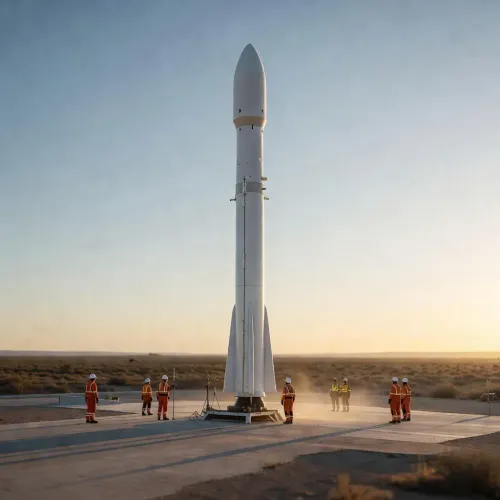
PM Modi spotlighted the launch of Vikram-1, India's first privately developed rocket, during Mann Ki Baat, crediting space sector reforms for enabling young Indian innovators to achieve historic milestones. Science Minister Dr. Jitendra Singh amplified the remarks, underlining the government's push for a mixed space ecosystem.
Key Takeaways
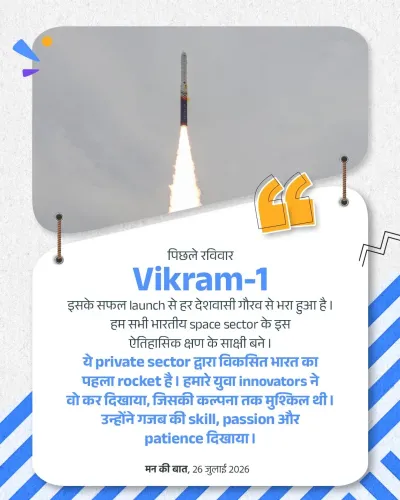
PM Modi highlighted the Vikram-1 launch — India's first privately developed rocket — during his Mann Ki Baat address on 27 July 2026 .
The PM credited the opening of the space sector to private participation for enabling young Indian innovators to achieve 'historic milestones.' India's space liberalisation began in June 2020 with the creation of IN-SPACe as a dedicated regulatory and promotional body for private space activity.
ISRO now operates in a collaborative rather than exclusive role, sharing facilities with private companies under the reformed framework.
The milestone aligns with the Atmanirbhar Bharat goal of reducing strategic import dependence and building domestic high-technology capability.
Next milestones to watch include further IN-SPACe -authorised private launches and possible parliamentary legislation formalising the space regulatory framework.
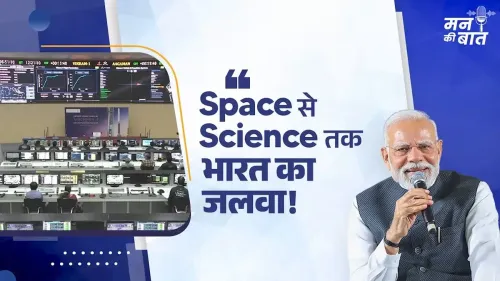
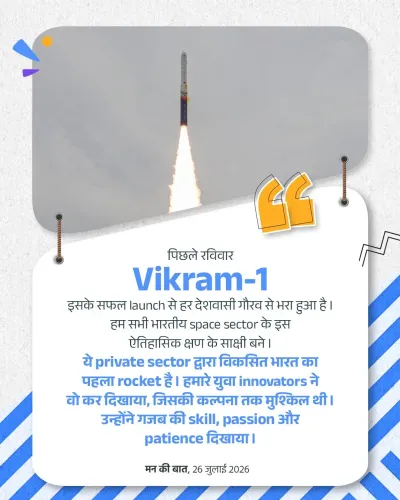
Union Science and Technology Minister Dr. Jitendra Singh on Sunday, 27 July 2026, shared that Prime Minister Narendra Modi, during his monthly radio address Mann Ki Baat, highlighted the successful launch of Vikram-1 — described as India's first privately developed rocket — calling it a milestone for the country's emerging private space ecosystem.
Context
In his post on X, Dr. Jitendra Singh relayed the Prime Minister's remarks, noting that PM Modi credited the opening of India's space sector to private participation for unlocking 'new opportunities for innovation.' The PM specifically acknowledged that India's young innovators had achieved 'historic milestones' and contributed to strengthening the nation's space ecosystem. The launch of Vikram-1 was cited as a direct outcome of that liberalisation.
Mann Ki Baat, the Prime Minister's monthly unscripted radio programme broadcast on the last Sunday of each month, has increasingly been used to spotlight technology and innovation success stories from across the country, giving national visibility to private and start-up achievements that might otherwise receive limited mainstream attention.
Policy Backdrop
The policy foundation for Vikram-1's emergence traces back to June 2020, when the Government of India announced sweeping reforms opening the space sector to private players and established the Indian National Space Promotion and Authorisation Centre (IN-SPACe). The body was created to serve as a single-window regulator and promoter for private space activity, operating alongside the Indian Space Research Organisation (ISRO).
Subsequent policy instruments — including the Spacecom Policy draft and enabling guidelines issued in 2021 — allowed private companies to independently design, build, and operate launch vehicles and satellites. These reforms marked a decisive shift away from India's decades-old state-monopoly model in space, drawing comparisons with the commercial crew frameworks adopted in the United States and parts of Europe.
The initiative also aligns with the broader Atmanirbhar Bharat agenda, which seeks to reduce import dependence in strategic and high-technology sectors while cultivating domestic industrial and start-up capability.
Stakeholders and Impact
The beneficiary most directly associated with Vikram-1 is the private space start-up ecosystem, which has grown substantially since the 2020 reforms. Companies and young innovators who previously had no regulatory pathway to access launch infrastructure or spectrum now operate under a structured framework administered by IN-SPACe.
ISRO, once the sole actor in India's space programme, now plays a collaborative role — sharing facilities, expertise, and infrastructure with private entities. The Prime Minister's decision to spotlight this milestone on Mann Ki Baat is expected to further encourage investment and talent into India's private space sector. For the Science and Technology Ministry, the launch represents a tangible policy dividend from reforms initiated under the current administration.
What's Next
Attention now turns to the pipeline of private-sector launches awaiting IN-SPACe authorisation, as well as any parliamentary legislation that could formalise and expand the regulatory framework governing India's commercial space activities. Dr. Jitendra Singh's amplification of the Prime Minister's remarks signals that the government intends to keep the private space sector's progress in the public spotlight — using milestones like Vikram-1 to build political and public momentum for deeper reforms ahead.
Point of View
The government ensures the narrative reaches both a mass radio audience and a digitally engaged one simultaneously. This two-channel communication strategy has become a recognisable pattern whenever the administration wants to claim credit for a policy dividend in a high-visibility sector. The move also pre-empts opposition framing by positioning the private space sector's success as a product of deliberate reform rather than organic market development.
NationPress
26 Oct 2026
Frequently Asked Questions
What is Vikram-1 and who developed it?
Vikram-1 is described as India's first privately developed orbital rocket. It is associated with the private space start-up ecosystem that emerged after India opened its space sector to private participation in 2020. The research notes it was developed by Skyroot Aerospace, though specific launch details from July 2026 remain unverified in public records available up to 2023.
What did PM Modi say about Vikram-1 on Mann Ki Baat?
PM Modi, during his Mann Ki Baat address, highlighted the successful launch of Vikram-1 and noted that opening the space sector to private participation had unlocked new opportunities for innovation, enabling young Indian innovators to achieve historic milestones.
What is IN-SPACe and what role does it play?
IN-SPACe, or the Indian National Space Promotion and Authorisation Centre, was established in June 2020 as a single-window regulator and promoter for private sector participation in India's space activities. It operates alongside ISRO and authorises private companies to build and launch vehicles and satellites.
How has India's space policy changed since 2020?
In June 2020, the Government of India announced reforms ending the state monopoly in space and created IN-SPACe. Subsequent guidelines in 2021 allowed private companies to independently design, build, and operate launch vehicles and satellites, moving India toward a mixed public-private space ecosystem.
Why did Dr. Jitendra Singh post about Mann Ki Baat and Vikram-1?
As Union Minister for Science and Technology, Dr. Jitendra Singh shared PM Modi's Mann Ki Baat remarks to amplify the government's message about the success of space sector reforms and to highlight Vikram-1 as a policy dividend of the liberalisation initiated in 2020.