Sitharaman Invokes Rajagopalachari to Indict Licence Raj
Synopsis
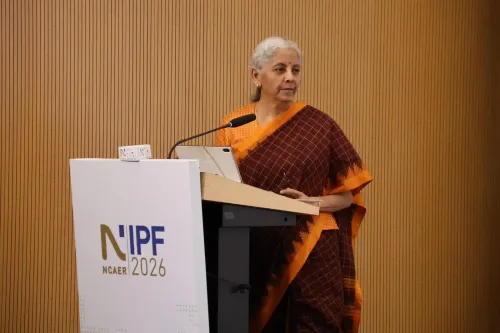
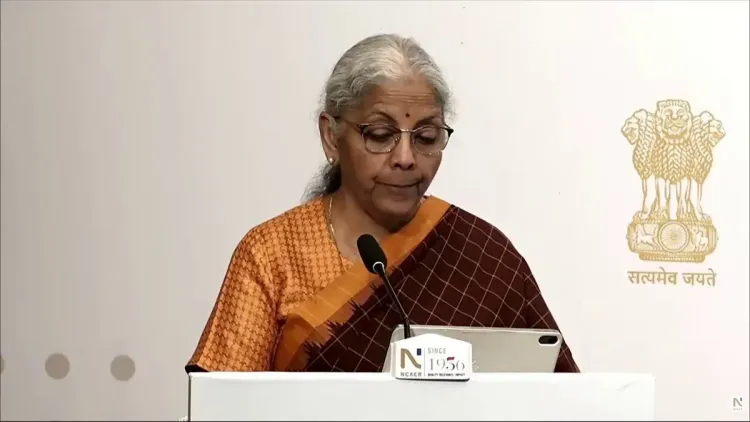
At the C.D. Deshmukh Lecture 2026 in New Delhi, Finance Minister Nirmala Sitharaman quoted Rajagopalachari's 1963 essay condemning the Licence-Permit-Quota Raj, arguing that dissent and evidence were suppressed when the regulatory framework was built in the 1950s.
Key Takeaways
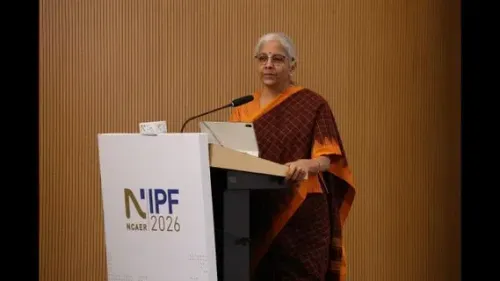
Finance Minister Nirmala Sitharaman delivered the C.D.
Deshmukh Lecture 2026 in New Delhi on 6 August 2026 .
Rajagopalachari 's 15 December 1963 essay in the Indian Libertarian Magazine , which named and condemned the 'Permit-licence-quota raj'.
Rajagopalachari argued the system 'impeded development and actually promotes exploitation' — the opposite of its stated intent.
Sitharaman noted that credible alternatives were proposed but 'not heard', and that 'evidence rarely found a seat at the table'.
The Industries (Development and Regulation) Act, 1951 formalised the licensing regime; it was largely dismantled by the 1991 New Economic Policy .
The lecture series honours C.D.
Deshmukh , Finance Minister during the very years the licensing framework was being built.
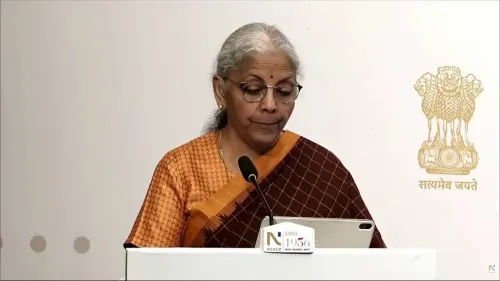
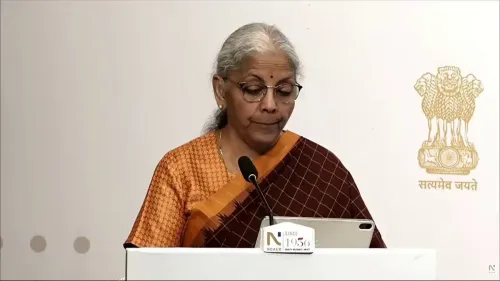
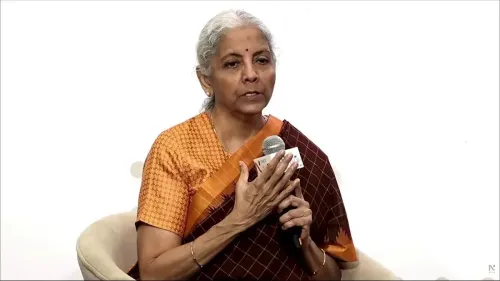
At the C.D. Deshmukh Lecture 2026 in New Delhi, Union Finance Minister Nirmala Sitharaman reached back six decades to deliver a pointed verdict on India's early economic architecture — quoting the very man who first named it and condemned it.
In the second excerpt shared from her address, Sitharaman cited C. Rajagopalachari — India's first Governor-General and founder of the Swatantra Party — who wrote in the Indian Libertarian Magazine on 15 December 1963 that the 'Permit-licence-quota raj' had been 'conceived with the intention of preventing chaotic development and illegal exploitation; but in fact it has impeded development and actually promotes exploitation.' Rajagopalachari's blunt conclusion: 'What appears as progress has been achieved in spite of the incubus, and not on account of the regimentation.'
Sitharaman's framing before that quote was equally sharp. 'Alternatives were argued for at the time, by people of standing who were amongst the ruling dispensation, and were not heard,' she said. 'Evidence, also, rarely found a seat at the table.' The indictment is not just of the policy — it is of how dissent was shut out even when it came from within.
The Man Who Named the System He Fought
Rajagopalachari, widely known as 'Rajaji', was no fringe critic. He had served as the last Governor-General of British India and as Chief Minister of Madras. His disillusionment with the Congress's planned-economy turn was deep enough to prompt him to found the Swatantra Party in 1959 — a classical-liberal formation that made rolling back the licence regime its central cause. That a figure of such stature, writing inside the ruling era, was 'not heard' is the precise sting Sitharaman is applying. The regulatory architecture Rajaji attacked had been formalised through the Industries (Development and Regulation) Act, 1951, which required industrial licences for virtually every sector of production. For four decades, entrepreneurs navigated a labyrinth of permits and quotas before a unit of output could move. The system was not dismantled until the New Economic Policy of 1991, when P.V. Narasimha Rao and then-Finance Minister Manmohan Singh triggered liberalisation.Why Sitharaman Is Invoking This at the Deshmukh Lecture
The choice of platform matters. The lecture series honours C.D. Deshmukh, Finance Minister from 1950 to 1956 — the very years the licensing framework was being cemented. Delivering this critique here is a deliberate historical juxtaposition: the Finance Minister of today, at a forum named for a Finance Minister of that era, arguing that the economic consensus of the 1950s was contested, evidence-light, and ultimately wrong. For the BJP, this is familiar territory. Successive governments have used the pre-1991 regulatory record as a foil to justify continued deregulation, ease-of-doing-business reforms, and the dismantling of legacy compliance burdens. Sitharaman's lecture slots into that long argument — but the Rajagopalachari citation gives it unusual intellectual weight, drawing on a critic who was neither a foreign economist nor a post-liberalisation voice, but a contemporary insider who saw the damage in real time. The question her framing quietly leaves hanging: if evidence 'rarely found a seat at the table' then, how robustly does it sit there now?Point of View
She sidesteps the charge of partisan revisionism. The Deshmukh Lecture platform amplifies the irony — critiquing the 1950s economic order at a forum named for one of its architects. This fits a broader BJP pattern of delegitimising the Nehruvian planned-economy legacy to justify ongoing deregulation, but the Rajaji citation lends it unusual historical credibility. Watch for whether the themes surface in the next Economic Survey or Budget speech as a doctrinal anchor for further licensing reform.
NationPress
6 Aug 2026
Frequently Asked Questions
What is the Licence-Permit-Quota Raj?
The Licence-Permit-Quota Raj refers to the system of industrial licensing, permits, and production quotas introduced in India in the 1950s under the Industries (Development and Regulation) Act, 1951, which tightly controlled private enterprise until liberalisation in 1991.
Who was C. Rajagopalachari and why did he criticise the system?
C. Rajagopalachari, known as Rajaji, was India's first Governor-General and a senior Congress leader who grew disillusioned with the planned economy. He founded the Swatantra Party in 1959 and wrote extensively against the permit-licence regime, arguing it stifled growth rather than enabling it.
What did Nirmala Sitharaman say at the C.D. Deshmukh Lecture 2026?
Sitharaman argued that credible alternatives to the Licence Raj were proposed at the time but ignored, and that evidence rarely influenced policy decisions. She quoted Rajagopalachari's 1963 essay to make the case that the regulatory system harmed rather than helped India's development.
Who was C.D. Deshmukh and why is the lecture named after him?
C.D. Deshmukh was India's Finance Minister from 1950 to 1956 — the formative years of the licensing framework. The lecture series in his name has become a platform for significant economic policy addresses.
When was India's Licence Raj dismantled?
The core elements of industrial licensing were dismantled during the New Economic Policy of 1991, introduced by Prime Minister P.V. Narasimha Rao with Manmohan Singh as Finance Minister, marking India's shift toward a liberalised market economy.