Sitharaman Quotes Matthai's 1950 Warning on Planning Commission Power

Synopsis
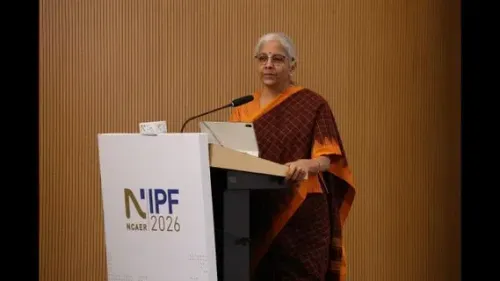
At the CD Deshmukh Lecture 2026 in New Delhi, Finance Minister Nirmala Sitharaman quoted John Matthai's 1950 resignation protest, in which he called the Planning Commission 'ill-conceived' and warned it was becoming a 'parallel cabinet' that would reduce the Cabinet to a 'registering authority.'
Key Takeaways
John Matthai resigned as Finance Minister in 1950 over the Planning Commission's growing authority, calling it 'ill-conceived.' Matthai warned the Commission was becoming a 'parallel cabinet' that would reduce the Cabinet to 'practically a registering authority.' The Planning Commission was constituted in March 1950 to direct five-year economic plans.
Deshmukh , the lecture's namesake, succeeded Matthai as Finance Minister and served from 1952 to 1956 .
The Planning Commission was eventually wound up in 2015 , over six decades after Matthai's protest.
Sitharaman's remarks were part of a multi-post thread from the lecture, suggesting a broader institutional argument.
A Finance Minister's resignation over institutional overreach — that was India's reality in 1950. At the CD Deshmukh Lecture 2026 in New Delhi, Union Finance Minister Nirmala Sitharaman reached back seven decades to surface a warning that still cuts sharp.
Sitharaman quoted John Matthai, India's Finance Minister from 1949 to 1950, who walked out of office in protest at the rising dominance of the newly formed Planning Commission. Matthai's words, delivered in June 1950, were unsparing: 'I consider the Planning Commission not merely ill-timed but in its working and general set-up ill-conceived. The Planning Commission was tending to become a parallel cabinet…it would weaken the authority of the Finance Ministry and gradually reduce the Cabinet to practically a registering authority.'
The Resignation That Defined a Fault Line
Matthai's departure was not a minor bureaucratic dispute. It was the first major institutional collision in independent India's economic governance — a sitting Finance Minister choosing exit over accommodation. The Planning Commission had been formally constituted in March 1950, just months after the Constitution came into force, tasked with formulating five-year plans and coordinating development priorities. Matthai saw it differently: a body accumulating authority that properly belonged to elected ministers answerable to Parliament. His successor, C.D. Deshmukh — the very figure this lecture series honours — served as Finance Minister from 1952 to 1956 and had earlier been RBI Governor. The lecture named after him now provides a platform where contemporary ministers revisit the institutional debates Deshmukh himself navigated.Why Sitharaman Chose This Quote, in This Room
Invoking Matthai at a lecture honouring Deshmukh is a layered choice. Both men shaped India's early fiscal architecture; both operated in the shadow of the Planning Commission's expanding footprint. The Commission endured for over six decades before being wound up in 2015 and replaced by a different institutional arrangement — a decision taken by the current government. Sitharaman's citation of Matthai's critique places that 2015 reform within a long arc of institutional tension, not as a political rupture but as the resolution of a debate that began at independence. The remark is part of a thread — marked (3/n) — suggesting a longer argument being built across multiple posts from the lecture. Seventy-six years on, a Finance Minister quoting her predecessor's resignation letter in a hall named after the man who replaced him: India's planning debates have always been personal, structural, and unresolved all at once.Point of View
She insulates the argument from partisan attack. The lecture setting, honouring C.D. Deshmukh, adds further weight: this is a government signalling that its reforms belong to a longer, bipartisan tradition of Finance Ministry assertion over planning bodies. Watch for whether these historical frames appear in the next Economic Survey or Budget speech as a formal policy narrative.
NationPress
21 Sept 2026
Frequently Asked Questions
Why did John Matthai resign as Finance Minister in 1950?
John Matthai resigned in 1950 to protest the growing power of the newly formed Planning Commission , which he believed was becoming a 'parallel cabinet' and undermining both the Finance Ministry and the Cabinet's authority.
What did Nirmala Sitharaman say at the CD Deshmukh Lecture 2026?
Sitharaman quoted John Matthai's June 1950 statement criticising the Planning Commission as 'ill-conceived' and warned it was reducing the Cabinet to 'practically a registering authority,' drawing a line from early institutional debates to contemporary governance.
Who was C.D. Deshmukh and why is the lecture named after him?
C.D. Deshmukh was India's RBI Governor and later Finance Minister from 1952 to 1956 . The lecture series honours his contribution to India's early fiscal and monetary architecture.
When was the Planning Commission abolished?
The Planning Commission was wound up in 2015 , more than six decades after John Matthai's resignation protest, and replaced by a different institutional body.
What was the Planning Commission set up to do?
Constituted in March 1950 , the Planning Commission was tasked with formulating five-year economic plans and coordinating national development priorities across ministries.