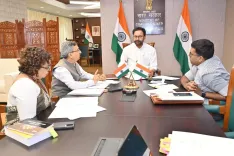
Sitharaman joins panel on new middle class at Aix-en-Provence forum

Synopsis
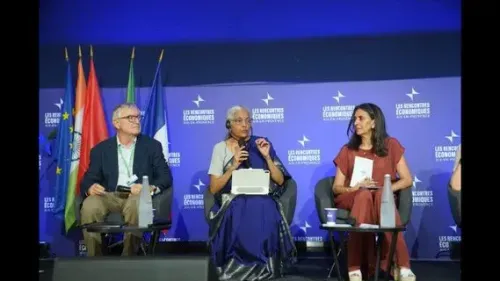
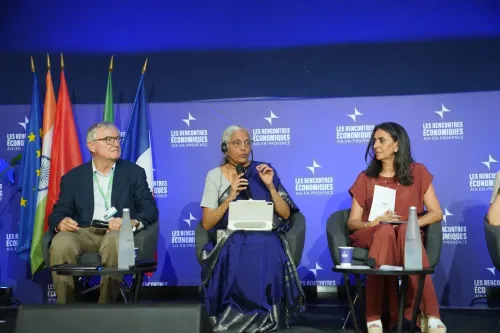
Union Finance Minister Nirmala Sitharaman participated in a panel on 'How to Promote the Rise of a New Middle Class?' at the Rencontres Économiques d'Aix-en-Provence in France on 3 July 2026, placing India's middle-class growth story before a global audience of policymakers and economists.
Key Takeaways
Nirmala Sitharaman joined a panel titled 'How to Promote the Rise of a New Middle Class?' at the Rencontres Économiques d'Aix-en-Provence on 3 July 2026 .
The forum is held annually at Aix-Marseille University in France and convenes global policymakers, academics, and business leaders.
India's middle-class expansion is rooted in the 1991 economic liberalisation and has been a recurring theme in recent Union Budget documents.
Indian finance ministers have increasingly participated in European economic forums to present India's growth trajectory and attract investment.
Panel themes may influence future Union Budget and Economic Survey discussions on consumption-led growth and structural reform.
Union Finance Minister Nirmala Sitharaman participated in a panel discussion titled 'How to Promote the Rise of a New Middle Class?' at the Rencontres Économiques d'Aix-en-Provence, one of Europe's premier annual economic forums, held at Aix-Marseille University in France on 3 July 2026.
Context
The Rencontres Économiques d'Aix-en-Provence is a high-profile international forum that brings together heads of government, central bankers, economists, and business leaders each year to debate pressing global economic questions. Hosted by Aix-Marseille University, the forum carries significant weight in shaping European and global economic discourse. Sitharaman's participation places India's voice at the centre of one of the forum's core thematic sessions.
The panel's central question — how to promote the rise of a new middle class — is directly relevant to India's development story. With hundreds of millions of Indians having crossed income thresholds over the past three decades, the country's middle-class expansion is frequently cited as one of the defining economic narratives of the twenty-first century.
Policy Backdrop
India's middle-class growth traces its modern roots to the 1991 economic liberalisation, which opened markets, attracted foreign investment, and created conditions for sustained urban income growth. Successive governments have built on that foundation through structural reforms, digital public infrastructure, and targeted welfare programmes aimed at broadening consumption and household financial inclusion.
The theme of middle-class promotion has featured prominently in recent Union Budget documents and Economic Survey chapters, with policymakers framing income-tax relief, housing schemes, and skilling initiatives as instruments to consolidate and expand this demographic. Sitharaman, who has presented multiple Union Budgets, has repeatedly highlighted middle-class aspirations as a driver of domestic consumption-led growth.
Indian finance ministers have in recent years increased their presence at European and multilateral economic forums, using such platforms to present India's growth trajectory, attract investment, and engage with global policy conversations. The Aix-en-Provence appearance is consistent with that pattern.
Stakeholders and Impact
The panel's audience — global policymakers, academics, and business leaders — represents precisely the community that shapes investment flows and multilateral economic frameworks affecting emerging markets. India's ability to articulate a credible middle-class growth story at such forums can influence sovereign credit perceptions and foreign direct investment decisions.
For middle-class households in India, the significance lies in the policy attention their demographic commands at the highest international levels. Discussions at forums like Aix-en-Provence often feed into recommendations that shape domestic fiscal and structural reform agendas in the medium term.
What's Next
Observers will watch for any references to themes from the Aix-en-Provence panel in subsequent Union Budget documents or the annual Economic Survey, where the middle-class growth narrative has been a recurring thread. Sitharaman's continued engagement at European and multilateral economic events signals India's intent to remain an active participant in shaping global economic conversations, particularly as the country positions itself as a leading voice for the Global South.
Point of View
Signalling New Delhi's intent to shape global narratives rather than merely respond to them. The choice of panel topic — promoting a new middle class — is strategically aligned with India's domestic political economy, where the aspirational middle class has been central to the BJP's electoral and policy messaging. At an international level, it positions India as a model for inclusive growth that other emerging economies might study. The forum's influence on policymaker thinking means that ideas aired in Aix-en-Provence can, over time, find their way into domestic fiscal frameworks and multilateral lending priorities.
NationPress
3 Jul 2026
Frequently Asked Questions
What did Nirmala Sitharaman do at Aix-en-Provence?
Nirmala Sitharaman participated in a panel discussion titled 'How to Promote the Rise of a New Middle Class?' at the Rencontres Économiques d'Aix-en-Provence, held at Aix-Marseille University in France on 3 July 2026.
What is the Rencontres Économiques d'Aix-en-Provence?
The Rencontres Économiques d'Aix-en-Provence is an annual international economic forum hosted by Aix-Marseille University in France that brings together policymakers, economists, and business leaders to debate major global economic themes.
Why is the new middle class important to India's economy?
India's middle class has expanded significantly since the 1991 economic liberalisation and is considered a key driver of domestic consumption-led growth. Successive Union Budgets have included measures such as income-tax relief, housing schemes, and skilling initiatives targeted at this demographic.
Does India's Finance Minister regularly attend international economic forums?
Yes, Indian finance ministers have increasingly participated in European and multilateral economic forums in recent years to present India's growth story, engage with global policymakers, and attract foreign investment.
What should we watch for after Sitharaman's Aix-en-Provence panel?
Observers will track whether themes from the panel — particularly around middle-class promotion and consumption-led growth — appear in future Union Budget documents or Economic Survey chapters, and whether India continues to expand its ministerial presence at similar European forums.