Sitharaman Unveils Export Credit Guarantee, Cotton Mission
Synopsis
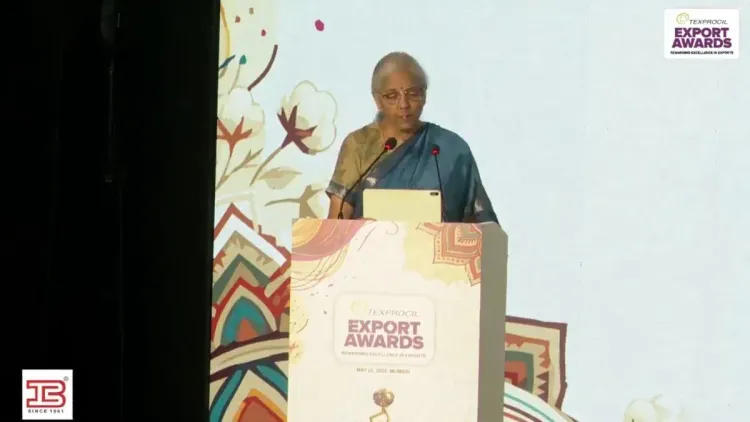
Union Finance Minister Nirmala Sitharaman, speaking in Mumbai, announced a 100% credit guarantee scheme enabling Rs. 20,000 crore in collateral-free export credit, alongside a ₹5,600 crore Mission for Cotton Productivity cleared by the Union Cabinet on May 5, 2026, targeting textile exporters and cotton farmers.
Key Takeaways
The Credit Guarantee Scheme for Exporters provides 100% credit guarantee coverage to Member Lending Institutions (MLIs) for collateral-free credit to eligible exporters.
MLIs can extend additional credit facilities of up to Rs.
20,000 crore under the scheme, with the textile sector specifically included.
The Union Cabinet approved the Mission for Cotton Productivity on May 5, 2026 , with an outlay of ₹5,600 crore .
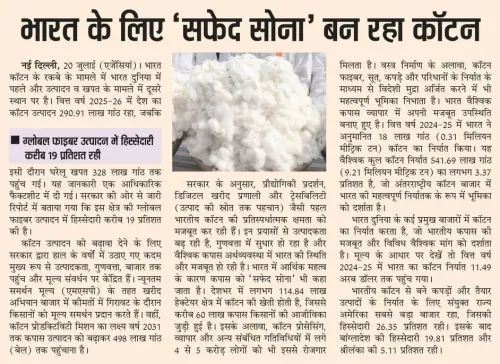
The cotton mission aims to keep India's cotton farming self-sufficient and highly productive , reducing import dependence.
Both measures are framed as responses to uncertainty in global trade , protecting exporters and the agricultural supply chain.
Finance Minister Sitharaman made the announcements in Mumbai as part of a series of policy disclosures on May 25, 2026 .
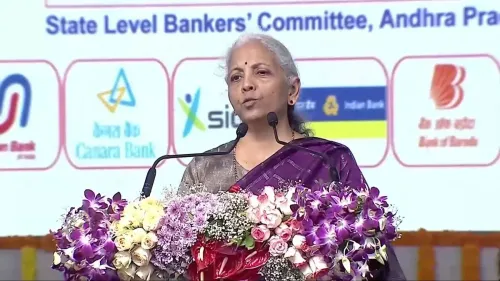
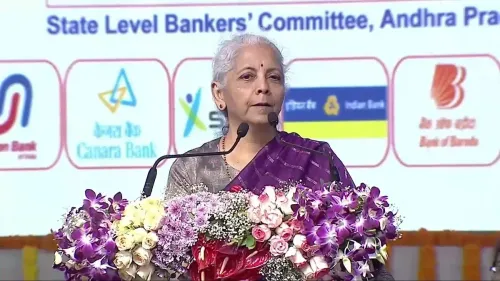
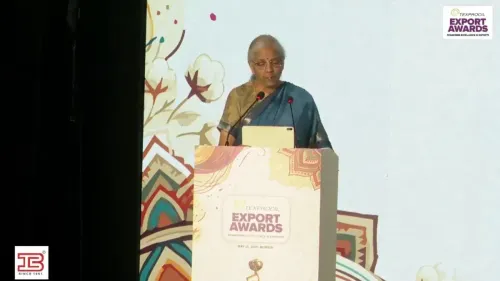
Union Finance Minister Nirmala Sitharaman, speaking in Mumbai on Monday, May 25, 2026, announced two major government initiatives aimed at shielding Indian exporters and cotton farmers from the pressures of an increasingly volatile global trade environment. The measures — a Credit Guarantee Scheme for Exporters and a ₹5,600 crore Mission for Cotton Productivity — together signal a concerted push to shore up India's export competitiveness and agricultural self-sufficiency.
Context
Addressing her audience in Mumbai, Sitharaman highlighted that the Credit Guarantee Scheme for Exporters has been approved to provide 100% credit guarantee coverage to Member Lending Institutions (MLIs). The scheme enables MLIs to extend additional collateral-free credit facilities of up to Rs. 20,000 crore to eligible exporters, with the textile sector explicitly named as a key beneficiary. The announcement forms part of a thread of policy disclosures the Finance Minister shared from Mumbai, marked '2/n', indicating it is the second in a series of posts.
Separately, she confirmed that the Union Cabinet cleared the Mission for Cotton Productivity on May 5, 2026, describing it as a 'landmark' intervention worth ₹5,600 crore intended to keep India's cotton farming 'self-sufficient and highly productive.'
Policy Backdrop
The credit guarantee architecture being deployed here builds on a longer tradition of export support measures in India. The government-owned Export Credit Guarantee Corporation (ECGC) has historically provided insurance and guarantee products to exporters facing non-payment risks in international markets. Collateral-free credit lines have been periodically widened — particularly for MSME exporters and labour-intensive sectors — whenever global demand conditions tightened.
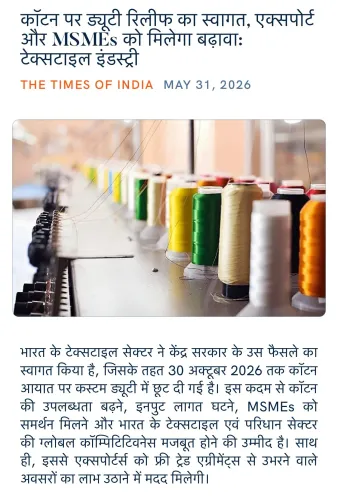
The textile sector has been a recurring focus of such interventions. An Interest Equalisation Scheme launched in 2015 offered interest subsidies on export credit to eligible sectors including textiles, and the latest credit guarantee move extends that protective logic by removing the collateral barrier altogether for qualifying borrowers. On the agricultural side, a Technology Mission on Cotton was first initiated in 2000 to improve seed quality and farming practices; the new ₹5,600 crore Mission for Cotton Productivity represents the most recent, and substantially funded, iteration of that long-running policy strand.
Stakeholders and Impact
The primary beneficiaries of the credit guarantee scheme are Indian exporters — especially small and medium enterprises in the textile industry — who have historically struggled to access working capital without pledging collateral. By offering 100% coverage to lending institutions, the government effectively de-risks the lending side of the equation, making banks and financial institutions more willing to extend credit during periods of global uncertainty.
Cotton farmers stand to gain from the productivity mission, which is designed to reduce India's dependence on imported cotton varieties and inputs. India is one of the world's largest cotton producers, and any sustained dip in domestic productivity has downstream consequences for the entire textile and apparel export chain — making the two announcements complementary in design. Businesses in the textile sector thus appear on both sides of the policy equation: as direct beneficiaries of export credit support and as downstream users of a more productive domestic cotton supply.
What's Next
Attention will now turn to the rollout guidelines for the Credit Guarantee Scheme for Exporters, including which MLIs are designated to participate and how quickly lending volumes ramp up. Analysts will also watch for any convergence between this scheme and the Production Linked Incentive (PLI) framework for textiles, which could amplify the impact of both measures. For the Mission for Cotton Productivity, the focus will be on implementation timelines and the distribution of the ₹5,600 crore outlay across states with significant cotton cultivation. Together, the two measures suggest the government is preparing a layered defence for trade-exposed sectors ahead of what could be a prolonged period of global tariff and supply-chain turbulence.
Point of View
The government removes a longstanding friction point for lenders, effectively using the sovereign balance sheet as a buffer for private-sector export activity. The ₹5,600 crore Cotton Productivity Mission complements this by addressing the upstream supply chain, signalling that the administration views textile export competitiveness as a vertically integrated policy challenge. Taken together, the measures align with a broader pattern of pre-emptive economic management ahead of anticipated global trade disruptions.
NationPress
13 Oct 2026
Frequently Asked Questions
What is the Credit Guarantee Scheme for Exporters announced by Nirmala Sitharaman?
The Credit Guarantee Scheme for Exporters provides 100% credit guarantee coverage to Member Lending Institutions, allowing them to extend collateral-free credit of up to Rs. 20,000 crore to eligible exporters, including those in the textile sector.
What is the Mission for Cotton Productivity and how much has been allocated?
The Mission for Cotton Productivity is a Union Cabinet-approved scheme worth ₹5,600 crore, cleared on May 5, 2026, designed to keep India's cotton farming self-sufficient and highly productive.
Who benefits from the export credit guarantee scheme?
Indian exporters — particularly small and medium enterprises in labour-intensive sectors like textiles — benefit by gaining access to collateral-free working capital credit through participating Member Lending Institutions.
Why did the government launch these schemes in 2026?
Finance Minister Sitharaman cited 'uncertainty in global trade' as the primary reason, indicating the measures are designed to protect Indian exporters and farmers from volatility in international markets.
How does the cotton productivity mission relate to textile exports?
India's textile export industry depends on a reliable domestic cotton supply; by boosting cotton farm productivity and reducing import dependence, the mission strengthens the upstream supply chain that feeds into textile manufacturing and exports.