Nirmala Sitharaman meets IIT Bombay physicist Dr Varun Bhalerao
Synopsis
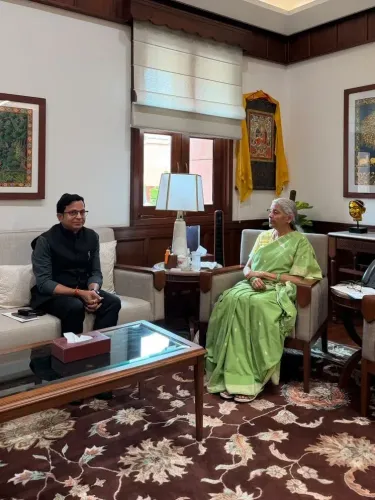
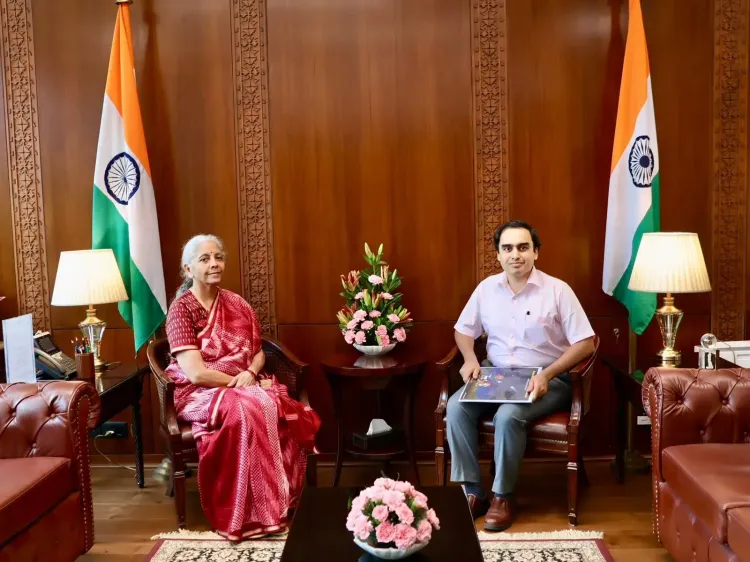
Union Finance Minister Nirmala Sitharaman on 29 May 2026 met Dr Varun Bhalerao, Professor of Physics at IIT Bombay, in what forms part of periodic consultations between the Finance Ministry and India's scientific community ahead of budget and policy cycles.
Key Takeaways
Union Finance Minister Nirmala Sitharaman received Dr Varun Bhalerao of IIT Bombay's Department of Physics on 29 May 2026 .
The meeting was confirmed via the Finance Minister's official X account; no agenda or outcome was disclosed.
Dr Bhalerao's work is in astrophysics and scientific instrumentation at one of India's premier public technical universities.
The Union Budget 2024-25 had bolstered R&D funding through the Anusandhan National Research Foundation .
Such consultations between the Finance Ministry and IIT faculty are part of routine processes to align research priorities with fiscal planning.
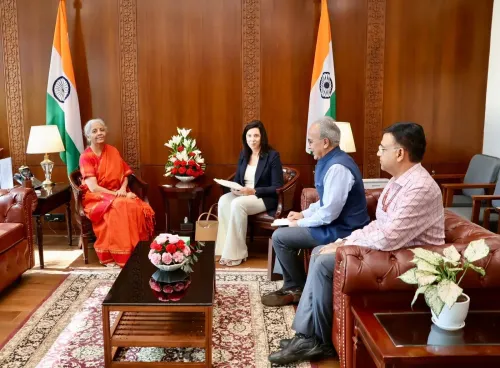
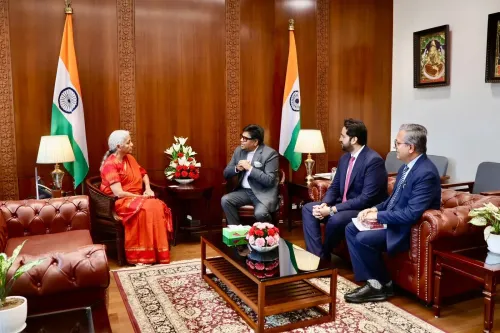
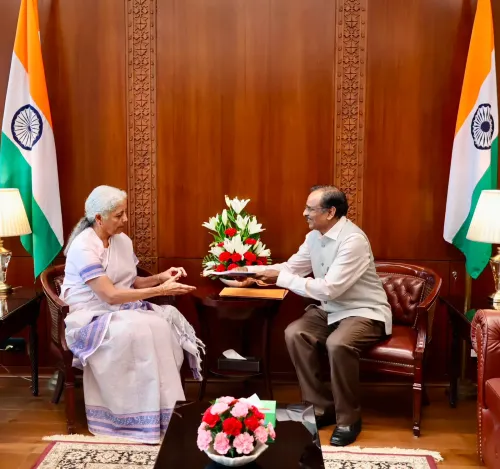
Union Finance Minister Nirmala Sitharaman received Dr Varun Bhalerao, Professor in the Department of Physics at IIT Bombay, at her office on Friday, 29 May 2026. The meeting, announced through the Finance Minister's official social-media account, is part of periodic consultations she holds with scientists and academics from the country's premier research institutions.
Context
Dr Bhalerao is a faculty member at the Indian Institute of Technology Bombay, one of India's foremost public technical universities, where his work spans astrophysics and scientific instrumentation. His department sits within an institution that has consistently ranked among the top contributors to India's fundamental and applied research output since its establishment in 1958. The call on the Finance Minister signals an interface between the scientific community and the country's fiscal policymakers.
No specific agenda or outcome of the meeting has been disclosed. The post confirms the visit without elaborating on the subjects discussed.
Policy Backdrop
The meeting comes against a backdrop of sustained policy emphasis on research-led growth. The National Education Policy 2020 explicitly called for deeper integration between research institutions and national development priorities, including enhanced funding for science, technology, engineering and mathematics. That direction was reinforced in the Union Budget 2024-25, which allocated additional resources for research and development through the Anusandhan National Research Foundation, a body designed to seed and grow competitive research across universities and institutes.
Finance ministers routinely consult domain experts ahead of budget cycles, and meetings with IIT faculty have historically fed into deliberations on higher-education grants, research fellowships and technology-mission outlays. Whether this interaction is pre-budget consultation or a standalone engagement has not been stated.
Stakeholders and Impact
For India's academic and scientific community, direct access to the Finance Ministry carries practical significance. Funding allocations for institutions such as IIT Bombay flow through the Union Budget, and inputs from active researchers can shape decisions on laboratory infrastructure, faculty positions and sponsored research programmes. Astrophysics and space-science instrumentation — areas associated with Dr Bhalerao's work — also intersect with national priorities around the Indian Space Research Organisation and indigenous satellite and observatory projects.
Broader stakeholders include IIT faculty across campuses, postdoctoral researchers dependent on nationally funded grants, and industry partners who co-invest in applied research emerging from these institutions.
What's Next
Observers will watch for any reference to enhanced research funding, new fellowship schemes or IIT-specific capital grants in the next Union Budget. Parliamentary standing committees on science and technology and on human resource development may also take note of such ministerial engagements as indicators of policy intent. The meeting underscores a continuing pattern in which the Finance Ministry treats top-tier academic institutions as stakeholders in shaping India's innovation-driven growth agenda.
Point of View
Ahead of what will be a full-year budget cycle, suggests the Ministry is actively canvassing domain expertise to shape allocations under frameworks like the Anusandhan National Research Foundation. For IIT Bombay's physics faculty, a direct line to the Finance Minister also signals that fundamental science, not just applied technology, is being treated as a budget-relevant priority. The meeting, modest in public detail, fits a broader pattern of the current Finance Ministry positioning itself as a partner to, rather than merely a funder of, India's research ecosystem.
NationPress
13 Oct 2026
Frequently Asked Questions
Why did the IIT Bombay professor meet Finance Minister Nirmala Sitharaman?
Dr Varun Bhalerao, a Physics Professor at IIT Bombay, called on Finance Minister Nirmala Sitharaman on 29 May 2026. The specific agenda was not disclosed, but such meetings are part of routine consultations between the Finance Ministry and scientists from premier institutions to inform research and education funding decisions.
Who is Dr Varun Bhalerao of IIT Bombay?
Dr Varun Bhalerao is a faculty member in the Department of Physics at IIT Bombay, where his research focuses on astrophysics and scientific instrumentation. IIT Bombay is one of India's foremost public technical universities, established in 1958.
What is the Anusandhan National Research Foundation?
The Anusandhan National Research Foundation is a government body set up to seed and grow competitive research across Indian universities and institutes. The Union Budget 2024-25 allocated additional resources to it as part of a broader push to enhance India's R&D capacity.
Does Nirmala Sitharaman regularly meet scientists and academics?
Yes, periodic meetings between the Finance Minister and scientists or faculty from top institutions form part of routine consultation processes. These interactions are used to align research and development priorities with macroeconomic objectives such as technology self-reliance and innovation-driven growth.
What could come out of the Finance Minister's meeting with IIT Bombay faculty?
Possible outcomes to watch include references to enhanced research funding, new fellowship schemes, or IIT-specific capital grants in the next Union Budget. Parliamentary committees on science and higher education may also track such engagements as signals of policy intent.