Sitharaman writes on Vastrakala, Tamil Nadu's drought-born embroidery art
Synopsis
Union Finance Minister Nirmala Sitharaman wrote a feature in Tamil daily Dinamalar on 19 July 2026, tracing how Vastrakala embroidery emerged as a livelihood alternative for farmers in the drought-prone Kanchipuram-Sriperumbudur-Thiruvallur belt of Tamil Nadu, calling patience, precision, and discipline the art's foundation.
Key Takeaways
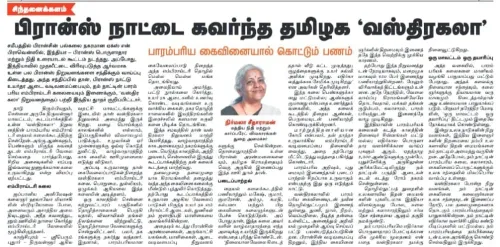
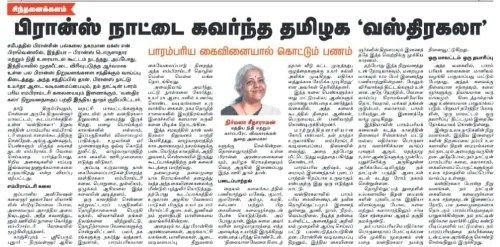
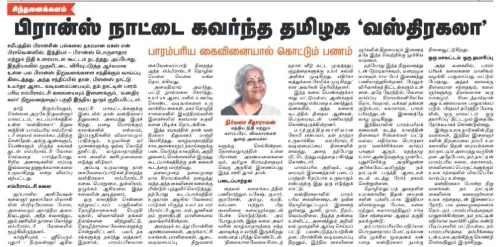
Union Finance Minister Nirmala Sitharaman published a feature article in Tamil daily Dinamalar on 19 July 2026 about the Vastrakala embroidery institution.
Vastrakala is located among the drought-prone districts of Kanchipuram , Sriperumbudur , and Thiruvallur in northern Tamil Nadu.
The embroidery tradition emerged as a livelihood alternative for farmers who could not rely on rain-fed agriculture during monsoon failures.
Sitharaman described patience, precision, and discipline as the three foundations of the Vastrakala embroidery art form.
Growing international interest in the craft, including from France , reflects India's broader push to position traditional artisan products in global markets.
The article amplifies national political attention on artisan communities in drought-vulnerable rural Tamil Nadu.
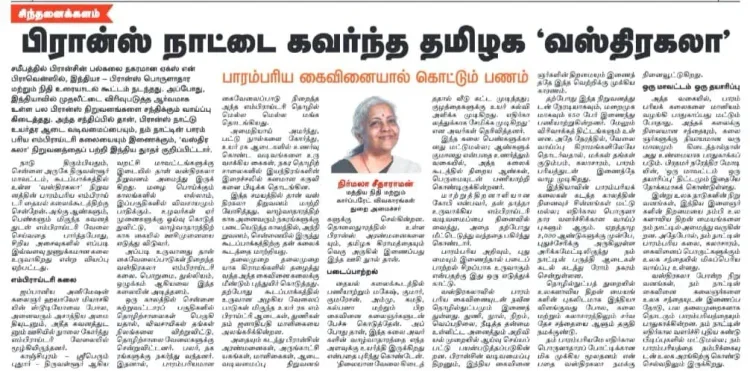
Union Finance Minister Nirmala Sitharaman on Sunday, 19 July 2026, wrote a feature article in the Tamil-language daily Dinamalar, spotlighting Vastrakala, a traditional embroidery institution rooted in the drought-prone districts of Kanchipuram, Sriperumbudur, and Thiruvallur in Tamil Nadu.
Context
In the article, Sitharaman describes how Vastrakala came to occupy a unique geographic and cultural space: situated at the intersection of three districts historically vulnerable to monsoon failure, the institution emerged as a livelihood anchor when farming became untenable. As she writes, 'உழவர்கள் ஏர்முனைகளுக்கு ஓய்வு கொடுத்துவிட்டு, வாழ்வாதாரத்திற்காக கையில் ஊசிமுனையை எடுத்து விடுவர்' — 'farmers would rest their ploughshares and pick up a needle for their livelihood.' The minister identifies patience, precision, and discipline as the three pillars on which this embroidery tradition stands.
The post, shared from the official handle of Sitharaman's office, quotes directly from her published piece and links to the full article. It carries two images, likely illustrating the craft and its practitioners.
Policy Backdrop
Kanchipuram and Thiruvallur are part of the rain-fed belt of northern Tamil Nadu where agricultural output swings sharply with annual rainfall. Craft-based clusters in such regions have historically received support under central schemes such as the Scheme for Fund for Regeneration of Traditional Industries (SFURTI) and the Mahatma Gandhi National Rural Employment Guarantee Act (MGNREGA), as well as state-level artisan welfare programmes. The broader national policy framework has increasingly sought to link traditional crafts with export promotion and Geographical Indication (GI) tagging to enhance their commercial viability.
India's push to position GI-tagged and handcrafted products in global markets has gained momentum in recent years, with bilateral cultural and trade forums — including those with France and other European Union members — serving as platforms to showcase such heritage goods. Vastrakala's embroidery art, rooted in necessity and refined over generations, fits squarely within this narrative of craft as both cultural heritage and economic resilience.
Stakeholders and Impact
The primary beneficiaries of Vastrakala's work are traditional artisans and drought-affected farming households in the Kanchipuram-Sriperumbudur-Thiruvallur belt. For these communities, embroidery has historically functioned as a counter-cyclical income source — most active precisely when the monsoon fails and fields lie fallow. Sitharaman's article, published in a widely read Tamil daily, brings national-level political attention to their craft and its origins.
Growing international interest in Indian handcraft — including in France, as referenced in the Dinamalar article's headline — signals potential export and cultural-exchange opportunities for artisans associated with Vastrakala. Such visibility, especially when amplified by a senior Union minister, can attract institutional funding, design collaborations, and market linkages that individual artisans could not access independently.
What's Next
The article's publication and its amplification by Sitharaman on social media may prompt follow-up action from both central and Tamil Nadu state bodies overseeing handicraft clusters and artisan welfare. Observers will watch for any new scheme announcements, export facilitation measures, or cultural-exchange tie-ups — particularly with France or EU partners — that reference Vastrakala or the broader embroidery tradition of northern Tamil Nadu.
More broadly, the minister's engagement with a regional craft narrative in a Tamil-language publication underscores the ongoing effort to connect national economic policy with grassroots livelihood stories — a framing that is likely to recur as India positions its artisan economy on global platforms.
Point of View
Particularly in a state where the BJP has historically sought stronger grassroots connect. By framing Vastrakala as a story of farmer resilience rather than government largesse, she aligns the craft narrative with the Centre's broader push to showcase India's artisan economy on global platforms, including in Europe. The timing, amid growing bilateral cultural interest from France, adds a soft-power dimension to what reads on the surface as a cultural tribute. It also reinforces the policy pattern of linking traditional crafts to GI tagging and export promotion as pillars of rural income diversification.
NationPress
18 Oct 2026
Frequently Asked Questions
What is Vastrakala and where is it located?
Vastrakala is a traditional embroidery institution in Tamil Nadu, situated at the intersection of the drought-prone districts of Kanchipuram, Sriperumbudur, and Thiruvallur. It emerged as a livelihood source for farmers when monsoon failures made agriculture unreliable.
What did Nirmala Sitharaman write about Vastrakala?
In a feature article published in the Tamil daily Dinamalar on 19 July 2026, Sitharaman described how Vastrakala embroidery was born from necessity — farmers in drought-hit districts would set aside their ploughs and take up needlework to sustain their families. She identified patience, precision, and discipline as the art's core values.
Why is Vastrakala embroidery significant for Tamil Nadu farmers?
In the rain-fed northern Tamil Nadu districts around Kanchipuram and Thiruvallur, agriculture is highly dependent on monsoon rains. When rains fail, embroidery crafts like those practised at Vastrakala provide an alternative income source, making the art both a cultural heritage and an economic safety net.
Is Vastrakala embroidery gaining international recognition?
There is growing international interest in Vastrakala's embroidery, including from France, as referenced in the Dinamalar article. India's broader push to promote GI-tagged and traditional crafts in global markets has helped elevate such regional art forms onto international platforms.
What central government schemes support traditional craft clusters like Vastrakala?
Craft clusters in drought-prone rural areas have historically received support through central initiatives such as the Scheme for Fund for Regeneration of Traditional Industries (SFURTI) and state-level artisan welfare programmes, alongside export promotion efforts linked to GI tagging.