Sonowal meets NINEISMINE child parliamentarians on INDGs
Synopsis
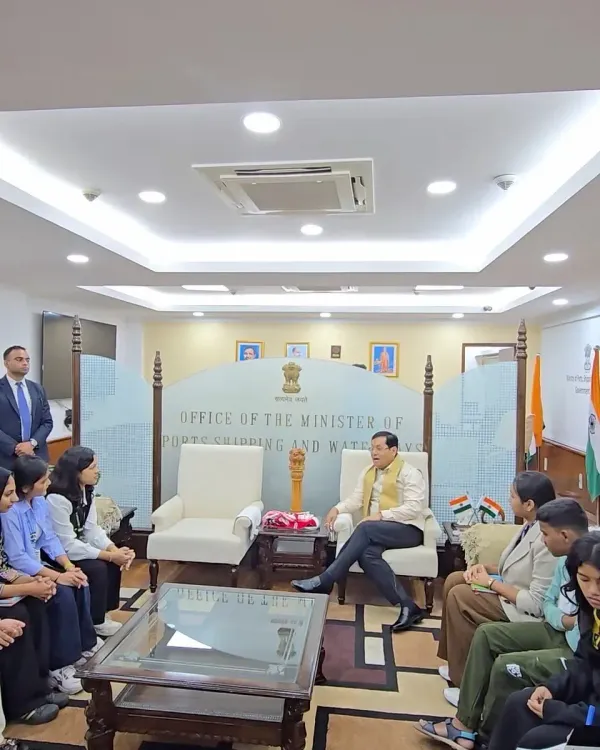
Union Minister Sarbananda Sonowal met NINEISMINE Children Parliamentarians on 18 November 2026, praising their push for Inclusive Development Goals (INDGs) representing children across 29 states and UTs, and calling for children to be active participants — not merely stakeholders — in India's development.
Key Takeaways
Sarbananda Sonowal , Union Minister of Ports, Shipping and Waterways, met NINEISMINE Children Parliamentarians on 18 November 2026 .
The children represent voices from 29 states and Union Territories through a structured child-parliament advocacy model.
They are pushing for Inclusive Development Goals (INDGs) , a child-led framework to integrate children's aspirations into national development planning.
Sonowal stated children must be 'active participants in shaping' the future, not mere stakeholders — aligning with NINEISMINE's core argument.
India's engagement with child-participation mechanisms builds on the National Policy for Children (2013) and the SDGs adopted in 2015 .
Formal adoption of INDGs into government schemes remains the key milestone to watch following this ministerial engagement.
When a minister sits down with children who have travelled from 29 states and Union Territories to advocate for their own futures, the room carries a particular kind of weight. Union Minister of Ports, Shipping and Waterways Sarbananda Sonowal on Wednesday, 18 November 2026, met young members of children's advocacy movement NINEISMINE — a group of 'Children Parliamentarians' pressing for a home-grown child-rights framework called Inclusive Development Goals (INDGs).
Who are the NINEISMINE Children Parliamentarians?
NINEISMINE is a child-led advocacy movement in India that works to ensure children are not passive objects of policy but active voices in shaping it. Its Children Parliamentarians represent young people from across the country, channelling their concerns on education, health, equity, and inclusion through a structured parliamentary format that mirrors adult democratic institutions — only with more urgency and considerably less cynicism.
The movement's central demand is recognition of Inclusive Development Goals (INDGs) — a child-led framework designed to integrate the aspirations of children into India's development planning, complementing the global Sustainable Development Goals (SDGs) that India adopted in 2015.
Sonowal's message: participants, not passengers
Posting about the interaction, Sonowal called the children's 'passion and commitment to building a better future truly inspiring.' He went further than routine praise, articulating a clear position: 'Children are not just mere stakeholders in our future, rather they must be active participants in shaping it.' That framing — moving children from stakeholder to participant — is precisely the philosophical shift NINEISMINE's advocacy is built around.
The minister commended the INDGs framework for ensuring that voices and aspirations of children across all 29 states and UTs are 'meaningfully represented' in development conversations at the national level.
India's child-participation landscape
India's National Policy for Children, adopted in 2013, laid a formal foundation for safeguarding child rights and promoting development. Structured mechanisms like children's parliaments have since become a recognised format for amplifying young voices, sitting alongside India's commitments under the SDGs on education, health, and inclusion. The NINEISMINE model extends this tradition by giving regional representation a systematic, advocacy-ready structure — the INDGs.
Ministerial engagement of this kind signals that the INDGs conversation has reached at least the level of senior government attention, even if formal adoption into policy schemes remains a next step to watch.
Children who already argue their case in front of Union Ministers rarely stop at a photo opportunity — the question now is whether INDGs find their way from the room into the roadmap.
Point of View
Whose political identity is rooted in Assam's grassroots, the optics of championing inclusive, regional representation are entirely consistent with his public profile. The sharper question is whether this interaction translates into any formal government endorsement or budgetary recognition of the INDGs framework. India's pattern on child participation — strong on stated principle, uneven on institutional follow-through — means the proof will lie in what happens next in the policy pipeline.
NationPress
18 Nov 2026
Frequently Asked Questions
What are Inclusive Development Goals (INDGs)?
INDGs, or Inclusive Development Goals, are a child-led advocacy framework promoted by NINEISMINE that seeks to ensure children's voices and aspirations are meaningfully included in India's development planning, drawing inspiration from but going beyond the global Sustainable Development Goals.
Why did Sarbananda Sonowal meet NINEISMINE children?
Union Minister Sarbananda Sonowal met NINEISMINE Children Parliamentarians on 18 November 2026 to engage with their advocacy for INDGs, calling their commitment to inclusive development inspiring and stating that children must be active participants — not just stakeholders — in shaping India's future.
How many states do NINEISMINE Children Parliamentarians represent?
The NINEISMINE Children Parliamentarians represent children from 29 states and Union Territories across India.
What is India's existing policy framework for children's rights?
India adopted the National Policy for Children in 2013 to safeguard child rights and promote development, and committed to the United Nations Sustainable Development Goals in 2015, which include targets on education, health and inclusion for children.