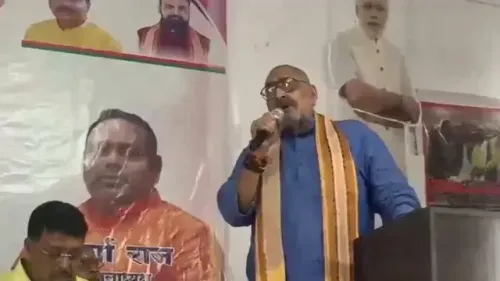
Sonowal credits Modi's 'Niyat and Niti' for poverty gains
Synopsis
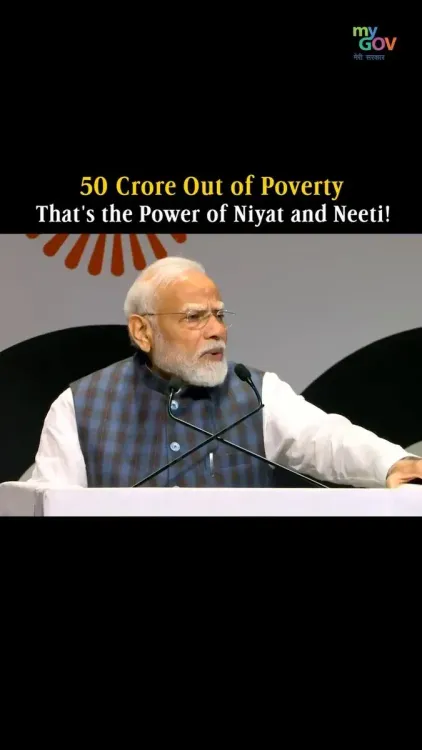
Union Minister Sarbananda Sonowal invokes PM Modi's 'Niyat and Niti' to claim 50 crore people lifted from poverty in 12 years, drawing a pointed contrast with five decades of unfulfilled Garibi Hatao promises dating to Indira Gandhi's 1971 campaign.
Key Takeaways
Union Minister Sarbananda Sonowal posted on 19 November 2026 crediting PM Modi's intent and policy for India's poverty reduction record.
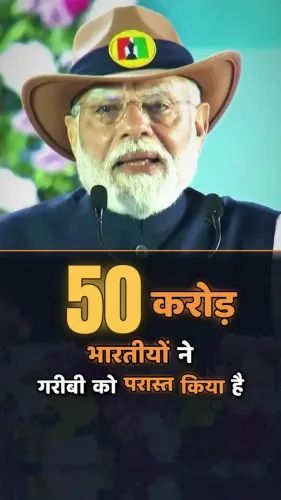
Sonowal claims 50 crore (500 million) people have been lifted out of poverty in 12 years under the Modi government since 2014.
The post draws a direct contrast with the Garibi Hatao slogan introduced by Indira Gandhi in the 1971 general election — a promise that persisted for over five decades without comparable outcomes, per the BJP's framing.
NITI Aayog 's Multidimensional Poverty Index is the government's primary data vehicle for such claims; the precise 50-crore figure has not been independently confirmed in published reports.
The messaging follows an established BJP pattern of anchoring welfare gains against Congress-era baselines to reinforce governance contrast heading into future electoral cycles.
Half a century after Indira Gandhi made Garibi Hatao (Eradicate Poverty) a national rallying cry, Union Ports and Shipping Minister Sarbananda Sonowal has drawn a sharp contrast — arguing that where the slogan endured for decades without measurable transformation, Prime Minister Narendra Modi's government has delivered what politics long promised.
Posting on Thursday, 19 November 2026, Sonowal wrote: 'India's progress is powered by the Niyat and Niti of Hon'ble PM Shri Narendra Modi Ji. Despite calls for Garibi Hatao since the 1970s, it took just 12 years to lift 50 crore people out of poverty.' The framing is deliberate — Niyat (intent) and Niti (policy) positioned as the twin engines that older governments, the implicit argument goes, never truly engaged.
From slogan to scoreboard: the 1971 baseline
Indira Gandhi launched the Garibi Hatao slogan during the 1971 general election, turning anti-poverty rhetoric into electoral currency. It became one of the most recognisable political phrases in independent India's history. For the next four decades, successive governments invoked variations of the same promise. Sonowal's post weaponises that history directly — the five-decade gap between the slogan's birth and the BJP's arrival in power is the implicit indictment.
The 50-crore figure and what NITI Aayog's data shows
The claim that 50 crore (500 million) people have been lifted out of poverty in 12 years is a figure Sonowal attributes to the Modi era's record since 2014. NITI Aayog's Multidimensional Poverty Index, which tracks deprivation across health, education, and living standards, has in earlier releases documented significant poverty reduction — though the precise figure of 50 crore over this specific period has not been independently confirmed in publicly available reports reviewed at the time of writing.
What is established: NITI Aayog's methodology has shown consistent improvement across flagship programmes — from direct benefit transfers under Jan Dhan Yojana to food security under the PM Garib Kalyan Anna Yojana. The government has repeatedly cited these indices to anchor its welfare narrative ahead of electoral cycles.
BJP's signature contrast-messaging playbook
Sonowal's post is a textbook example of a rhetorical approach the BJP has refined across nearly a decade in power: anchor a development claim against the longest possible historical baseline, then credit the contrast entirely to post-2014 governance. The Congress-era Garibi Hatao slogan is the preferred foil — familiar enough for every voter to recognise, yet carrying the weight of unfulfilled promise. By invoking it, Sonowal does not need to name an opponent. The history does the work.
As the next NITI Aayog Multidimensional Poverty Index report approaches, the government will almost certainly refresh these numbers — and opposition parties will scrutinise the methodology just as closely. The numbers matter less as final verdicts than as the terrain on which the next welfare argument will be fought.
Fifty years after the slogan was born, the battle over who finally delivered on it is very much alive.
Point of View
Not just an electoral one. The invocation of Indira Gandhi's 1971 slogan is strategically precise: it ties Congress to decades of broken promises without naming the party directly. However, the 50-crore figure, if unverified by the next NITI Aayog release, could become a liability — opposition parties are likely to demand a methodology breakdown. The real contest ahead is not over the slogan but over whose numbers hold up.
NationPress
19 Nov 2026
Frequently Asked Questions
What did Sarbananda Sonowal say about poverty reduction under PM Modi?
Sonowal posted that India's progress is powered by PM Modi's 'Niyat and Niti' (intent and policy), claiming that 50 crore people were lifted out of poverty in just 12 years — contrasting this with over five decades of unfulfilled Garibi Hatao promises.
What is the Garibi Hatao slogan and who started it?
Garibi Hatao, meaning 'Eradicate Poverty,' was introduced by former Prime Minister Indira Gandhi during the 1971 general election campaign. It became one of India's most iconic political slogans but was widely criticised for not translating into sustained poverty reduction.
Has NITI Aayog confirmed that 50 crore people were lifted out of poverty?
NITI Aayog's Multidimensional Poverty Index has documented significant poverty reduction under the Modi government, but the specific claim of 50 crore people over 12 years has not been confirmed in publicly available published reports at this time.
What is India's Multidimensional Poverty Index?
India's Multidimensional Poverty Index, published by NITI Aayog, measures poverty across three dimensions — health, education, and standard of living — using multiple indicators beyond income, giving a broader picture of deprivation than traditional poverty lines.
Why do BJP leaders often reference the Garibi Hatao slogan?
BJP leaders use the Garibi Hatao reference to contrast Congress-era promises with their own governance record, positioning the Modi government as having delivered on a development agenda that the opposition failed to fulfil across several decades.