Sonowal Hails India's 300 GW Non-Fossil Fuel Milestone
Synopsis
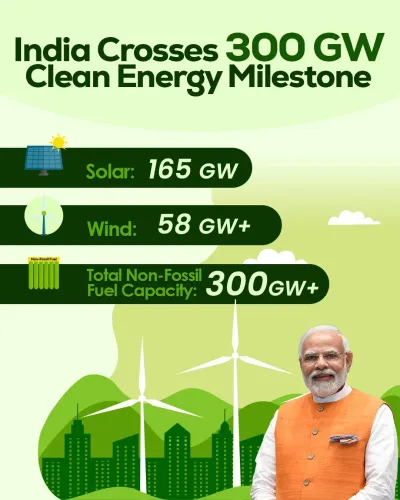
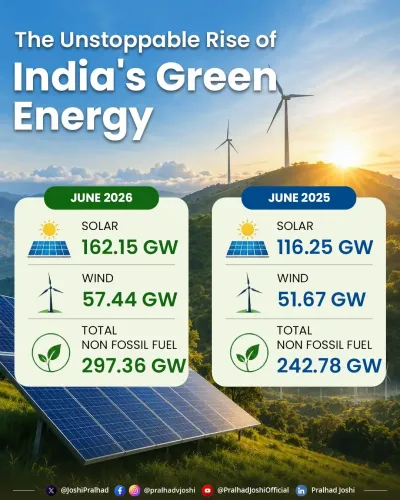
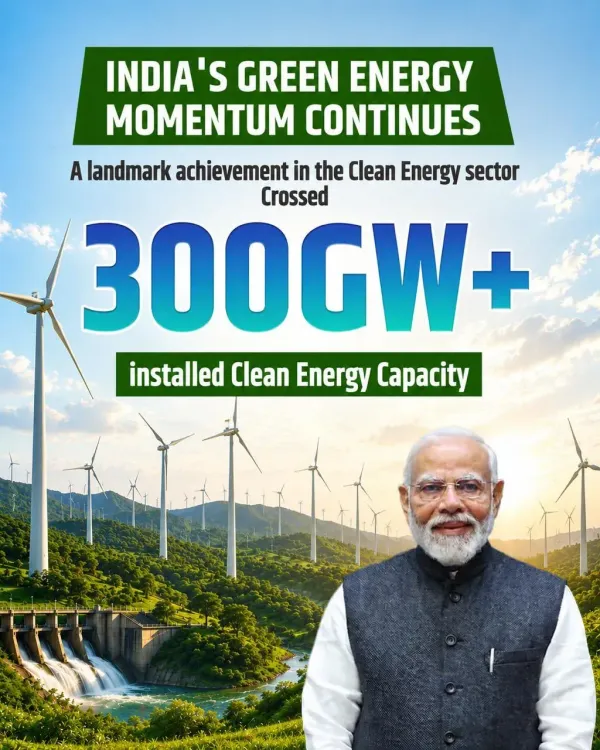
India has crossed 300 GW of non-fossil fuel installed capacity, Union Minister Sarbananda Sonowal announced on 8 August 2026. The milestone represents 60 percent of India's COP26 pledge of 500 GW by 2030, underscoring the country's accelerating clean-energy transition under PM Modi's Panchamrit framework.
Key Takeaways
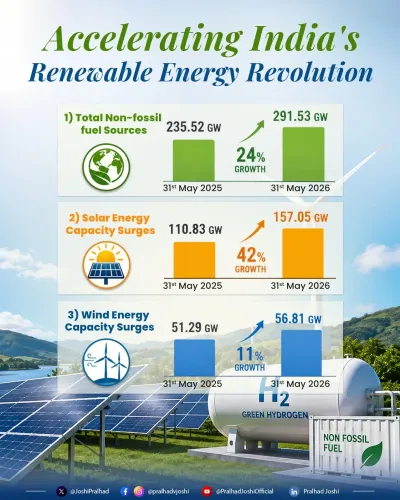
India has crossed 300 GW of installed non-fossil fuel power capacity as of August 2026.
This equals 60 percent of India's COP26 commitment of 500 GW non-fossil capacity by 2030 .
The milestone aligns with India's domestic target of 50 percent non-fossil share in cumulative electric power capacity by 2030.
PM Modi's Panchamrit framework , announced at COP26 in November 2021, set the 500 GW waypoint alongside a net-zero target of 2070.
Growth has been driven by solar, wind, hydro and nuclear additions supported by government auctions and viability gap funding.
India has crossed a landmark 300 GW of installed non-fossil fuel power capacity — a threshold that places the country firmly on the map as one of the world's most ambitious clean-energy builders. Union Minister of Ports, Shipping and Waterways Sarbananda Sonowal marked the moment on Saturday, 8 August 2026, calling it 'a decisive step towards energy security, sustainability and the vision of a clean India.'
Why 300 GW is a Number Worth Stopping For
At the COP26 climate summit in Glasgow in November 2021, Prime Minister Narendra Modi committed India to reaching 500 GW of non-fossil fuel capacity by 2030 — a pledge lodged under India's updated Nationally Determined Contributions to the Paris Agreement. The 300 GW mark, therefore, is not just a round number: it represents 60 percent of that 2030 goal already in the ground, with four years still to run. India also carries a domestic target of 50 percent of cumulative electric power capacity from non-fossil sources by 2030, and crossing 300 GW moves that needle significantly.
The build-out has been driven by a broad mix of solar, wind, hydro and nuclear additions, underpinned by competitive auctions, viability gap funding and state-level renewable purchase obligations that have steadily pulled private capital into the sector.
The Panchamrit Promise and the Road to 500 GW
PM Modi's Panchamrit framework — India's five-point climate commitment announced at COP26 — set net-zero by 2070 as the horizon and 500 GW non-fossil capacity as the nearest hard waypoint. Each gigawatt added chips away at India's dependence on imported fossil fuels, a strategic imperative that sits alongside the climate one. The Ministry of New and Renewable Energy's pipeline of upcoming auctions and transmission infrastructure investments will determine whether the final 200 GW sprint to the 2030 finish line stays on schedule.
Sonowal's post, tagged #300GWCleanEnergy, signals that the milestone is being claimed as a whole-of-government achievement — not just a sector statistic.
Point of View
As Sonowal does, frames clean energy as a flagship governance achievement ahead of any domestic or international review cycles. The real test, however, is whether transmission infrastructure and grid-balancing investments keep pace with generation capacity, since raw installed numbers do not automatically translate into reliable clean power delivered to consumers. Watchers of India's energy policy will focus next on whether the Ministry of New and Renewable Energy accelerates the tender pipeline to close the remaining 200 GW gap before 2030.
NationPress
8 Aug 2026
Frequently Asked Questions
What does India's 300 GW non-fossil fuel capacity milestone mean?
India has installed 300 GW of power capacity from non-fossil sources — including solar, wind, hydro and nuclear — meaning it has achieved 60 percent of its COP26 pledge to reach 500 GW by 2030.
What is India's renewable energy target for 2030?
India pledged at COP26 in 2021 to reach 500 GW of non-fossil fuel power capacity by 2030 and to source 50 percent of its cumulative electric power from non-fossil sources by the same year.
What is the Panchamrit climate commitment?
Panchamrit is PM Modi's five-point climate pledge announced at COP26 in November 2021. It includes reaching 500 GW non-fossil capacity, generating 50 percent energy from renewables, reducing carbon intensity by 45 percent, cutting projected carbon emissions by one billion tonnes, and achieving net-zero by 2070.
Who is Sarbananda Sonowal?
Sarbananda Sonowal is a senior BJP leader and Union Minister of Ports, Shipping and Waterways in the Government of India. He previously served as Chief Minister of Assam.
How has India built its non-fossil fuel capacity?
India has expanded non-fossil capacity through competitive renewable energy auctions, viability gap funding, state-level renewable purchase obligations, and sustained investment in solar, wind, hydro and nuclear projects.