Sonowal Marks 12 Years of Make in India: Ships to Chips

Synopsis
On the twelfth anniversary of Make in India, Ports Minister Sarbananda Sonowal invokes PM Modi's vision with a 'Ships to Chips' frame, linking maritime manufacturing to India's emerging semiconductor ambitions under the same flagship programme.
Key Takeaways
Make in India marks its 12th anniversary in September 2026 , having been launched by PM Modi on 26 September 2014 .
Minister Sonowal's 'Ships to Chips' phrase ties traditional shipbuilding — central to his own ministry — with high-technology semiconductor production.
The initiative originally targeted 25 sectors and has since been reinforced by production-linked incentive schemes across electronics, pharma, and defence.
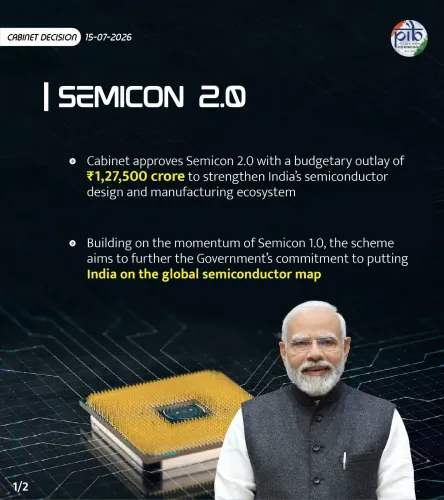
The India Semiconductor Mission is the current frontier the Minister's post implicitly points to.
Port-led industrialisation under the Sagarmala programme forms the maritime manufacturing backbone that complements the broader Make in India effort.
Twelve years after Prime Minister Narendra Modi unveiled the Make in India initiative in September 2014, India's manufacturing ambition has stretched from the shipyard to the semiconductor fab — and Union Ports and Shipping Minister Sarbananda Sonowal wants the world to notice.
From the waterfront to the wafer: what the 'Ships to Chips' frame means
Sonowal's post captures a deliberate arc: 'From Ships to Chips, India now makes for the world.' It is shorthand for a twelve-year journey that began with persuading global manufacturers to set up assembly lines on Indian soil and has since pushed into some of the most complex, capital-intensive industries on the planet. Shipbuilding sits at one end of that spectrum — large-scale, steel-intensive, deeply linked to port infrastructure. Semiconductors sit at the other — precision-engineered, technology-dense, and among the most strategically contested supply chains of the decade.
The framing is pointed. By anchoring both sectors under a single slogan, the Minister is making the case that Make in India is no longer a programme for low-cost assembly; it is a claim on advanced manufacturing.
Make in India at 12: the policy lineage behind the milestone
Make in India was launched on 26 September 2014 — making this week its twelfth anniversary. The initiative's original goal was to raise manufacturing's share of GDP and draw foreign direct investment across 25 sectors, from automobiles and defence to textiles and electronics. Over the following decade, production-linked incentive schemes were layered on top, targeting everything from mobile phones to pharmaceutical ingredients.
Sonowal's own ministry sits squarely inside that story. Port-led industrialisation — clustering factories, logistics parks, and shipyards around major ports — has been a recurring theme of the Sagarmala programme, which runs parallel to Make in India in the maritime domain. Connecting that older industrial logic to the newer semiconductor push is the Minister's signal that both efforts belong to the same national manufacturing project.
India Semiconductor Mission and the next frontier
The 'chips' half of the slogan points directly at the India Semiconductor Mission, the government's push to establish domestic fabrication capacity. Semiconductor manufacturing requires years of investment before a single wafer rolls off a line — which makes public political commitment, and the visibility that comes with it, part of the enabling environment. Watchers of the sector will be tracking whether fab projects move from ground-breaking to commercial production, and how port-linked industrial corridors feed into the supply chains those fabs will need.
Twelve years in, the headline has changed — from 'India could manufacture' to 'India manufactures.' Whether the chips era delivers on that promise at scale is the next chapter.
Point of View
Positioning the Ports ministry's Sagarmala-driven port industrialisation as integral to the same Make in India arc that now aspires to semiconductor sovereignty. The 'Ships to Chips' frame signals a conscious effort to rebrand Make in India from a low-cost-assembly story to a high-value, dual-use manufacturing narrative ahead of an election cycle in which economic self-reliance remains a core BJP proposition. The semiconductor angle is also a geopolitical signal: as global chip supply chains fragment, India's ability to credibly insert itself depends on exactly this kind of sustained, high-level political visibility. Whether the policy infrastructure — fab subsidies, skilled-labour pipelines, power and water guarantees — can match the rhetoric is the tension that will define the programme's next chapter.
NationPress
25 Sept 2026
Frequently Asked Questions
When was Make in India launched?
Make in India was launched by Prime Minister Narendra Modi on 26 September 2014 , making September 2026 its twelfth anniversary.
What does 'Ships to Chips' mean in Sonowal's post?
The phrase captures India's manufacturing journey from large-scale shipbuilding — linked to Sonowal's own Ports ministry — to advanced semiconductor production, arguing that Make in India now spans both ends of the industrial complexity spectrum.
What is the India Semiconductor Mission?
The India Semiconductor Mission is a government programme aimed at establishing domestic chip fabrication capacity, attracting investment and technology partnerships to build a semiconductor manufacturing ecosystem inside India.
What is the Sagarmala programme?
Sagarmala is India's port-led industrialisation initiative that clusters factories, logistics parks, and shipyards around major ports, and it operates in tandem with the broader Make in India programme in the maritime domain.
What sectors did Make in India originally target?
At launch, Make in India identified 25 sectors — including automobiles, defence, electronics, textiles, and pharmaceuticals — as priority areas for boosting domestic production and foreign direct investment.