Stalin salutes fishers, slams secretariat move on World Fisheries Day
Synopsis
On World Fisheries Day 2026, DMK president M. K. Stalin saluted Tamil Nadu's fishing communities, highlighted Dravidian Model welfare measures, and attacked the ruling government's reported plan to build a new secretariat at the historic Pattinapakkam fishing hamlet.
Key Takeaways
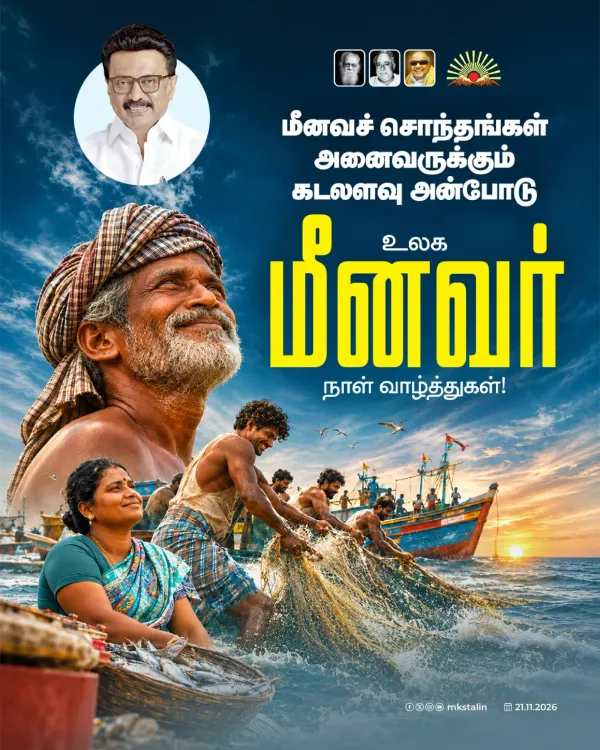
Stalin posted a World Fisheries Day message on 21 November 2026 in Tamil, hailing fisherfolk as நெய்தல் நில நாயகர்கள் ('lords of the coastal landscape').
Stalin listed Dravidian Model measures including fishing-ban-period relief hikes, new harbours, hook-and-line zones, and fuel subsidies delivered under DMK rule.
He attacked the current ruling party's reported plan to construct a new state secretariat at Pattinapakkam , calling it a destruction of a traditional fishing habitat.
Stalin alleged the secretariat site decision was made on an astrologer's advice — a claim the research flags as unverified from established public record.
He accused the incumbent Chief Minister of portraying a fisherman on screen without understanding their real struggles.
The DMK pledged to continue advocating for fishermen's sea safety, traditional fishing rights, and the education and economic advancement of coastal families.
On World Fisheries Day, 21 November 2026, DMK president M. K. Stalin paid tribute to Tamil Nadu's coastal fishing communities with an ocean-sized pledge: the Dravida Munnetra Kazhagam will never stop fighting for their safety, traditional rights, and economic dignity — and then pivoted to a sharp political attack on the ruling government's secretariat relocation plans.
Pride in the 'Neidhal Nila Nayagars' — and what the DMK did for them
Writing in Tamil, Stalin described fisherfolk as 'நெய்தல் நில நாயகர்கள்' ('lords of the coastal landscape') — a classical Sangam literary reference that places Tamil fishing communities at the very foundation of the civilisation's cultural identity. It is a framing the DMK has used consistently, rooting welfare arguments in cultural pride rather than charity.
Stalin listed the specific measures delivered under the Dravidian Model governance framework: a raised fishing-ban-period relief amount, construction of new fishing harbours, hook-and-line fishing zones (தூண்டில் வளைவுகள்), and fuel subsidies for boats. DMK governments going back to the 1970s have periodically expanded these benefits, and Stalin's framing positions the latest iteration as a continuation of that multi-decade commitment to coastal welfare.
Pattinapakkam: where a historic hamlet meets a government blueprint
The sharpest line in the post targets a proposal, reportedly under consideration by the current state administration, to build a new secretariat complex at Pattinapakkam — a historic fishing settlement on Chennai's coastline. Stalin alleged the decision was made on the advice of an astrologer, calling it a move that would 'destroy the traditional living space of fisherfolk.'
Pattinapakkam has been at the centre of coastal land-use disputes before. Chennai's expanding urban footprint and recurring proposals to redevelop its shoreline have repeatedly collided with the livelihoods and ancestral claims of fishing families who have worked those shores for generations. For Stalin, the secretariat proposal is not a planning question — it is a question of whose city this is.
The jab at the Chief Minister: 'playing a fisherman on screen'
Stalin's most pointed rhetorical strike was aimed at the incumbent Chief Minister directly, accusing him of 'having acted as a fisherman in films' but having no genuine understanding of their real struggles. The line is a reference to the Chief Minister's film career before entering politics — a biographical detail Stalin weaponises to draw a contrast between cinematic sympathy and lived solidarity.
Tamil Nadu's two dominant Dravidian parties have long competed fiercely on fisheries welfare, trading announcements of subsidies, harbour projects, and ban-period support. What is different this time is the specific territorial dimension: a government building versus a community's ancestral ground. That is a fight with photographs, protest marches, and vote arithmetic attached to it.
DMK's three-point pledge to coastal Tamil Nadu
Stalin closed with a three-part commitment: protect fishermen's safety at sea, defend traditional fishing rights, and improve education and economic outcomes for fishing families. The post ends with a salute to those who 'risk their lives battling the waves to feed the world' — a closing line calibrated to resonate on a day when fishing communities across the globe are being recognised.
With state budget season approaching and fishing groups watching the secretariat relocation debate closely, Stalin's World Fisheries Day post is as much a political marker as it is a tribute — a signal to Tamil Nadu's coastal constituencies that the DMK intends to own this fight.
Point of View
Then pivot to a concrete territorial grievance that puts the ruling party on the defensive. The Pattinapakkam angle is significant because coastal land-use disputes carry immediate electoral weight in Chennai's shoreline constituencies, and framing a government building proposal as cultural erasure is far more potent than a subsidy comparison. With state budget allocations for the fisheries department still ahead, the post also serves as a pressure point — signalling that DMK will make fishing-community welfare a live issue before those numbers are set.
NationPress
21 Nov 2026
Frequently Asked Questions
What is World Fisheries Day and when is it observed?
World Fisheries Day is observed every year on 21 November to highlight the vital socio-economic role of fishing communities and promote sustainable fisheries worldwide.
What welfare schemes did the DMK government implement for Tamil Nadu fishermen?
According to Stalin's post, DMK's Dravidian Model governance delivered a raised fishing-ban-period relief amount, construction of new fishing harbours, hook-and-line fishing zones, and fuel subsidies for fishing boats.
Why is Pattinapakkam in the news for fishermen?
Pattinapakkam is a historic fishing hamlet in Chennai whose coastal land has been subject to redevelopment proposals. Stalin's post alleges the current government plans to build a new secretariat there, which he says would destroy the traditional living space of fishing families.
What is the Dravidian Model?
The Dravidian Model is the DMK's governance framework emphasising targeted relief, subsidies, and development programs for marginalised and traditional communities, including coastal fishing populations.
What did Stalin say about the Tamil Nadu Chief Minister on World Fisheries Day?
Stalin accused the Chief Minister of having 'played a fisherman in films' while lacking genuine understanding of real fishermen's struggles — a reference to the Chief Minister's film career before entering politics.