Stalin Meets Student Funded by Annaal Ambedkar Overseas Scheme
Synopsis
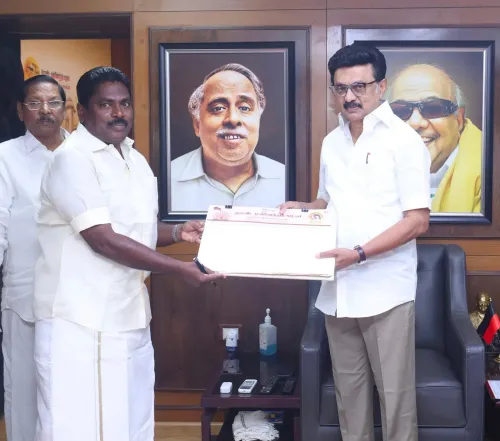
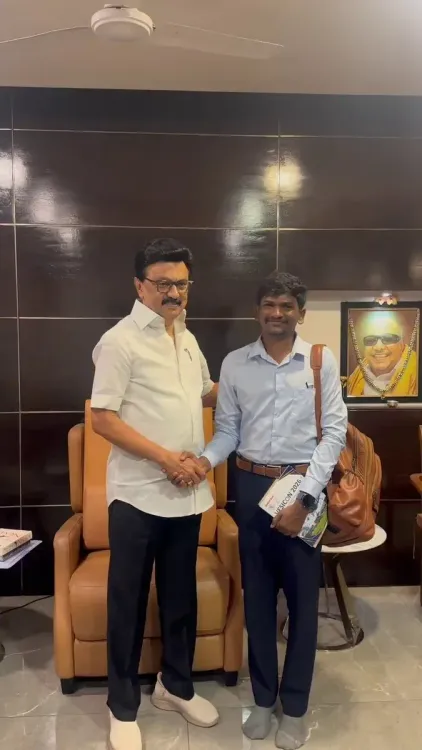
DMK president M. K. Stalin met Bharathidasan, a first-generation graduate from Aandipatti now researching in Malaysia under the Annaal Ambedkar Overseas Higher Education Scheme, and called on the current government to sustain support for such students.
Key Takeaways
Bharathidasan , a first-generation graduate from Aandipatti , is conducting research in Malaysia under the Annaal Ambedkar Overseas Higher Education Scheme.
He met DMK president M.
Stalin on 15 October 2026 and expressed gratitude for support from the #DravidianModel government and party.
Stalin described listening with keen interest to Bharathidasan's research and said he felt 'immense pride' that many first-generation graduates are benefiting from the scheme.
The scheme is named after B.
Ambedkar and targets Dalit, backward-class, and first-generation students for overseas higher education funding.
Stalin issued a direct appeal to the current government to continue providing assistance to students like Bharathidasan without interruption.
A young researcher from Aandipatti walked into DMK president M. K. Stalin's office on Thursday, 15 October 2026 — not as a supplicant, but as proof. Bharathidasan, a first-generation graduate funded under the Annaal Ambedkar Ayalaga Uyar Kalvi Thittam (Annaal Ambedkar Overseas Higher Education Scheme), is currently conducting doctoral research at a university in Malaysia, and he stopped by to say thank you.
Stalin shared the meeting on X in Tamil, writing that Bharathidasan 'met me today, joyfully expressing gratitude for the assistance provided by the #DravidianModel government and the party.' The post captures a moment the DMK frames as the human dividend of its flagship social-welfare architecture — a boy from a small town in Theni district now doing research on the world stage.
From Aandipatti to a Malaysian university lab
Stalin noted he 'listened with keen interest' as Bharathidasan described his ongoing research at the overseas institution. The detail is deliberate: Aandipatti is a modest town, and a first-generation graduate reaching a foreign research programme is precisely the trajectory the scheme was designed to create. Stalin said he felt 'immense pride' hearing that many more first-generation graduate students like Bharathidasan are benefiting from the scheme.
The Annaal Ambedkar scheme — named after B. R. Ambedkar — is positioned by the DMK as an extension of the party's long-standing social-justice mission: channelling state resources to give Dalit, backward-class, and first-generation students access to elite global education that private funding alone could never deliver.
Stalin's appeal to the current government
The post carries a pointed closing line. Stalin writes that 'the current government must continue providing the necessary support to our students like Bharathidasan and encourage them.' The phrasing — 'tharpoathaiya arasu', meaning 'the present government' — is a careful piece of political signalling, reminding whichever administration holds power that this pipeline of state-backed overseas scholars must not be broken.
It is a reminder that schemes built on annual budget allocations are only as durable as political will — and that the students mid-research abroad are the most vulnerable if that will wavers.
Bharathidasan came to say thank you. Stalin used the moment to demand continuity. For the students still waiting for their scholarships, that demand may matter far more than the handshake.
Point of View
He anchors the abstract 'Dravidian Model' brand to a flesh-and-blood beneficiary, a narrative device the DMK has long used to defend social-welfare spending against fiscal critics. The closing appeal to 'the current government' hints at DMK anxiety that state-funded overseas scholarship pipelines can be quietly defunded between budget cycles. More broadly, the post fits a pattern in Indian state politics where welfare scheme stewardship — who built it, who sustains it, who might cut it — is fought as much on social media as in the legislature.
NationPress
15 Oct 2026
Frequently Asked Questions
What is the Annaal Ambedkar Ayalaga Uyar Kalvi Thittam?
It is a Tamil Nadu government scheme named after B. R. Ambedkar that funds first-generation and socially marginalised students to pursue higher education and research at overseas universities.
Who is Bharathidasan and where is he studying?
Bharathidasan is a first-generation graduate from Aandipatti in Theni district, Tamil Nadu, currently conducting research at a university in Malaysia under the Annaal Ambedkar Overseas Higher Education Scheme.
Why did Stalin meet Bharathidasan on 15 October 2026?
Bharathidasan visited Stalin to express gratitude for the support extended by the DMK government and party under the Dravidian Model, and Stalin used the occasion to hear about his research in Malaysia.
What is the Dravidian Model in Tamil Nadu politics?
The Dravidian Model is the DMK's governance framework emphasising social justice, caste-based welfare, education access, and public health — used as a political brand to distinguish Tamil Nadu's development approach from other state models.
What did Stalin ask the government to do for overseas students?
Stalin appealed directly to the current government to continue providing all necessary support and encouragement to students like Bharathidasan who are pursuing research abroad under state scholarship schemes.