What Does the Supreme Court's Stay on Sengar's Sentence Mean?

Synopsis
On December 29, AAP's Swati Maliwal hailed the Supreme Court's decision to stay the bail of Kuldeep Sengar, emphasizing that crimes against women and children won't be taken lightly. This pivotal ruling sends an important message about justice. Discover the implications of this landmark decision in our detailed report.
Key Takeaways
Supreme Court stayed bail for Kuldeep Sengar.
Emphasizes justice for women and children.
Swati Maliwal applauds the decision.
Unique circumstances led to this ruling.
CBI directed to file a counter-affidavit.
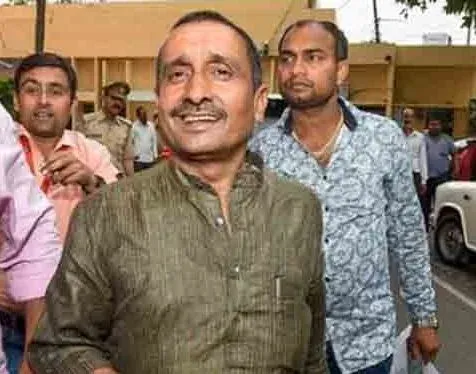
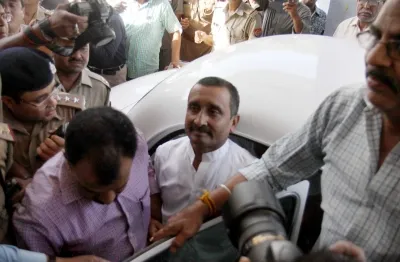
New Delhi, Dec 29 (NationPress) AAP Rajya Sabha member Swati Maliwal expressed her support for the Supreme Court's recent decision to halt the implementation of the Delhi High Court ruling that had suspended the life sentence and allowed bail for former BJP leader Kuldeep Singh Sengar, who was convicted in the 2017 Unnao rape case. She emphasized that this intervention conveys a powerful message that offenses against women and children will not be overlooked.
Maliwal took to the social media platform X to share her thoughts: “I welcome the decision made by the Hon’ble Supreme Court to stay the High Court's order that granted bail and suspended the sentence of convicted MLA Kuldeep Sengar.
“In a case defined by extreme brutality against a minor, justice must be unwavering. This intervention sends a strong message that crimes against women and children will not be tolerated,” she continued.
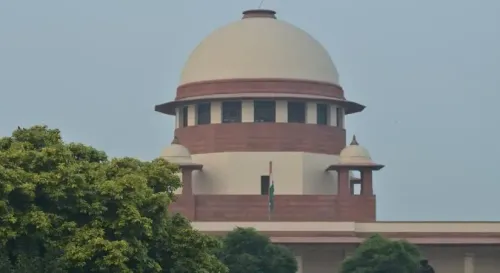
The three-judge bench of the Supreme Court noted, “We recognize that typically, when a convict or an undertrial is released, such orders are not usually stayed by this court without a hearing. However, given the unique circumstances where the convict has been convicted for another offense, we are staying the operation of the Delhi High Court ruling.”
The bench, led by Chief Justice of India (CJI) Surya Kant alongside Justices J.K. Maheshwari and Augustine George Masih, instructed that a notice be served to Sengar in response to the Central Bureau of Investigation (CBI) plea and mandated that a counter-affidavit be filed within four weeks.
The apex court clarified that Sengar will not be released following the contested Delhi High Court ruling.
The CJI-led bench agreed to evaluate the argument presented by Solicitor General (SG) Tushar Mehta, who indicated that the interpretation of the Delhi High Court would imply that a police constable could be recognized as a “public servant” under the Protection of Children from Sexual Offences (POCSO) Act, while a legislative member would be excluded.
Representing the CBI, SG Mehta stated that the Delhi High Court “made an error” in concluding that a legislator is not included in the definition of a “public servant” regarding sentencing.
Highlighting the trial court’s conviction details, the Centre’s second-highest legal officer noted that the victim was under 16 years of age—around 15 years and 10 months—at the time the rape occurred.
Point of View
I believe that the Supreme Court's decision to stay the bail of Kuldeep Sengar emphasizes the judiciary's commitment to upholding justice, especially in cases involving crimes against vulnerable populations. This ruling serves not only as a legal precedent but also as a societal message that such crimes will be pursued with the seriousness they deserve.
NationPress
14 Sept 2026
Frequently Asked Questions
What was the Supreme Court's decision regarding Kuldeep Sengar?
The Supreme Court stayed the operation of the Delhi High Court's order that had granted bail to Kuldeep Sengar and suspended his life sentence in the 2017 Unnao rape case.
Why is this decision significant?
This decision is significant as it reinforces the message that crimes against women and children will not be treated lightly and that justice must be served uncompromisingly.
What did Swati Maliwal say about the ruling?
Swati Maliwal welcomed the Supreme Court's decision, stating that it sends a strong message about the seriousness of crimes against women and children.
What are the next steps following the Supreme Court's ruling?
The Supreme Court has issued a notice to Sengar in response to the CBI's plea and requested a counter-affidavit to be filed within four weeks.
How does this ruling impact future cases?
This ruling sets a crucial precedent for handling cases involving severe crimes against minors and emphasizes the judiciary's role in protecting vulnerable individuals.