South Korea's Lee, ADB chief Kanda agree to deepen ties on critical minerals and AI
Synopsis
South Korea's President Lee and ADB chief Kanda agreed on 14 September to collaborate on critical minerals in Central Asia, Seoul's 'AI for all' initiative, and the ASEAN Power Grid — a broad-based multilateral push as global supply chain rivalries intensify and the won slips on Fed rate-hike fears.
Key Takeaways
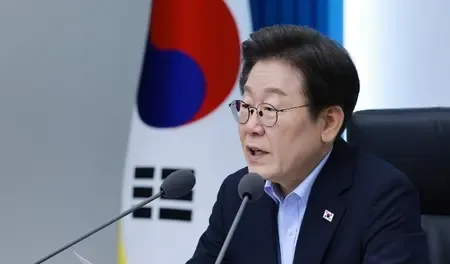
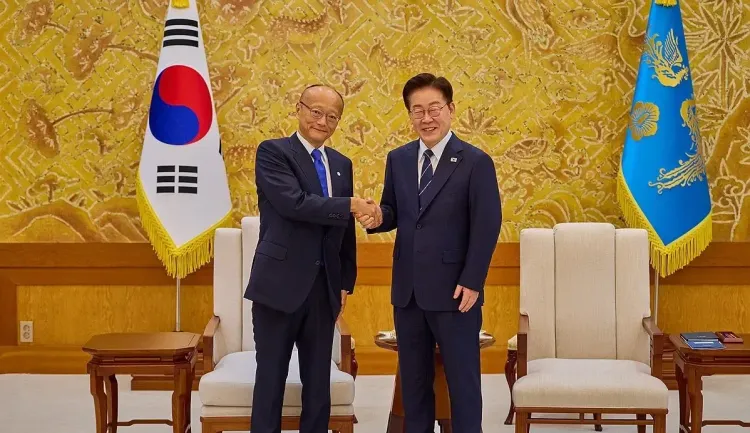
President Lee Jae Myung and ADB President Masato Kanda met at Cheong Wa Dae, Seoul on 14 September .
Both sides agreed to cooperate on critical mineral supply chains in Central Asia , which the ADB calls a top priority.
South Korea's 'AI for all' project — targeting AI access across income, age and digital literacy divides — was proposed as a model for ADB development cooperation.
Energy cooperation, including nuclear power and the ASEAN Power Grid , was also on the agenda.
The South Korean won fell to 1,347.3 per dollar on Monday as markets priced in a US Fed rate hike, with Brent crude above US$100 per barrel .
South Korean President Lee Jae Myung and Asian Development Bank (ADB) President Masato Kanda agreed on Monday, 14 September to strengthen cooperation across critical minerals, artificial intelligence (AI), and clean energy, including nuclear power, following talks at Cheong Wa Dae in Seoul. The agreement signals a broadening of South Korea's multilateral economic diplomacy at a time when global supply chains remain under strain.
Critical Minerals and Central Asia
President Lee proposed expanding the bilateral framework between South Korea and the ADB to help stabilise critical mineral supply chains in Central Asia, pointing to the region's 'abundant natural resources and geographical advantages' as key drivers of growth potential. ADB President Kanda welcomed the proposal, affirming that strengthening critical mineral supply chains ranks among the bank's top institutional priorities. The push reflects a wider global scramble to secure upstream mineral access as electric vehicle and semiconductor industries intensify demand.
AI Cooperation and Seoul's 'AI for All' Push
On artificial intelligence, President Lee briefed Kanda on the South Korean government's 'AI for all' project — an initiative designed to build an 'AI-basic society' where citizens can access AI services regardless of income, age, or digital literacy. 'We can achieve meaningful results by integrating South Korea's AI capabilities and ADB's expertise in development,' Lee was quoted as saying by the presidential office. The two sides see the initiative as a model for technology-driven inclusive development across the ADB's member economies.
Energy and ASEAN Power Grid Ties
Beyond minerals and AI, the two leaders discussed deepening collaboration on energy, including nuclear power, with both sides agreeing to explore how South Korea's technology and experience could support ADB-backed initiatives such as the ASEAN Power Grid project. South Korea has been actively positioning its nuclear energy expertise as an export in recent years, and the ADB's infrastructure mandate in Southeast Asia offers a potential platform for that push.
Won Slips as Fed Rate Expectations Rise
Separately, the South Korean won weakened against the US dollar on Monday, with the currency quoted at 1,347.3 won per dollar at 3:30 pm local time, down 1.4 won from the previous session's close. The dip came as market expectations grew for a US Federal Reserve rate hike later in the week, compounded by Brent crude futures hovering above US$100 per barrel amid an escalating US-Iran military conflict in the Middle East. Analysts noted that rising energy costs and a stronger dollar together present a dual headwind for import-dependent Asian economies.
The talks at Cheong Wa Dae are expected to translate into formal workstreams between Seoul and the ADB on minerals and AI in the coming months, with both sides indicating readiness to move from dialogue to concrete project frameworks.
Point of View
South Korea is deliberately using multilateral institutions like the ADB as a hedge — securing upstream access in Central Asia while exporting its AI governance model downstream. The ASEAN Power Grid angle is similarly strategic, offering Seoul a vehicle to internationalise its nuclear energy programme at a moment when Southeast Asian governments are reconsidering their energy mixes. Mainstream coverage tends to treat these summits as diplomatic courtesies; the more consequential question is whether the workstreams announced here produce binding project agreements, or dissolve into the usual joint-statement ambiguity.
NationPress
14 Sept 2026
Frequently Asked Questions
What did South Korea's President Lee and ADB chief Kanda agree on?
President Lee Jae Myung and ADB President Masato Kanda agreed on 14 September to deepen cooperation on critical mineral supply chains, artificial intelligence, and energy including nuclear power. The talks took place at Cheong Wa Dae in Seoul.
Why is South Korea focusing on critical minerals in Central Asia?
President Lee highlighted Central Asia's abundant natural resources and geographical advantages as key to stabilising global supply chains. Securing upstream mineral access is increasingly critical for South Korea's semiconductor and EV industries.
What is South Korea's 'AI for all' project?
It is a government initiative aimed at creating an 'AI-basic society' where citizens can access AI services regardless of income, age, or digital literacy. Lee proposed it as a framework for ADB-backed inclusive technology development across member economies.
How does the ADB fit into South Korea's ASEAN energy plans?
Both sides agreed to explore how South Korea's nuclear and energy technology could support the ADB's ASEAN Power Grid project. South Korea has been actively marketing its nuclear expertise internationally, and the ADB's Southeast Asia infrastructure mandate offers a ready platform.
Why did the South Korean won fall on 14 September?
The won slipped to 1,347.3 per dollar — down 1.4 won — as markets raised expectations for a US Federal Reserve rate hike. Rising Brent crude prices above US$100 per barrel, driven by escalating US-Iran tensions, added to the pressure on the currency.