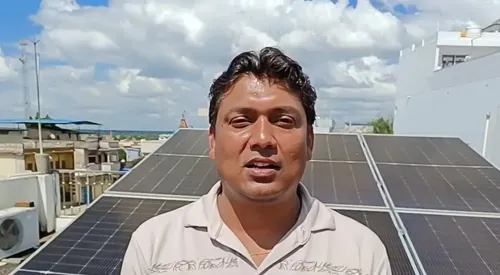
PM Surya Ghar scheme cuts Amravati family's power bill from ₹4,000 to ₹300
Synopsis
An Amravati resident says the PM Surya Ghar Muft Bijli Yojana slashed his monthly electricity bill from ₹3,000–₹4,000 to just ₹200–₹300 — a saving of over 90%. The ground-level testimonial puts a human number on the Modi government's flagship rooftop solar push and underlines how energy subsidies can directly reshape household budgets.
Key Takeaways
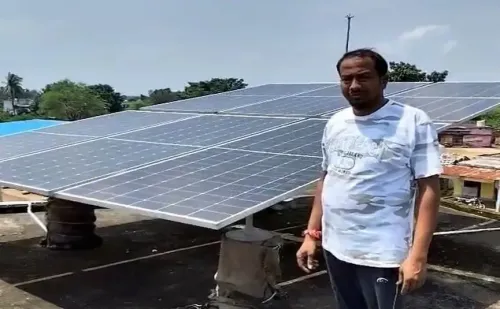
Ravi Kumar of Amravati, Maharashtra enrolled in the PM Surya Ghar Muft Bijli Yojana approximately two years ago .
His monthly electricity bill fell from ₹3,000–₹4,000 to ₹200–₹300 after rooftop solar installation.
Kumar said the savings allow his family to redirect funds toward other essential household expenses.
The scheme, launched by the Centre under PM Narendra Modi , subsidises rooftop solar systems for residential households across India.
Kumar urged the government to expand the programme to help more households, especially in semi-urban and rural areas, access similar savings.
The Pradhan Mantri Surya Ghar Muft Bijli Yojana, the Central Government's flagship rooftop solar initiative, is delivering measurable financial relief to households across Maharashtra, with a beneficiary from Amravati reporting a dramatic reduction in monthly electricity costs since the scheme was installed at his residence approximately two years ago.
A Family's Electricity Bill Story
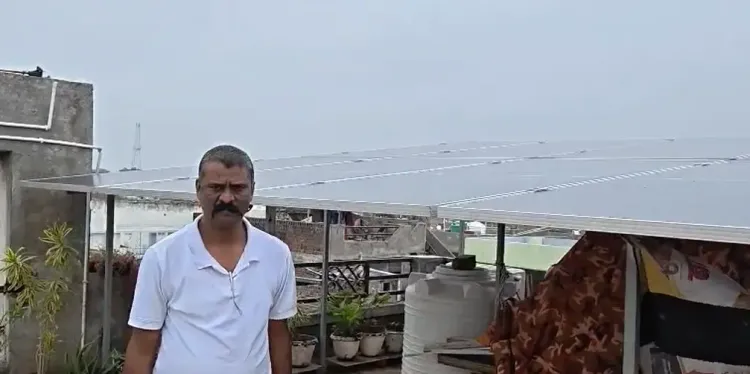
Ravi Kumar, a resident of Amravati in Maharashtra, enrolled in the PM Surya Ghar Muft Bijli Yojana roughly two years ago after rising electricity costs put pressure on his household budget. Since the rooftop solar system was commissioned at his home, his family's monthly electricity expenditure has fallen sharply.
'Previously, my electricity bills ranged from ₹3,000–₹4,000; now, I only pay between ₹200–₹300 per month,' Kumar said. 'This has resulted in financial savings for my family. The scheme is beneficial for every Indian citizen and every household.'
What the Savings Mean Day to Day
Kumar explained that the reduction in power expenses has given his family greater financial flexibility, freeing up funds that were earlier absorbed by utility bills. 'The savings on electricity costs allow the family to set aside funds for other essential expenses, helping us make better use of our available income,' he said.
He added that the scheme's benefits extend beyond his household, with several neighbours and fellow residents also reporting relief under the initiative. Rising electricity tariffs have long strained middle- and lower-income family budgets, leaving limited room for discretionary or emergency spending.
About PM Surya Ghar Muft Bijli Yojana
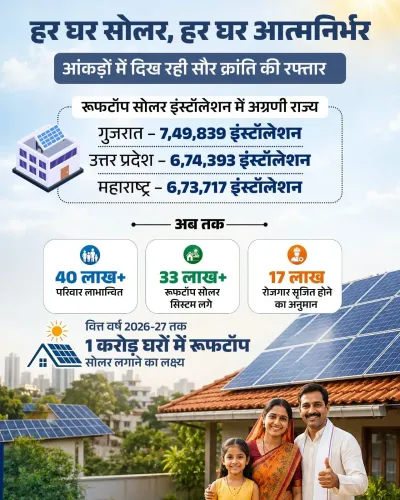
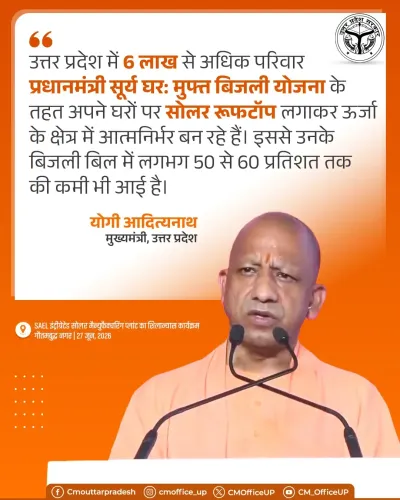
Launched by the Centre under Prime Minister Narendra Modi, the PM Surya Ghar Muft Bijli Yojana is designed to incentivise residential households to install rooftop solar panels, reducing their dependence on conventional grid electricity. The scheme provides subsidies and facilitation support to eligible households, with the broader goal of expanding solar energy adoption at the grassroots level.
By anchoring solar generation at the household level, the programme seeks to lower monthly bills and simultaneously contribute to India's renewable energy targets — part of the country's wider push to diversify its power mix away from fossil fuels.
Kumar's Appeal to the Government
Expressing appreciation for Prime Minister Modi, Kumar urged the government to sustain and expand welfare-oriented programmes of this kind. He said broader outreach would enable more households — particularly in semi-urban and rural areas — to benefit from the savings solar energy offers.
As adoption grows and installation costs continue to decline, welfare-linked solar schemes are expected to become an increasingly significant component of India's household energy landscape in the years ahead.
Point of View
But the numbers Kumar cites — a more than 90% reduction in monthly electricity costs — are striking enough to deserve scrutiny rather than simple amplification. The PM Surya Ghar scheme's subsidy architecture remains largely opaque to the general public: who bears the installation cost beyond the subsidy, what the maintenance obligations are, and whether the savings hold after the system ages are questions the government has not addressed prominently. Rooftop solar adoption in India has historically been skewed toward urban, upper-middle-income households with creditworthy profiles. Whether this scheme is genuinely reaching Amravati's lower-income residents or primarily rewarding those already in a position to apply is the headline that remains unwritten.
NationPress
21 Oct 2026
Frequently Asked Questions
What is the PM Surya Ghar Muft Bijli Yojana?
The PM Surya Ghar Muft Bijli Yojana is a Central Government scheme that provides subsidies and support to residential households for installing rooftop solar panels, reducing their dependence on grid electricity. It was launched under Prime Minister Narendra Modi as part of India's broader push to expand renewable energy adoption at the household level.
How much did the scheme save the Amravati beneficiary?
Ravi Kumar of Amravati, Maharashtra, said his monthly electricity bill dropped from ₹3,000–₹4,000 to ₹200–₹300 after a rooftop solar system was installed under the scheme — a reduction of over 90%. He enrolled approximately two years ago and says the savings have significantly improved his family's financial flexibility.
Who is eligible for the PM Surya Ghar Muft Bijli Yojana?
The scheme targets residential households across India, with a focus on encouraging solar adoption at the grassroots level. Interested households can apply through the programme's official channels; the government provides subsidy support to reduce upfront installation costs.
How does rooftop solar reduce electricity bills?
Rooftop solar panels generate electricity from sunlight, which households can use directly instead of drawing power from the grid. This reduces the number of units consumed from the conventional supply, lowering monthly bills. Surplus power can, in some configurations, be fed back to the grid.
What is the government's broader goal behind the scheme?
Beyond household savings, the PM Surya Ghar Muft Bijli Yojana is designed to diversify India's power mix by expanding residential solar capacity, contributing to the country's renewable energy targets and reducing the overall strain on conventional electricity infrastructure.