Ankit Sharma murder: Delhi court sets July 23 for Tahir Hussain sentencing

Synopsis
Five years after IB officer Ankit Sharma's body was pulled from a drain in Khajuri Khas, a Delhi court has convicted former AAP councillor Tahir Hussain in his murder — and will decide the quantum of punishment on July 23. The 320-page judgment convicts all five accused on murder and rioting charges, but acquits them of criminal conspiracy, a distinction that will shape the sentencing debate.
Key Takeaways
Karkardooma Court fixed July 23 for sentencing arguments against Tahir Hussain and four co-convicts in the Ankit Sharma murder case.
The 320-page judgment by Additional Sessions Judge Parveen Singh convicted all five under Section 302 (murder) and multiple rioting-related sections of the IPC.
All five were acquitted of criminal conspiracy under Section 120B ; six other accused were also acquitted.
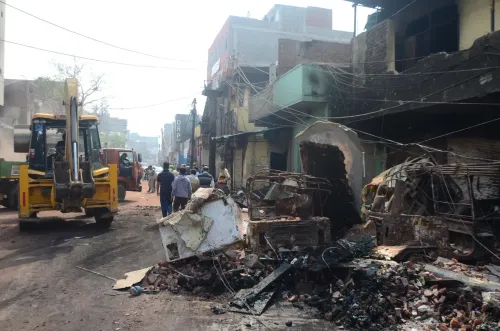
IB officer Ankit Sharma's body was recovered from a drain in Khajuri Khas on 26 February 2020 during the North-East Delhi communal violence.
The Delhi High Court had earlier dismissed Hussain's bail plea in the case.
A Delhi court on Tuesday, 14 July fixed July 23 as the date to hear arguments on the quantum of sentence for former Aam Aadmi Party (AAP) councillor Tahir Hussain and four co-convicts in the murder of Intelligence Bureau (IB) officer Ankit Sharma during the 2020 North-East Delhi riots. The Karkardooma Court announced the schedule a day after delivering its conviction judgment on Monday.
The Conviction and Charges
In a detailed 320-page judgment, Additional Sessions Judge Parveen Singh held Hussain guilty under multiple sections of the Indian Penal Code (IPC), including Section 302 (murder), Section 365 (kidnapping or abducting with intent to secretly and wrongfully confine a person), Section 153A (promoting enmity between religious groups), and Sections 147, 148, and 149 (rioting and rioting with a deadly weapon). Co-convicts Javed, Anas, Nazim, and Kasim were found guilty of the same offences.
Notably, all five were acquitted of the charge of criminal conspiracy under Section 120B of the IPC. Six other accused were also acquitted after the court held that the prosecution had failed to establish their guilt beyond reasonable doubt.
The Case Background
The case stems from the killing of IB officer Ankit Sharma, whose body was recovered from a drain in the Khajuri Khas area on 26 February 2020, amid the communal violence that engulfed North-East Delhi. According to the prosecution, Hussain and the co-accused were part of an unlawful assembly that abducted and murdered Sharma during the riots.
An FIR was registered on the complaint of Sharma's father, Ravinder Kumar, who alleged that his son had left home on 25 February to purchase household items but never returned. Charges against 11 accused, including Hussain, were formally framed in March 2023, covering offences including rioting, promoting enmity, murder, and criminal conspiracy.
What the Prosecution Alleged
At the charge-framing stage, the prosecution had alleged that Hussain incited the mob to target members of the Hindu community and reportedly exhorted them to 'not spare them.' These allegations formed a central part of the case, though the criminal conspiracy charge was ultimately not sustained by the court.
Prior Legal Proceedings
Hussain had previously sought bail in the case, but the Delhi High Court dismissed his plea after examining the allegations and material placed on record. The case has been one of the most closely watched arising from the February 2020 communal violence, which left over 50 people dead across North-East Delhi.
With sentencing arguments now scheduled for July 23, the court's decision on punishment will mark the next critical stage in a case that has drawn sustained public and legal scrutiny for over five years.
Point of View
Even as murder and rioting convictions stand, is a legally significant distinction — it narrows the sentencing ceiling and may influence how higher courts view the case on appeal. The prosecution's inability to sustain the conspiracy charge against all 11 accused also raises questions about the evidentiary framework built over five years of trial. For the Sharma family, the conviction is a measure of justice; for the broader 2020 riots accountability picture, this is one of many cases still winding through the courts, with outcomes uneven across accused of different community backgrounds. The July 23 hearing will test whether the court treats the communal context as an aggravating factor in sentencing.
NationPress
13 Oct 2026
Frequently Asked Questions
What is the Ankit Sharma murder case?
The case involves the killing of Intelligence Bureau officer Ankit Sharma, whose body was recovered from a drain in Khajuri Khas, North-East Delhi, on 26 February 2020, during the communal riots that month. Former AAP councillor Tahir Hussain and four others have been convicted of his murder by the Karkardooma Court.
When is the sentencing hearing for Tahir Hussain?
The Delhi court has fixed July 23 to hear arguments on the quantum of sentence for Tahir Hussain and the four co-convicts. The conviction judgment was delivered on Monday, 14 July.
What charges was Tahir Hussain convicted on?
Hussain was convicted under IPC Section 302 (murder), Section 365 (kidnapping), Section 153A (promoting religious enmity), Section 188 (disobedience to public order), and Sections 147, 148, and 149 (rioting). He and all four co-convicts were acquitted of criminal conspiracy under Section 120B.
Who were the other convicts in the case?
The four co-convicts named in the judgment are Javed, Anas, Nazim, and Kasim. All five were found guilty of the same offences, while six other accused were acquitted for lack of sufficient evidence.
What was the Delhi High Court's earlier ruling on Tahir Hussain's bail?
The Delhi High Court dismissed Hussain's bail application after examining the allegations and material on record, allowing his continued custody pending trial and now conviction.