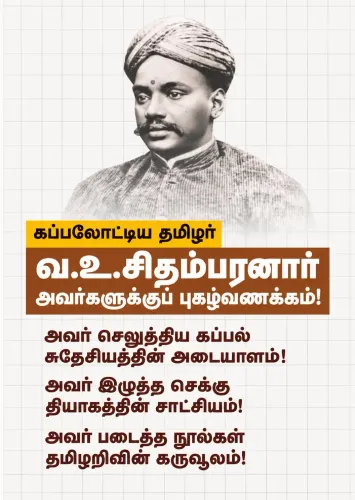
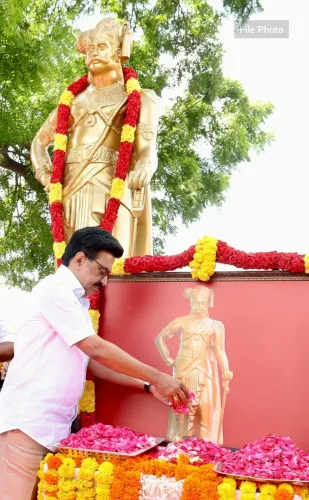
Tamil Nadu CMO honours V.O. Chidambaram on death anniversary
Synopsis
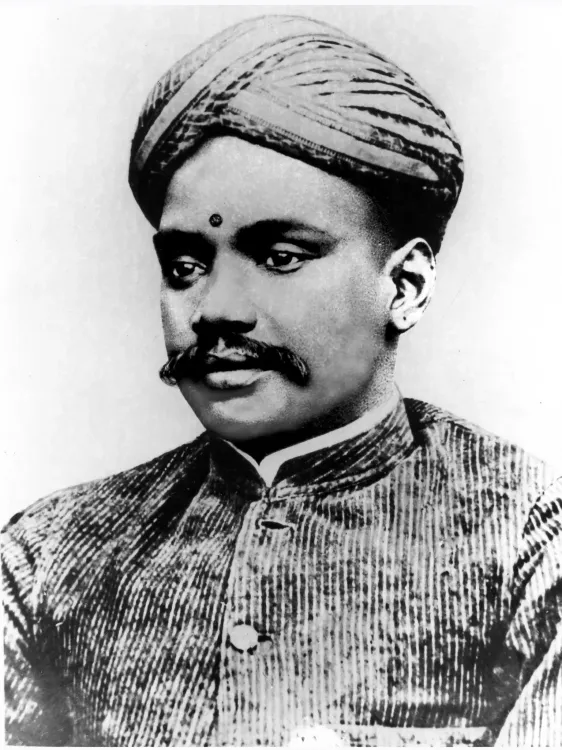
The Chief Minister's Office of Tamil Nadu paid tribute to V.O. Chidambaram Pillai on his death anniversary, honouring the freedom fighter who founded India's first indigenous shipping company in 1906 and endured imprisonment for his Swadeshi activism.
Key Takeaways
Chidambaram Pillai is remembered as Kappalottiya Tamilan — 'the Tamil who steered ships' — for founding the Swadeshi Steam Navigation Company in 1906 .
The Tamil Nadu Chief Minister's Office posted a formal death-anniversary tribute on 18 November 2026 .
Chidambaram Pillai lost his property and endured hard-labour imprisonment for his role in the Indian freedom movement.
He also led the 1908 Coral Mills strike in Tuticorin , one of colonial South India's earliest organised labour actions.
The tribute invoked Swadeshi spirit and self-reliance as principles to guide present-day national progress.
A century after he dared to launch Indian-owned ships against the might of the British Empire, V.O. Chidambaram Pillai — immortalised in Tamil history as Kappalottiya Tamilan (the Tamil who steered ships) — was remembered on Wednesday, 18 November 2026, with a solemn tribute from the Chief Minister's Office of Tamil Nadu.
The official post offered what it called 'heroic salutations' (veeravanakkam) to Chidambaram Pillai on his death anniversary, honouring 'his unparalleled sacrifice and patriotism.' The tribute invoked his courage, self-respect, love for the Tamil language, and care for workers as 'a guiding lighthouse for us always.'
The man who took on British shipping with a single company
V.O. Chidambaram Pillai founded the Swadeshi Steam Navigation Company in 1906, launching a direct economic challenge to the British India Steam Navigation Company's monopoly over coastal shipping out of Tuticorin (present-day Thoothukudi). The venture was more than commerce — it was an act of economic nationalism that physically embodied the Swadeshi movement's call to build Indian alternatives to colonial enterprise.
The British response was swift and punishing. Chidambaram Pillai was arrested, tried, and sentenced to hard labour — a gruelling prison term during which, as the CMO's post recalled, he 'lost all his property for the liberation of the motherland and endured the cruelties of imprisonment.' He also led the 1908 Coral Mills strike in Tuticorin, one of the earliest organised labour actions in colonial South India, cementing his reputation as a champion of workers as well as a nationalist.
Tamil Nadu's pattern of invoking Swadeshi memory in public life
The tribute is part of a consistent official practice in Tamil Nadu: state governments of successive political persuasions have marked the death anniversaries of independence-era regional leaders to underscore Tamil Nadu's distinct contribution to the freedom struggle — one that is frequently overshadowed in national narratives dominated by the north Indian heartland.
The CMO's post closed with a collective pledge — 'let us follow the principles of V.O. Chidambaram Pillai, who sowed the seeds of Swadeshi spirit, self-reliance, and patriotism in the hearts of the people, and strive for the progress of the nation.' That invocation of suyadchi sinthanai (self-reliance thinking) carries a quiet contemporary resonance at a time when both the state and central governments frequently appeal to Made-in-India and Atmanirbhar frameworks.
Point of View
The CMO subtly aligns a 120-year-old legacy with current economic nationalism discourse. The labour dimension of Chidambaram Pillai's legacy is notably foregrounded, signalling the state's awareness of its working-class constituency. These tributes are low-cost politically but high-value symbolically, reinforcing Tamil pride while maintaining ideological continuity across administrations.
NationPress
18 Nov 2026
Frequently Asked Questions
Who was V.O. Chidambaram Pillai?
V.O. Chidambaram Pillai was a Tamil freedom fighter and lawyer who founded the Swadeshi Steam Navigation Company in 1906 to challenge British shipping dominance, earning the title Kappalottiya Tamilan — the Tamil who steered ships. He was imprisoned for his nationalist activities and was also a pioneer of organised labour movements in South India.
What is the Swadeshi Steam Navigation Company?
The Swadeshi Steam Navigation Company was founded by V.O. Chidambaram Pillai in 1906 at Tuticorin (now Thoothukudi) as the first Indian-owned shipping enterprise to directly challenge the British India Steam Navigation Company's coastal monopoly.
When is V.O. Chidambaram Pillai's death anniversary?
V.O. Chidambaram Pillai's death anniversary falls on 18 November, which is officially observed in Tamil Nadu with state tributes honouring his contribution to the freedom movement.
Why is V.O. Chidambaram Pillai called Kappalottiya Tamilan?
He earned the title Kappalottiya Tamilan , meaning 'the Tamil who steered ships,' because he founded and operated India's first indigenous steam-shipping company, symbolising economic resistance to British colonial power.
What was the 1908 Tuticorin Coral Mills strike?
The 1908 Coral Mills strike in Tuticorin was one of the earliest organised labour actions in colonial South India, led by V.O. Chidambaram Pillai, who mobilised mill workers as part of his broader Swadeshi and nationalist campaign.