CM Dhami: Tanakpur-Bageshwar Rail Field Survey Complete

Synopsis
Uttarakhand Chief Minister Pushkar Singh Dhami announced that the field survey for the 170-km Tanakpur-Bageshwar railway line has been completed, calling it a boost for Kumaon's connectivity, tourism, trade and local economy under the Centre's hill-state infrastructure push.
Key Takeaways
Field survey for the 170-km Tanakpur-Bageshwar railway line is complete, CM Dhami said on X.
The line will link Tanakpur in the plains to Bageshwar in the Kumaon hills.
Dhami credited PM Narendra Modi's leadership for the connectivity push.
Project follows the template of the 125-km Rishikesh-Karnaprayag line approved in 2010.
Next steps include the detailed project report, land acquisition and Railway Budget sanction.
Forest and environmental clearances will be critical given the fragile Himalayan terrain.
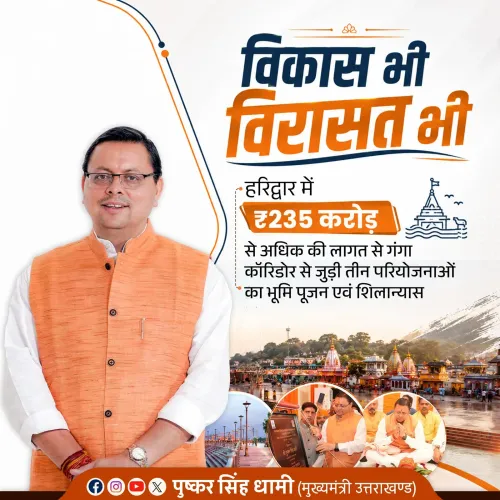
Uttarakhand Chief Minister Pushkar Singh Dhami on Wednesday announced that the field survey for the 170-kilometre Tanakpur-Bageshwar railway line has been completed, marking a key procedural milestone for one of the state's most ambitious rail connectivity projects in the Kumaon region. The announcement, made on X, credited Prime Minister Narendra Modi's leadership for the continued push on hill-state connectivity.
In his post, the Chief Minister wrote that under the 'able leadership and guidance' of the Prime Minister, work was being carried out continuously to strengthen connectivity in the state, adding that the '170 kilometre lambi Tanakpur-Bageshwar railway line pariyojana ka field survey poorn ho chuka hai' (the field survey of the 170-km Tanakpur-Bageshwar railway line project has been completed). He said the project would energise tourism, trade, employment and the local economy.
Context
The proposed line is intended to connect Tanakpur in the Champawat district plains with Bageshwar, a hill district in eastern Uttarakhand long cut off from the rail network. The alignment traverses some of the steepest terrain in the Kumaon Himalayas, which has historically constrained surface transport options for residents and pilgrims.
A field survey is one of the earliest technical stages in the Indian Railways project pipeline, preceding the detailed project report, financial sanction and land acquisition. Its completion does not by itself guarantee construction, but it allows planners to firm up the alignment, gradient and station locations for the subsequent engineering phase.
Policy backdrop
The Tanakpur-Bageshwar project sits within a broader central push to extend rail links into India's Himalayan states. The Rishikesh-Karnaprayag new line, a 125-km project approved in 2010 and currently under construction in Garhwal, established the template for centrally funded hill railway works in Uttarakhand.
Since 2021, the PM Gati Shakti National Master Plan has sought to integrate rail, road and other infrastructure planning, with hill states flagged as priority zones for last-mile connectivity. Field surveys followed by detailed project reports have become the standard multi-stage approval route for new lines under Indian Railways.
Stakeholders and impact
For residents of Bageshwar, Champawat and adjoining districts, a functioning rail link would shorten travel times to the plains and reduce dependence on the narrow hill highways that are frequently disrupted by landslides during the monsoon. Local traders have long argued that lower freight costs could open up markets for Kumaoni produce, handicrafts and dairy.
The tourism industry stands to gain access to circuits around Pithoragarh, Munsiyari and the temple town of Bageshwar, which currently see footfall constrained by road-only access. The Chief Minister specifically flagged 'paryatan, vyapar, rozgar' (tourism, trade and employment) as the project's economic levers.
Environmental groups, however, are likely to scrutinise the alignment closely. Any new hill railway requires forest clearances, tunnelling through fragile geology and rehabilitation of communities along the route, issues that have shaped public debate around comparable projects in Uttarakhand and Himachal Pradesh.
What's next
The next markers to watch will be the sanction of the detailed project report, the issuance of land acquisition notifications along the corridor and the project's inclusion in the next Union Railway Budget allocation. Parallel forest and environmental clearances will determine how quickly physical work can begin.
For the Dhami government, the announcement reinforces a political narrative built around 'double-engine' delivery of central infrastructure in Uttarakhand. The pace at which the Tanakpur-Bageshwar line moves from survey to sanction will, in turn, shape expectations in the Kumaon belt ahead of future electoral cycles.
Point of View
But it is still several gates away from construction, and the Rishikesh-Karnaprayag experience shows how hill alignments can stretch over more than a decade. The political value lies in keeping the Kumaon belt, often seen as under-served compared to Garhwal, visibly inside the connectivity narrative. The real test will be whether the project clears the detailed project report and budget sanction stages in the coming fiscal cycle.
NationPress
18 Oct 2026
Frequently Asked Questions
What is the Tanakpur-Bageshwar railway line project?
It is a proposed 170-km new railway line in Uttarakhand connecting Tanakpur in the plains to Bageshwar in the Kumaon hills, aimed at improving connectivity to remote districts.
What did CM Pushkar Singh Dhami announce about the project?
Dhami announced that the field survey for the 170-km Tanakpur-Bageshwar railway line has been completed, marking an early procedural milestone in the project pipeline.
Why is the Tanakpur-Bageshwar rail line important for Kumaon?
It is expected to ease travel, lower freight costs and boost tourism, trade, employment and the local economy in districts like Bageshwar and Champawat that currently rely on road links.
Has the Tanakpur-Bageshwar railway line been sanctioned for construction?
No, completion of the field survey is an early stage. The project still needs a detailed project report, financial sanction, land acquisition and forest and environmental clearances.
How does this project compare to Rishikesh-Karnaprayag railway?
The Rishikesh-Karnaprayag line is a 125-km hill rail project approved in 2010 and currently under construction in Garhwal. Tanakpur-Bageshwar would extend a similar model to the Kumaon region.