Tejashwi writes to Bihar CM over teacher transfers, pending salaries
Synopsis
RJD leader Tejashwi Yadav wrote to Bihar Chief Minister on August 11, 2026, demanding reversal of improper transfers of Urdu, Arabic, and Persian teachers, immediate clearance of pending salaries for aided madrasa and Sanskrit school staff, and guaranteed deployment of Urdu and Sanskrit teachers in every state school.
Key Takeaways
RJD leader and Leader of Opposition Tejashwi Yadav wrote a formal letter to the Bihar Chief Minister on August 11, 2026 .
The letter demands reversal of what Yadav calls 'improper transfers' of Urdu, Arabic, and Persian teachers in Bihar government schools.
It calls for immediate payment of long-pending salaries owed to staff at aided madrasas and Sanskrit vidyalayas .
Yadav also demands that every government school in Bihar be posted with at least one Urdu and one Sanskrit teacher .
The intervention highlights recurring administrative lapses in Bihar's parallel education streams — modern schools, madrasas, and Sanskrit institutions.
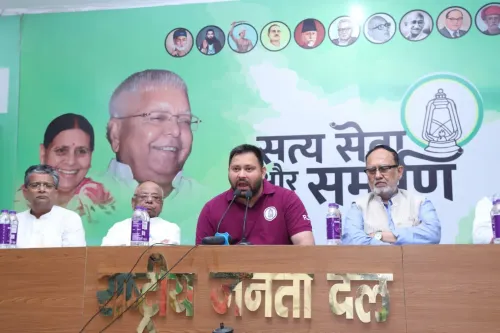
Three demands, one letter — and a direct challenge to the Nitish Kumar government. RJD leader Tejashwi Yadav, Leader of the Opposition in the Bihar Legislative Assembly, wrote to the Chief Minister on Tuesday, August 11, 2026, demanding an immediate halt to what he called improper transfers of Urdu, Arabic, and Persian teachers in state-run schools, urgent clearance of long-pending salaries for staff at aided madrasas and Sanskrit vidyalayas, and guaranteed posting of Urdu and Sanskrit teachers in every government school across the state.
Posting on X, Yadav wrote: 'बिहार के सरकारी विद्यालयों में उर्दू, अरबी एवं फारसी शिक्षकों के अनुचित स्थानांतरण तथा अनुदानित मदरसों एवं संस्कृत विद्यालयों के शिक्षक-कर्मियों के लंबित वेतन के अविलंब भुगतान...' — in plain terms: teachers are being moved without reason, their colleagues in aided institutions are waiting on salaries owed to them, and students in state schools are going without Urdu and Sanskrit instruction altogether.
Three grievances, one letter to Nitish Kumar
The letter bundles three distinct but connected failures. First, the transfers: Yadav alleges that Urdu, Arabic, and Persian teachers in Bihar's government schools are being relocated in ways that are administratively unjustified — a charge that, if substantiated, would mean students in those schools lose access to language instruction mid-year. Second, the salary backlog: staff at aided madrasas and Sanskrit vidyalayas — two parallel, state-supported streams of traditional education — are reportedly waiting on wages that have not been cleared. Third, the deployment gap: Yadav is demanding that every government school be guaranteed at least one Urdu and one Sanskrit teacher, implying that hundreds of schools currently have neither.A recurring fault line in Bihar's education administration
This is not the first time Bihar's opposition has raised alarms about the state's parallel schooling streams. The state runs a complex education architecture — modern government schools, aided madrasas offering religious and general instruction, and Sanskrit vidyalayas preserving classical learning — each with its own cadre of teachers and funding pipelines. When fiscal pressure mounts or administrative attention lapses, it is typically the staff at these aided and specialised institutions who feel it first: delayed salaries, unresolved transfer orders, and unfilled vacancies. For the teachers in question — Urdu, Arabic, and Persian instructors in mainstream schools, and the madrasa and Sanskrit school workforce — the stakes are livelihood and continuity of service. For students, particularly in minority-concentrated districts and in communities that rely on Sanskrit education, it translates directly into gaps in the classroom.What the Bihar Education Department must answer
Yadav's letter puts the Bihar Education Department and the Finance Department on notice. The immediate question is whether the government will respond with a concrete timeline for salary clearance and a freeze on the disputed transfers before the next legislative session. Any supplementary budget demand or assembly question on this issue will now carry the weight of a formal, on-record letter from the Leader of the Opposition — making it harder to dismiss as routine political noise. The letter lands at a moment when Bihar's education administration is under broader scrutiny. Whether it produces a departmental response or a floor fight in the Assembly, Tejashwi Yadav has drawn a clear line: the state's most linguistically and institutionally diverse teachers cannot be the last in line.Point of View
On-record demand that the government must visibly respond to or ignore at political cost. By bundling three distinct issues (transfers, salary arrears, and deployment gaps) into one letter, he broadens the coalition of aggrieved stakeholders from madrasa staff to Sanskrit school workers to Urdu-medium students, making this harder to frame as a purely minority-community concern. The intervention fits a longer pattern in Bihar where opposition leaders use teacher salary and transfer disputes — emotionally resonant and administratively verifiable — to probe the government's fiscal management ahead of legislative sessions. Whether the Bihar Education Department responds with a concrete timeline or stays silent will determine whether this letter becomes an assembly flashpoint.
NationPress
11 Aug 2026
Frequently Asked Questions
Why did Tejashwi Yadav write to the Bihar Chief Minister about teachers?
Tejashwi Yadav wrote to the Bihar Chief Minister on August 11, 2026, raising three issues: allegedly improper transfers of Urdu, Arabic, and Persian teachers in government schools; long-pending salary payments for staff at aided madrasas and Sanskrit vidyalayas; and the absence of Urdu and Sanskrit teachers in many state schools.
What are aided madrasas in Bihar and why are their teachers owed salaries?
Aided madrasas are government-supported Islamic seminaries in Bihar that provide both religious and general education. Their teachers are on state-assisted payrolls, and salary delays typically occur during periods of fiscal stress or administrative backlog in the Education or Finance Department.
What is the demand regarding Urdu and Sanskrit teachers in Bihar schools?
Tejashwi Yadav has demanded that the Bihar government ensure at least one Urdu teacher and one Sanskrit teacher is posted in every government school in the state, addressing what he says is a widespread gap in language instruction.
What are Sanskrit vidyalayas in Bihar?
Sanskrit vidyalayas are state-aided institutions in Bihar focused on Sanskrit language education and classical learning. Like aided madrasas, their staff are on government-assisted payrolls and have reportedly faced delays in salary disbursal.
What happens next after Tejashwi Yadav's letter to the Bihar CM?
The Bihar Education Department and Finance Department are expected to respond with a position on salary clearance timelines and the disputed transfers. If no response is forthcoming, the issue is likely to be raised as an assembly question or supplementary budget demand in the next legislative session.