Tharoor flags conflicting accounts on Kerala fertiliser shortage
Synopsis
Congress MP Dr. Shashi Tharoor has questioned the Union Ministry's claim that no fertiliser shortage affected Kerala's 2025–26 Puncha paddy season, calling for a comprehensive review after farmer associations, a fellow MP, and the state's Agriculture Minister all flagged supply gaps.
Key Takeaways
Shashi Tharoor publicly disputed the Ministry's 'no shortage' finding for Kerala's 2025–26 Puncha paddy season on 21 July 2026 .
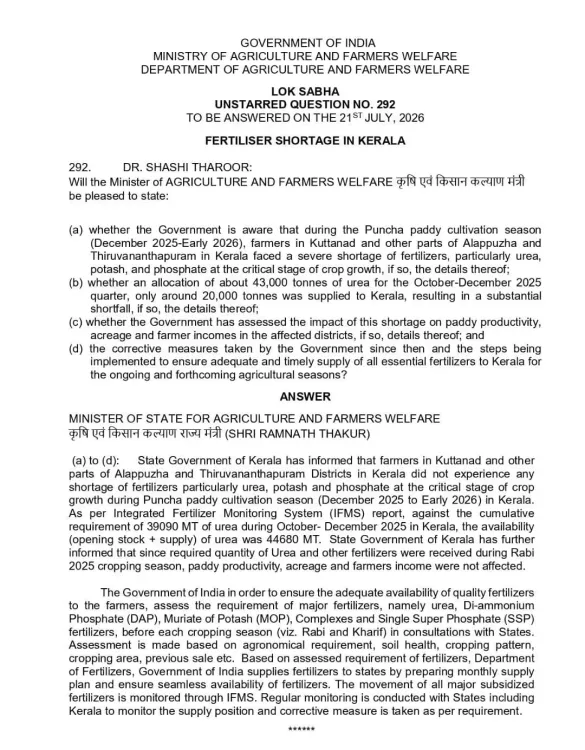
The Ministry based its assessment on State Government inputs and IFMS (Integrated Fertilizer Management System) data.
Tharoor's parliamentary question was grounded in representations from multiple farmers' associations and reports flagging ground-level scarcity.
The issue was also raised by Congress MP Shri K.
Suresh and Kerala's then Agriculture Minister in December 2025 .
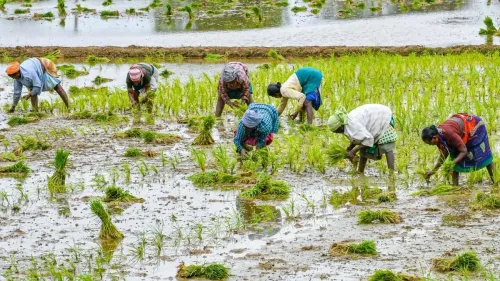
Kuttanad , Kerala's primary paddy-growing delta, was among the regions most affected by the reported fertiliser supply gaps.
Tharoor has called for a comprehensive factual assessment to align official data with farmer-level realities.
Congress MP Dr. Shashi Tharoor on Tuesday, 21 July 2026 challenged the Union Ministry's assessment of fertiliser availability during Kerala's 2025–26 Puncha paddy season, calling the divergence between official data and farmer-level reports 'bizarre' and demanding a comprehensive factual review.
Context
In a post on X, Dr. Tharoor noted that the Ministry's response leaned on inputs from the State Government and data from the Integrated Fertilizer Management System (IFMS) to conclude that no shortage had occurred during the Puncha season — the winter paddy cultivation cycle in Kerala that typically runs from October to March. He countered that his parliamentary question was grounded in representations made by 'multiple farmers' associations' and reports by credible media outlets, making the Ministry's clean-chit difficult to reconcile with ground realities.
The Puncha season is critical for paddy growers in Kuttanad, Kerala's rice bowl, a low-lying agricultural delta heavily dependent on timely input supply. Any disruption in fertiliser access during this window can directly affect yield and farm incomes.
Policy Backdrop
Fertiliser distribution in India is governed partly through the Nutrient Based Subsidy (NBS) scheme, introduced in 2010, which regulates pricing and aims to encourage balanced nutrient use across states. The IFMS is the central government's primary tool for tracking stock movement and distribution at the retail level. Critics have long argued that IFMS data reflects supply dispatched from the central pool rather than actual availability at the farm gate — a distinction that becomes especially consequential in geographically dispersed or logistics-constrained regions like Kuttanad.
Dr. Tharoor pointed out that the issue had also been raised by his colleague Shri K. Suresh, a fellow Congress MP, and by Kerala's then Agriculture Minister as far back as December 2025, suggesting the concern had persisted across multiple channels before reaching Parliament.
Stakeholders and Impact
Kerala's paddy farmers, particularly those cultivating during the Puncha season in Kuttanad, are the most directly affected stakeholders. Fertiliser scarcity during a critical sowing or top-dressing window can reduce yields and push farmers toward costlier open-market procurement, eroding already thin margins. The issue also implicates pineapple growers, with reports indicating that input scarcity had contributed to price volatility in that crop as well.
The divergence between IFMS-derived official accounts and farmer-association representations raises a broader question about data transparency: whether centralised digital tracking systems capture last-mile reality, especially in a state where cooperative farming structures and seasonal logistics add layers of complexity.
What's Next
Dr. Tharoor has called for 'a comprehensive assessment to establish the facts and ensure that farmers' concerns are accurately reflected in policy responses.' Parliamentary follow-up — through starred or unstarred questions, or a possible adjournment motion — remains an available route, as does a formal request for a field assessment by the Ministry of Chemicals and Fertilizers. Ahead of the next kharif or rabi cycles, pressure may mount on the Ministry to reconcile IFMS data with state-level and farmer-body inputs, or to commission an independent review of distribution gaps in Kerala.
Point of View
Not supply received, leaving a gap that state governments and farmer bodies frequently contest. By anchoring his challenge in cross-party and cross-institutional corroboration — a fellow MP, a state minister, and multiple farmer associations — he is effectively building a record for escalation beyond a single parliamentary exchange. The episode fits a broader pattern in which southern, import-dependent states find central data systems ill-suited to capturing last-mile distribution failures. If the Ministry does not commission an independent field review, the issue is likely to resurface in the next crop season with greater political intensity.
NationPress
22 Jul 2026
Frequently Asked Questions
What did Shashi Tharoor say about Kerala's fertiliser shortage?
Dr. Tharoor stated that the Ministry's claim of no fertiliser shortage during Kerala's 2025–26 Puncha paddy season contradicts representations made by multiple farmers' associations and concerns raised by fellow MP K. Suresh and Kerala's then Agriculture Minister in December 2025. He called the conflicting accounts 'bizarre' and demanded a comprehensive factual assessment.
What is the Puncha season in Kerala?
The Puncha season is Kerala's winter paddy cultivation cycle, typically running from October to March. It is especially significant in Kuttanad, the state's primary rice-growing delta, where timely fertiliser availability is critical to yields.
What is IFMS and why is it relevant to this issue?
IFMS stands for Integrated Fertilizer Management System, the central government's digital platform for tracking fertiliser stock movement and distribution. The Ministry cited IFMS data to conclude no shortage occurred, but critics argue such systems track supply dispatched rather than supply actually available at the farm level.
Which Kerala region was most affected by the reported fertiliser shortage?
Kuttanad, often called Kerala's rice bowl, was among the most affected regions. It is a low-lying agricultural delta heavily dependent on timely input supply, where any disruption during the Puncha season can significantly reduce paddy yields.
What action has Tharoor called for on the fertiliser issue?
Dr. Tharoor has called for a comprehensive assessment to establish the facts and ensure that farmers' concerns are accurately reflected in policy responses, signalling possible further parliamentary follow-up with the Ministry of Chemicals and Fertilizers.